


Above is a video commentary on this that is, of course, worth watching. Below is more or less the commentary, but written out as a column (but who would want to read it when you can watch it? Of course, you can also find it on your favorite podcasting app, or listen here. Search out both of our podcasting channels - So, Does It Matter, Spoken and So, Does It Matter, The Podcast. The video above is also on YouTube here.
🕐 9-minute read
A Deal Years In The Making, But Mere Hours In The Closing
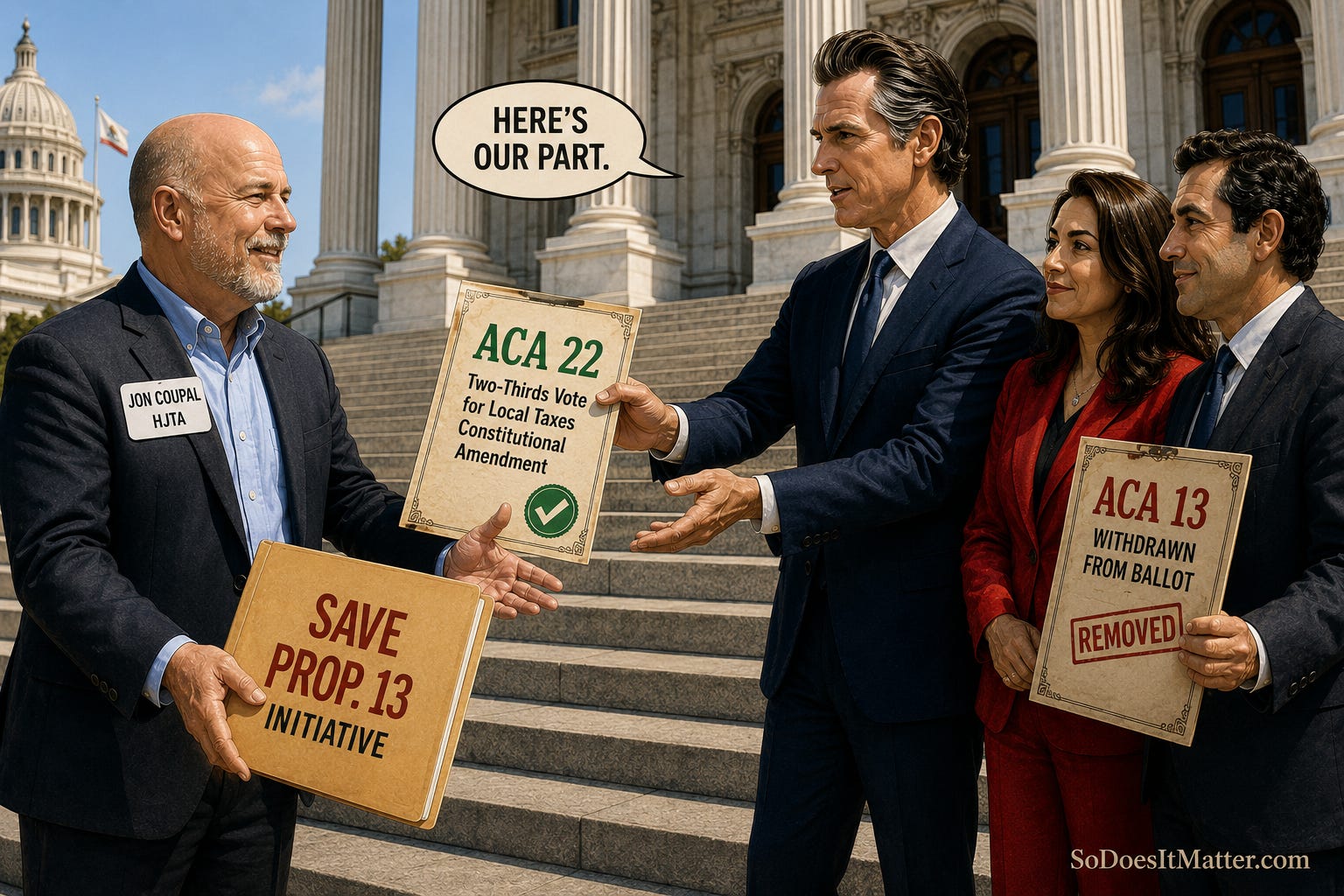
Most people have no idea that California law contains a specific provision that allows the proponents of a citizen-initiated ballot measure to voluntarily pull it off the ballot — but only up to a hard deadline. The whole point of that provision is to create a window for negotiation. If both sides can reach a deal, you avoid a costly, brutal statewide campaign. Both sides give something up. Both sides get something in return.
This year, that deadline was yesterday — June 25th.
And yesterday, one of the more consequential last-minute deals in recent California political history got made. I want to walk you through it. It’s a little convoluted. But the outcome matters for every California taxpayer, so bear with me.
What The Save Prop. 13 Measure Would Have Done
The Howard Jarvis Taxpayers Association had qualified an initiative for the November ballot — gathered the signatures, cleared the bar, done everything right. They were calling it the Save Prop. 13 initiative.
It was designed to do two big things.
First, close what’s known as the Upland loophole. Back in 2017, the California Supreme Court hinted — without fully deciding — that citizen-initiated local tax measures might not be subject to Proposition 13’s two-thirds vote requirement. In other words, if a special tax were put on the ballot by a citizens’ petition rather than by a government body, it might only need a simple majority to pass. That’s a significant loophole, and it’s been exploited ever since. The Save Prop. 13 measure would have locked a two-thirds requirement into the state constitution for all local special taxes — no exceptions, no workarounds, no matter who put the measure on the ballot.
Second, crack down on real estate transfer taxes in charter cities — retroactively. That means directly wiping out measures like Los Angeles’s Measure ULA, the so-called mansion tax, and any other local transfer tax exceeding the limit applicable to general law cities. Billions in existing local revenue, gone. Measure ULA alone has raised over a billion dollars since 2023 — and multiple academic studies have blamed it for the city’s dramatic drop in new housing construction. This change would have been retroactive back to 2017.
A broad, sweeping constitutional fix on two fronts. Qualified, legitimate, ready for November.
The Opposition — And Why This Was Going To Be A War
Here’s who was lined up against it.
Governor Newsom. Legislative Democrats. And most importantly, the state’s powerful unions.
The unions are the key here. A constitutional two-thirds requirement for local special taxes is a direct threat to their primary funding pipeline. And the many local taxes already in place, passed on the lower threshold, are already being used to hire many public employees. These are the people who fund ballot campaigns to raise your taxes to pay for the programs and pensions they depend on. They had every reason to treat this as a must-kill measure. And they had the resources to back that up.
On the other side, standing with HJTA, were the California Business Roundtable, the California Taxpayers Association, and the California Business Properties Association. A serious coalition. Along with a broad business and grassroots coalition.
The Negotiations — And The Offer That Went Nowhere
Negotiations began. Of course they did.
The first offer on the table was a statute — not a constitutional amendment — that would have provided some relief from transfer taxes. The Upland loophole fix wasn’t part of it. And a statute can be undone by any future legislature, the moment it becomes politically inconvenient. There’s not a lot of trust in the State Capitol, and for good reason. Jon Coupal knows the difference between a constitutional fix and a statutory one. That offer collapsed.
But a second attempt yesterday produced a deal.
HJTA’s Four Demands
Coupal did something smart. He put his demands in writing — a public letter to the Legislature, dated June 25th. No ambiguity. No handshake promises. Here is exactly what has to happen for me to sign away this qualified measure. You either do these things, or I don’t sign.
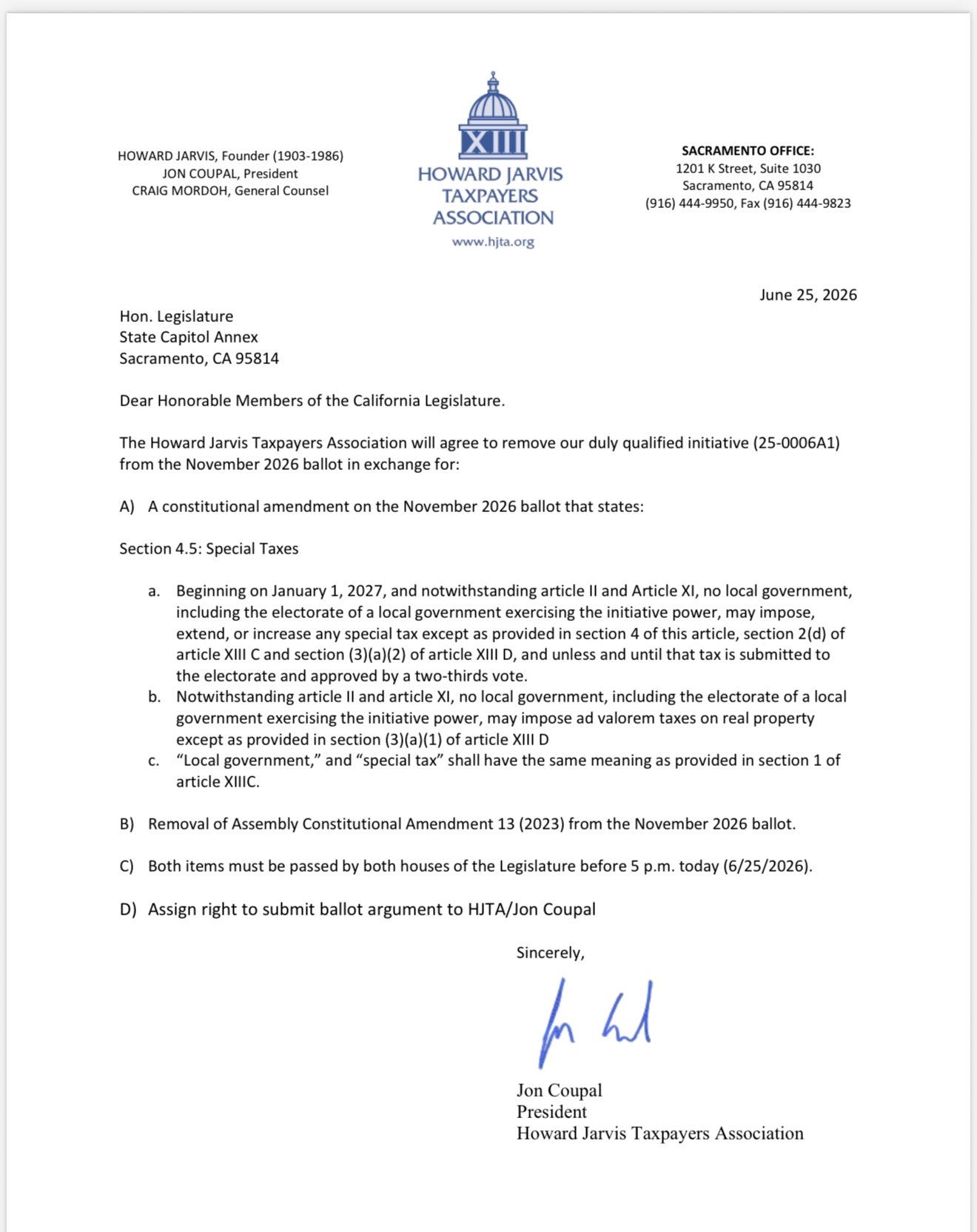
Four demands.
First. A new constitutional amendment — what became ACA 22 — placed on the November ballot. The core provision: beginning January 1st, 2027, no local government — and this explicitly includes the electorate acting through the initiative power — may impose, extend, or increase any special tax without voter approval by a two-thirds supermajority. The Upland loophole, closed. In the constitution. Permanently.
Second. Removal of ACA 13 from the November ballot. ACA 13 was a constitutional amendment Democrats had already placed on the ballot — in plain terms, a trap. It would have required any future citizen initiative proposing a higher voter threshold to itself pass by that same higher threshold. Meaning ACA 22 would have needed two-thirds of statewide voters just to take effect. Getting ACA 13 off the ballot wasn’t a bonus ask. It was essential.
Third. Both items had to be passed by both houses of the Legislature before 5 p.m. yesterday. Votes on the record before Coupal signs anything.
Fourth. The right to submit the official ballot argument assigned to HJTA and Jon Coupal personally — direct control over how ACA 22 is introduced to every California voter in the ballot pamphlet.
With roughly half a day to work with from the time this letter was produced, the Legislature did it. Both chambers convened, passed ACA 22, and voted to remove ACA 13. Overwhelmingly. Coupal signed the withdrawal before the deadline. The original Save Prop. 13 measure is off the ballot. ACA 22 is on it.
What HJTA Won For Taxpayers — And What They Gave Up
The constitutional core of what they always wanted. Two-thirds means two-thirds — locked into the state constitution, applicable to every local special tax going forward. The Upland loophole is closed. The poison pill is gone. And HJTA writes the ballot argument going into November.
What did they give up?
On the cutting-room floor is statewide transfer tax reform. The original initiative’s transfer tax provisions were retroactive to 2017 — meaning they would have wiped out Measure ULA and any other local transfer tax exceeding the limit applicable to general law cities, eliminating billions in existing revenue. That’s gone entirely from ACA 22. And make no mistake: removing that retroactive wipeout was almost certainly a key incentive for the unions to come to the table. Those existing taxes — ULA included — are no longer under threat from a statewide ballot measure. That fight is deferred to another day.
That is a genuine loss. Anyone who tells you otherwise isn’t being straight with you.
The Bottom Line
Nobody forced Jon Coupal’s hand. HJTA had a qualified ballot measure and could have taken it to voters in November. They chose not to.
The judgment he made — and it’s a reasonable one — is that a clean constitutional fix, with the poison pill off the table and ballot argument rights in hand, is worth more in the long run than a broader measure facing a brutal, essentially unlimited opposition campaign. Well-heeled unions in California are not people you want to fight if you don’t have to. I mean, they could still oppose this new measure, but this one is much harder to defeat.
HJTA noted that in 2024, the Legislature was actively trying to make it easier to raise taxes through Proposition 5, which HJTA defeated. Yesterday, that same Legislature voted to make it harder. That’s nothing.
Rob Lapsley of the California Business Roundtable, Rob Gutierrez of the California Taxpayers Association, and Matthew Hargrove of the California Business Properties Association — the leaders of the three major business groups that stood with HJTA on this fight — issued a joint statement following the consummation of the deal that read, in part: “As co-chairs of the Local Taxpayer Protection Act committee, we strongly support the compromise negotiated between the Howard Jarvis Taxpayers Association, legislative leaders, and the Governor’s Office to directly address California’s cost-of-living crisis by restoring critical taxpayer protections that voters originally enacted through Propositions 13 and 218 but that have been eroded by court decisions in recent years.”
The November vote on ACA 22 will be the final verdict on whether this was the right call. If it passes — and HJTA believes it will pass overwhelmingly — Coupal will get his constitutional win without the war.
That’s the deal. That’s what happened. And for California taxpayers, the outcome is at least worth watching.
So, Does It Matter?
Yes. A constitutional two-thirds requirement for local special taxes is exactly the kind of durable, structural protection that California taxpayers have been trying to lock in for years. The reality is that decades of Democratic dominance have led to an overwhelmingly liberal judicial system in the state, clearly requiring very strong, clear protections in the state constitution. The Upland loophole, while dubious, was real; it was being exploited, and closing it matters. The concessions are real, too — the retroactive transfer tax wipeout is gone, and the scope of the Upland fix is narrower than the original. But if ACA 22 passes in November, Jon Coupal will have secured the core of what Prop. 13 was always intended to do. Without the war. That’s a win worth acknowledging.
Jon Coupal’s Own Take
HJTA President Jon Coupal has a column in the Southern California News Group papers this morning with his own take on all of this. You can find it here on the Orange County Register website. But that is paywalled, so if you wait until next week, go to the HJTA.org website, click on “Jon’s Weekly Column,” and you will find it there without a paywall!


