

Xavier Becerra’s “Power Hour” Gimmick
California’s gubernatorial front-runner promises “free” electricity but has little to say about why it costs so much.

Typically, our afternoon content is behind a paywall — or there is something extra for our paid subscribers. If you are not one, please consider upgrading. You are missing a significant portion of what we produce each week, and your support makes it possible. If you want to get it all and support my efforts, please consider a paid subscription!
You can listen to this content on our Podcast — So, Does It Matter, Spoken! - on your favorite podcasting app. Or you can just go listen here.
🕒 5-minute read
Sacramento Discovers Free Electricity
Sacramento has discovered free electricity. As usual, “free” means somebody else gets the bill.
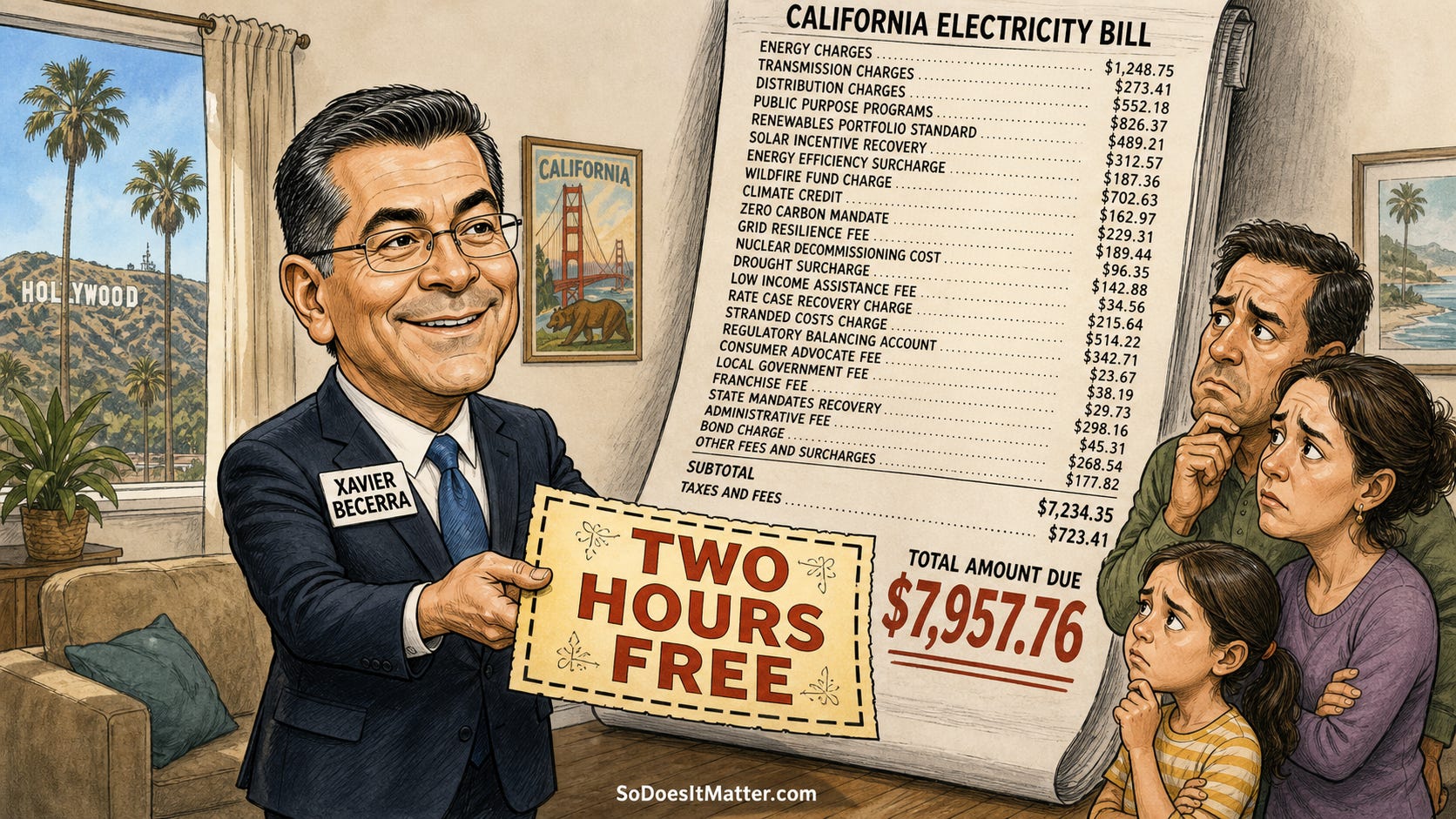
Xavier Becerra, the Democratic front-runner for governor, wants to give lower-income Californians two free hours of electricity each afternoon, when solar installations can produce more power than the state needs. “Charge your devices, wash your clothes, wash your dishes,” he said at a POLITICO forum. Do it between 1 and 3 p.m., and “I won’t charge you a dime.”
Notice the “I.” Becerra will not generate the electricity, deliver it, or pay for it. He would still like voters to remember who supposedly gave it to them.
As campaign gimmicks go, “power hour” is a good one. The name is catchy, the pitch takes seconds, and Becerra gets to play the affordability candidate without challenging the policies that made California power so expensive.
This is not affordable electricity. It is a two-hour break from the price.
Someone Always Pays
To be fair, there is a sound pricing idea somewhere in here. Excess solar production can push midday wholesale prices to zero or below. Giving customers a reason to shift some of their power use into those hours may help the grid.
The catch is that wholesale electricity is only one part of the bill. The grid must still be built, maintained and protected. Transmission, distribution, wildfire prevention, and government programs are not free between 1 and 3 p.m.
Andrew Campbell of UC Berkeley’s Energy Institute at Haas explained the problem to POLITICO: If participating customers do not contribute to infrastructure costs during the free period, somebody else pays them—or the same customers pay them later.
So “power hour” is really “cost-shift hour.”
California already has the nation’s second-highest residential electricity prices. In early 2026, Californians paid 32.08 cents per kilowatt-hour, according to the U.S. Energy Information Administration. Oregon residents paid 14.72 cents. Washington residents paid 14.09 cents.
California has an affordability crisis. Becerra is offering happy hour.
The System Gets A Pass
Becerra says Californians must “readapt” and “recalibrate.” There is the governing philosophy in two words. Do not change the system. Train the customer to live around it.
The nonpartisan Legislative Analyst’s Office points to wildfire expenses, greenhouse gas policies, and utility operating structures as major forces behind California rates. Wildfire costs alone account for an estimated 7 to 13 percent of average non-CARE bills from major investor-owned utilities. The office also found that the renewable portfolio mandate increased retail rates for those customers by almost 5 percent.
Here is a better question for an affordability candidate: Which ratepayer-funded programs still work? Which ones have become expensive ornaments? And which costs should be moved into the state budget, where lawmakers would have to defend them instead of quietly stuffing them into utility bills?
Climate policy deserves the same unsentimental review. California produced about 371 million metric tons of greenhouse gases in 2022, according to the California Air Resources Board. Worldwide emissions were approximately 57.4 billion metric tons, according to the United Nations Environment Program. California’s share was roughly 0.65 percent.
The Chosen Few Get Relief
Who can make the most of free midday electricity? People with electric vehicles, home batteries, programmable appliances and control over their schedules. That is not a perfect description of Californians struggling to pay their utility bills.
A renter working away from home between 1 and 3 p.m. may have little electricity use. A restaurant or small business cannot close during expensive hours and reopen when Sacramento declares the power cheap. Without a battery or electric vehicle, a household has no practical way to save midday electricity for the evening.
This is California’s familiar two-step. The government drives up costs for everybody, then announces relief for a select group. Those outside the program keep paying while politicians congratulate themselves for helping.
California is not short of discounts, subsidies or preferred rates. It is short of reasonably priced electricity.
So, Does It Matter?
Steve Hilton, the Republican nominee for Governor, says he has repeatedly asked Becerra to participate in a series of debates before the November election. Hilton also challenged him publicly during a CNN appearance. Becerra has not agreed to the proposed series (no surprise)
Perhaps that is clever politics. “Power hour” plays well on a friendly stage, particularly when the applause arrives before the details. It sounds less impressive once somebody asks which charges disappear, what a family would actually save, and where the rest of the bill goes.
Hilton would ask why electricity in California costs more than twice as much as it does in Oregon and Washington. He would ask why Becerra’s answer is another special rate instead of reducing mandates, subsidies, and ratepayer-funded programs. If “power hour” is a serious proposal, Becerra should be willing to defend it without a friendly moderator moving things along.
Maybe this is only the first gimmick. Californians should hear Becerra’s ideas tested by a policy-savvy opponent before handing him the most powerful office in the state.
California’s affordability crisis will not be solved by telling people when to wash their socks. Every promise of a “free” government benefit should start with a simpler question:
Who gets the bill?