

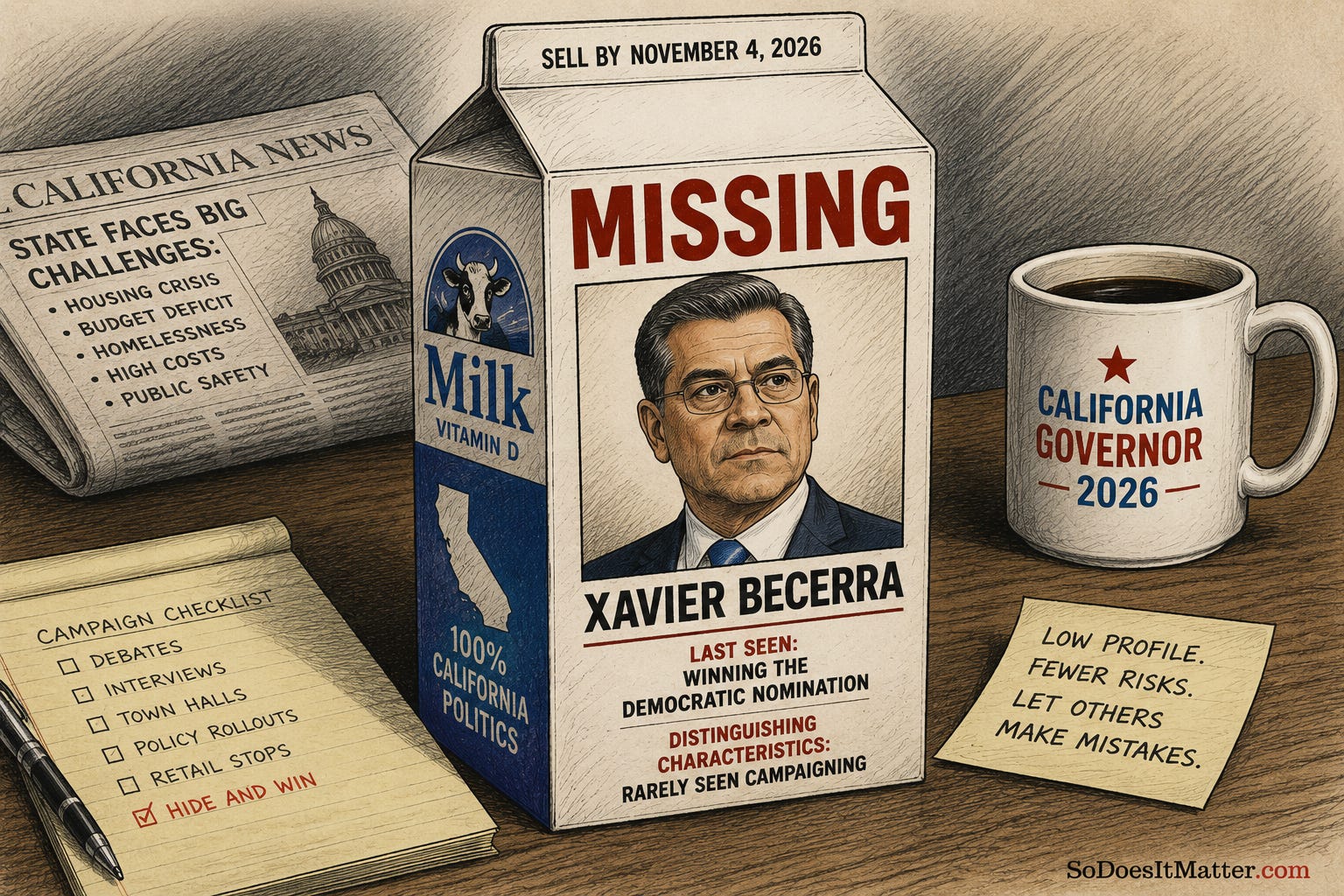
Where’s Xavier?
More than a month after becoming the Democratic nominee for governor, Xavier Becerra has been remarkably hard to find. That is probably not an accident.
Our morning content is free for all subscribers and guests! Usually our afternoon content is behind a paywall… If you are not yet a paid subscriber, consider upgrading — you are missing a significant portion of what we produce each week, and your support makes it possible. If you want to get it all and support my efforts, please consider a paid subscription! Today there is exclusive content below this column for paid subscribers.
You can also listen to this post on our podcast feed, So, Does It Matter? SPOKEN. It is available on your favorite podcast app. And you can listen to it here.
⏰ 4.5 minute read
The Dog That Isn’t Barking
It has been more than a month since Xavier Becerra became the Democratic nominee for governor, and the most noticeable thing about his campaign is how little anyone has noticed it.
He has not disappeared. There have been appearances, statements and the usual signs that a campaign technically exists. But Becerra is running for governor of the largest state in the country, and you would be forgiven for wondering whether anyone told him the general election had started.
Steve Hilton, meanwhile, has been everywhere. He is traveling the state, talking to reporters, pushing out policy ideas and filling social media feeds. Whatever anyone thinks of Hilton, he is plainly trying to make this race a contest.
Becerra appears to have a different idea.
Where’s Xavier?
Hiding In Plain Sight
The easy answer is that Becerra is running a lazy campaign. The more likely answer is that he is running a cautious one.
And, politically, it makes sense.
As of April 3, California had more than 23.1 million registered voters. Democrats accounted for 44.9 percent of them, compared with just 25 percent for Republicans. That is not merely an advantage. It is the foundation of Becerra’s entire strategy. He begins the general election knowing that millions of Californians will vote almost automatically for the Democrat, while Hilton must fight for nearly every vote beyond the Republican base.
California is still deep blue. Democrats hold every statewide constitutional office, and Republicans have not won a statewide race here since 2006. Becerra does not need to create excitement. He needs to avoid creating trouble.
Hilton has to give voters a reason to reconsider their normal voting habits. Becerra only has to make sure they do not.
Every interview is a chance to stumble. Every debate gives Hilton a stage he might not otherwise have. Every unscripted moment creates the possibility of a damaging clip ricocheting around the internet for days. The safest campaign for a strong favorite is often the one that produces the fewest surprises.
Two Different Jobs
Hilton’s assignment is brutally difficult.
He must run close to a flawless campaign, raise serious money, dominate earned media and persuade independents and a meaningful number of Democrats to cross party lines. He needs to make the election about California’s failures rather than national party labels. He also needs the public to see him as a plausible governor, not merely a Republican protest vote.
Even that may not be enough.
For Hilton to have a real chance, Becerra probably needs a major problem of his own. A scandal. A spectacular mistake. A campaign collapse large enough to break through California’s partisan habits. Something on the scale of the political implosions we have seen consume other supposedly safe Democratic candidates.
Becerra knows that. So does his campaign.
Why engage Hilton more than necessary? Why give him free attention? Why help turn a race Becerra should win into one Californians might actually start watching?
The Debate We Are Not Getting
That may be smart politics. It is not good for voters.
California’s next governor will confront a budget that remains structurally shaky, a housing shortage, rising utility bills, a property insurance crisis, homelessness, crime, water shortages and schools losing students by the tens of thousands. These are not ceremonial issues. They affect whether families can afford to stay here and whether businesses continue to invest here.
Voters deserve more than a few controlled appearances and carefully drafted statements. They deserve debates, extended interviews and direct answers. They deserve to see both candidates pressed on what they would actually do.
Instead, Becerra’s incentive is to run out the clock.
When he does engage, expect him to avoid Hilton’s arguments whenever possible and reduce him to a label: the Trump candidate. In California, that may be all Becerra believes he needs to say.
So, Does It Matter?
Do not expect this strategy to change unless the race changes first.
Becerra will appear often enough to prove he is alive, healthy and still running. He will react when necessary, say as little as possible when it is not, and keep moving toward November without giving Hilton the confrontation he wants.
It is cynical, but it is rational.
The problem is that Californians are not choosing a ceremonial figurehead. They are choosing a governor for a state with serious problems and very little margin for more failure. Becerra may believe the safest path to victory is to avoid a real campaign.
For him, that may be true.
For the rest of us, the question remains:
Where’s Xavier?