


Our morning content is free for all subscribers and guests! Not a subscriber yet? Become one today! You can subscribe for FREE to get most of my content delivered to your inbox. A PAID subscription is $7 a month or $70 a year, and it gets you access to ALL of my stuff (about 35% more). Why subscribe? Because now more than ever, you need someone calling balls and strikes, and who isn’t owned by ANYONE.
You can also listen to this post — along with my California Post column — on our podcast feed, So, Does It Matter? SPOKEN. It is available on your favorite podcast app. And here.
🕐 4-minute read
Election Day Is No Longer Election Day
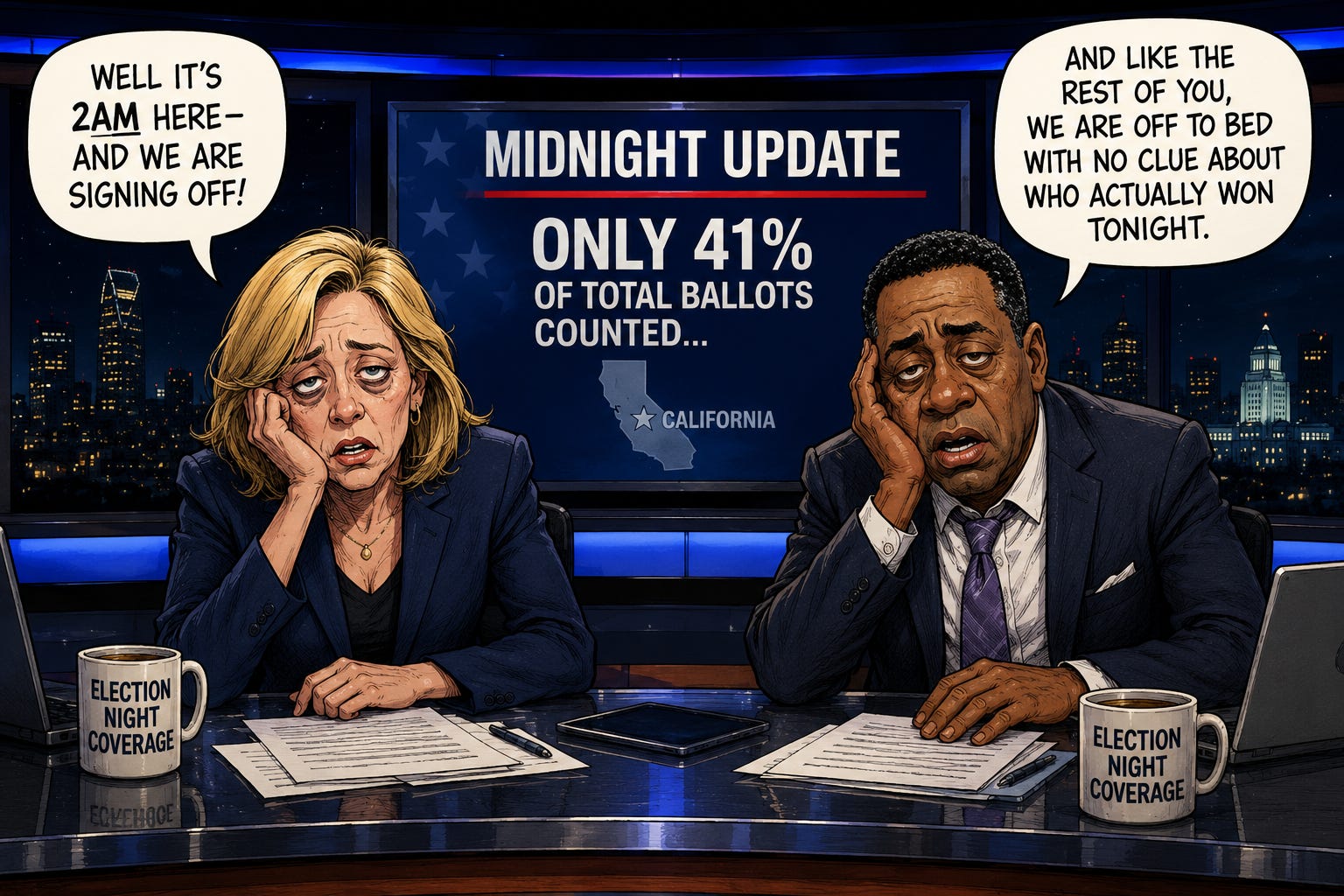
If you are planning to wake up on June 3 and find out who made the runoff for governor — or whether Spencer Pratt grabbed a spot in the Los Angeles mayoral runoff — lower your expectations. This is California. We do not really have Election Day anymore. We have Election Month, followed by Counting Month.
The official primary election is June 2. But ballots were mailed out weeks before that, and voters have had a long runway to cast them by mail, drop box, vote center, or in person. Once the polls close, the counting is not close to over.
In a normal state, Election Day is when voters cast their ballots, and the public expects results. In California, Election Day is more like the deadline for beginning the final phase of a long bureaucratic process. If you are looking for clarity in close races, forget it.
California’s Slow-Motion Election System
California law allows mail ballots to be counted as long as they are postmarked by Election Day and received within the permitted window afterward. That means ballots can still legally arrive after the cable news panels, campaign speeches, and election-night spin are already over.
Then there are provisional ballots, conditional voter registration ballots, ballots with signature issues that voters can “cure,” ballots dropped off late in the day, and ballots that arrived before Election Day but were not yet processed. All of this happens across 58 counties, each with its own registrar, staffing levels, procedures, pace, and backlog.
California gives counties weeks to finish the official canvass. The state has taken some steps to speed up parts of the process, but the reality remains: close races can stay unresolved long after election night. That is not a conspiracy theory. It is the system Sacramento has built.
The First Count May Tell Us Very Little
The first results are not necessarily representative of the final results. Election-night numbers can reflect ballots that arrived early and were processed early. Later updates may include late-mail voters, Election Day voters, provisional voters, conditional-registration voters, younger voters, or voters in counties that count more slowly.
So when the first batch drops, campaigns will spin like crazy. The candidate ahead will say the race is effectively over. The candidate behind will say there are still ballots left to count. And in many cases, both may be technically telling the truth.
That is the problem. In a close race, the first results may not reveal the winner. They may only reveal which ballots were counted first.
The Governor’s Race Could Be A Mess
This year’s governor’s race is a perfect example. California’s top-two primary does not care about party labels when deciding who advances. The top two vote-getters move on to November, regardless of party.
That means the real fight may not be over who finishes first. It may be over who finishes second. If the second-place fight comes down to Steve Hilton, Xavier Becerra, and Tom Steyer separated by just a few points — or less — the election-night results may not settle anything.
A candidate could be in second place on election night and fall to third days later. A candidate could be in third place and climb into the runoff after later ballots are counted. Campaigns could spend days telling their supporters not to panic while reporters, pundits, donors, and activists stare at county vote updates as if they were waiting for smoke from the Sistine Chapel.
Because California has so many candidates in the race, the threshold for second place may not be especially high. A crowded field makes small ballot shifts matter more. That is exactly the kind of race California’s system is worst at clarifying quickly.
The LA Mayor’s Race May Be Even More Dramatic
Then there is Los Angeles. Mayor Karen Bass is running for another term in a city that is visibly struggling. Homelessness remains out of control. The city budget is under strain. Fire recovery has been a disaster. Hollywood production is shrinking. Street repairs never seem to happen. And there is a growing sense that Los Angeles is nowhere near ready to host the World Cup, let alone the Olympics.
If Bass clears 50 percent, the mayor’s race is over. If she falls short, the top two candidates move on to a November runoff. So Los Angeles may be waiting on two cliffhangers at the same time: whether Bass survives outright, and if she does not, whether Spencer Pratt or Nithya Raman grabs the second runoff slot.
Spencer Pratt’s candidacy may not fit the usual political mold, but that is precisely why it is worth watching. In a low-turnout, fractured field, name recognition, social media energy, and deep voter frustration with Los Angeles' direction can all matter.
If Pratt and Raman are fighting for second place, election night may not be the end of the story. It may be the start of the story. Late-counted ballots could decide whether the November runoff is a conventional incumbent-versus-progressive contest — or something far stranger.
Convenience Is Not An Excuse For Incompetence
Other large states manage to process ballots, report results, and give voters a clear picture much faster than California. Florida, for example, has shown that a big, diverse, high-turnout state can count votes efficiently without turning election results into a month-long guessing game. California has made different policy choices, and voters are living with the consequences.
This is not about whether every legal ballot should be counted. Of course they should. The issue is whether California’s political class has created a system that practically guarantees confusion in close races.
Mail every active voter a ballot. Let voting stretch across weeks. Allow mailed ballots to arrive after Election Day if postmarked in time. Add signature cures, provisional ballots, conditional registrations, county-by-county procedures, and weeks-long canvassing deadlines. Then act surprised when the public does not know who won.
That is not a model of efficiency. It is a model of delay. California lawmakers have prioritized maximum access while treating speed, clarity, and public confidence as afterthoughts. Accuracy matters. But timeliness matters too. A voting system should be able to do both. Other states prove that it is a false choice.
So, Does It Matter?
California’s political class has turned Election Day into something closer to Election Season. The ballots go out early. The voting stretches for weeks. The counting stretches even longer. And the public is told to be patient while the machinery of 58 counties slowly grinds through the process.
In a blowout, maybe that does not matter much. But in any race that is remotely close, it matters a lot. Not because the ballots should not be counted. They should. Not because accuracy is unimportant. It is essential.
But because a system that cannot tell voters who made the runoff for governor, or who advanced in the Los Angeles mayor’s race, until days or weeks after Election Day is not something to celebrate. It is a warning sign.
On June 2, Californians will vote. But if you are expecting finality when the polls close, you will be sorely disappointed.
By June 5 or June 6, we may know who is way ahead, who is way behind, and which campaigns are pretending to be optimistic. But in the races people will actually be watching — the fight for second place in the governor’s race, whether Karen Bass clears 50 percent, who might grab the second spot in the Los Angeles mayoral runoff, and dozens of other close contests across California — close means unclear.
In California, Election Day may end at 8 p.m. But don’t wait for results.
More Reading…
There are a couple of major developments coming nationally that could really change how elections are administered here…

