

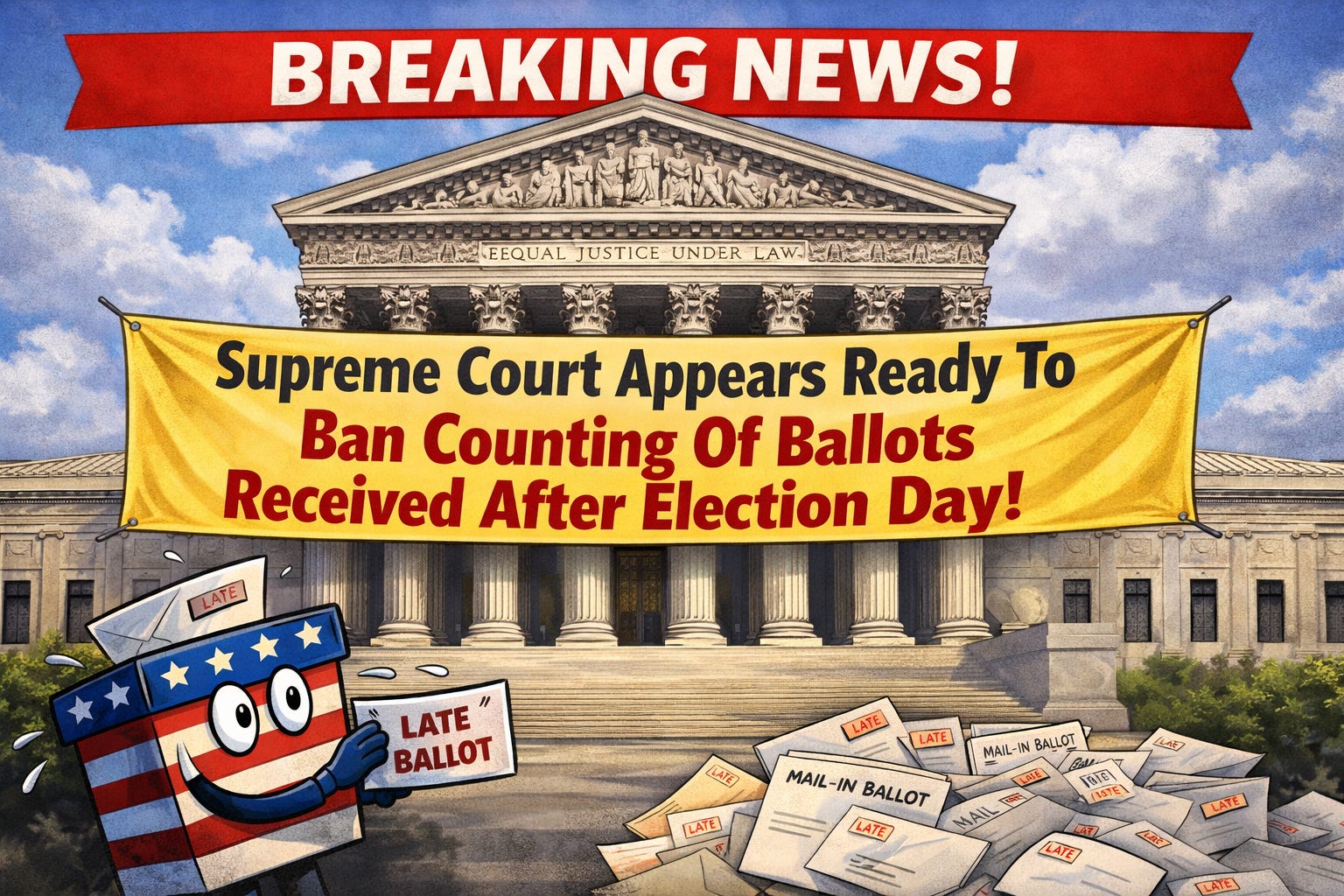
*Breaking News*SCOTUS Signals, In Hearing This Morning, Major Shift On Mail-In Ballot Deadlines — California’s Loose System Could Be In Trouble
The Supreme Court appears ready to require ballots to be received by Election Day — a direct challenge to California’s week-long counting window

When we put out breaking news, our typical format is to share the hard news above the paywall, and the more detailed news, and of course, our top-notch analysis (what does this mean?) is below the paywall.
⏱️ 5 min read
Supreme Court Signals A Crackdown On Endless Ballot Counting
The U.S. Supreme Court heard arguments Monday in a case that could force California to overhaul how it counts votes — and eliminate the practice of adding hundreds of thousands of ballots to the total after Election Day. Based on the tone of the justices, that outcome now looks likely.
At issue is a straightforward but consequential question: Does “Election Day” actually mean Election Day, or does it mean something more flexible, in which ballots can continue to arrive and be counted days later? California has built its system around that flexibility, allowing ballots to arrive up to 7 days after Election Day, as long as they are postmarked on time.
During arguments in Watson v. Republican National Committee, the Court’s six conservative justices signaled they are prepared to require that ballots be received by Election Day to be valid. Formally, any ruling would apply to federal elections, not state or local contests. But in California, where federal, state, and local races all appear on the same ballot, that distinction may prove largely academic — a legal nuance with little practical effect on how elections are actually conducted.
If that happens, California’s system doesn’t just get adjusted — it gets fundamentally reworked. By the way, 13 other states also currently allow for ballots to be counted after election day, and would be significantly impacted if this decision goes down as was augered by this morning’s hearing.
California’s System Relies On Late Ballots
This isn’t a technical detail in California — it is central to how elections are run. In the 2024 election alone, more than 406,000 ballots were counted after Election Day — enough to shift outcomes and prolong uncertainty well beyond Election Night.
It is also worth noting that while today’s hearing was notable, it was not surprising. The legal theory has been building for some time, and the Court’s current makeup makes this outcome entirely foreseeable.
For breaking news, we keep the core facts above the paywall and reserve the deeper analysis and political implications for paid subscribers.
Below the paywall, we break down:
• Which voters are most likely to cast late-arriving ballots — and why that matters
• How a strict Election Day deadline could reshape turnout patterns in California
• Why this isn’t just a legal ruling, but a behavioral shift in who successfully votes
• How campaigns will need to adjust to a shorter ballot return window
• The bigger issue this raises about confidence in election outcomes
