

Two Huge Second Amendment Developments In Two Days Could Reshape California Gun Law
The Supreme Court and the Justice Department just put California’s gun laws under an extraordinary spotlight.

Our morning content is available to all subscribers and guests! You can listen to this post (and all posts) on our podcast feed, So, Does It Matter? SPOKEN. It is available on your favorite podcast app. And you can listen to it here.
There is a substantial amount of extra content on this post, below the paywall, for paid subscribers. (To promote our podcast channel, all of the extra content is spoken on our podcast channel.)
⏱️ 5-minute read
Forty-Eight Hours That Changed The Conversation
In less than two days, two enormous Second Amendment developments landed almost simultaneously.
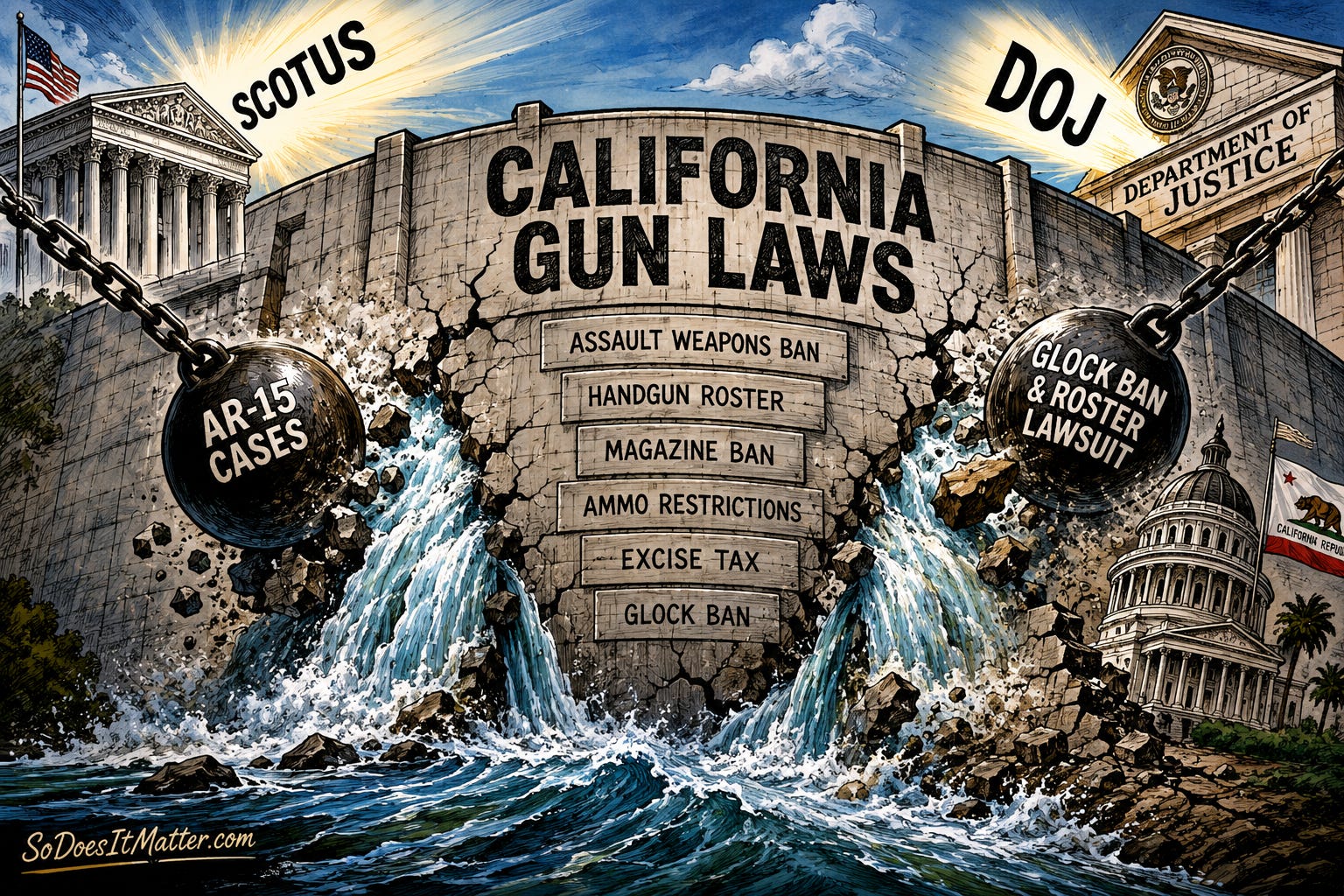
On Tuesday, the Supreme Court agreed to hear challenges to assault weapon bans in Connecticut and Cook County, Illinois. The Court consolidated the two cases — Grant v. Higgins and Viramontes v. Cook County — and placed them on next term’s docket. While those cases come from other states, the eventual ruling will likely apply nationwide, including to California’s own assault weapons ban — setting up what could become the most significant Second Amendment decision since Bruen.
Then on Wednesday, as California’s Glock restrictions (my in-depth piece on this is now unlocked for all readers) officially took effect, the Department of Justice filed suit challenging not only the state’s new Glock law but California’s handgun roster system itself!
Separately, these are major stories. Together, they may represent the most serious legal challenge yet to California’s broader approach to gun regulation. For years, California has largely been playing offense in the Second Amendment arena. Over the last forty-eight hours, that dynamic may have started to change.
The Supreme Court Takes Up The AR-15 Question
The Supreme Court’s decision to hear the assault weapon cases is a genuinely historic development.
For years, lower courts have upheld state-level bans on AR-15s and similar semiautomatic rifles. The Supreme Court repeatedly declined opportunities to intervene, frustrating gun-rights advocates who believed the Court’s decisions in Heller and Bruen already pointed toward the answer.
Just last June, Justice Brett Kavanaugh issued a pointed statement when the Court declined to hear a challenge to Maryland’s assault weapons ban in Snope v. Brown. He acknowledged that challengers had a “strong argument” that AR-15s are protected under the Second Amendment and predicted the Court would take up the issue “in the next Term or two.” Justices Thomas, Alito, and Gorsuch would have heard the case immediately — one vote short of the four needed to grant review. This week, the Court made good on Kavanaugh’s prediction.
The constitutional question is surprisingly straightforward: does the Second Amendment protect AR-15s and similar semiautomatic rifles?
California is not directly involved in either case, but its assault weapons ban is among the oldest and most expansive in the nation. If the Court concludes that rifles owned by millions of Americans are protected arms, the state’s law is on extraordinarily shaky ground.
The issue ultimately comes down to “common use.” Heller held that the Second Amendment protects arms in common use for lawful purposes like self-defense, but also said weapons “most useful in military service” may be banned. Lower courts have exploited the gap between those two statements, treating AR-15s as military-style weapons outside constitutional protection. Gun-rights advocates argue the logic collapses under scrutiny: a firearm owned by an estimated fifteen to twenty million Americans for lawful purposes cannot be considered unusual, whatever its cosmetic resemblance to military hardware. The Supreme Court is now preparing to decide which principle controls.
The Department Of Justice Comes After Sacramento
If Tuesday belonged to the Supreme Court, Wednesday belonged to the Department of Justice.
As California’s Glock restrictions took effect yesterday, the Justice Department filed a seventeen-page complaint challenging both the new law and California’s handgun roster — the state-approved list of handgun models that Californians are allowed to buy new from licensed dealers. This is not merely a lawsuit over one new law. It is a direct federal challenge to one of the central structures California uses to control handgun sales.
The case arises from the Civil Rights Division, which in December established the first-ever Second Amendment Section. It is headed by Assistant Attorney General Harmeet Dhillon — a figure well known to anyone who follows California politics. Dhillon is the former vice chair of the California Republican Party and a former Republican National Committeewoman who is now wielding federal enforcement power against the state she has spent her career trying to change, in the name of a constitutional right that Sacramento has spent decades trying to narrow.
The larger point is what this represents: the federal government is now treating Second Amendment claims as civil-rights claims worthy of direct federal enforcement. For years, California conservatives have argued that Sacramento treats the Second Amendment as a second-class right. Now the federal government is saying, in effect, that California may have gone too far.
Acting Attorney General Todd Blanche stated that California “cannot ban the most popular type of handgun in America.” Dhillon added that the Civil Rights Division would defend law-abiding citizens from states that seek to disarm them illegally.
The DOJ is not starting this fight from scratch. Organizations including the California Rifle and Pistol Association, the NRA, and the Firearms Policy Coalition have spent years litigating California’s firearms restrictions. CRPA’s own challenge to the roster in Boland v. Bonta won a preliminary injunction in 2023 before the Ninth Circuit stayed the ruling on appeal. The federal government is joining an existing battle, not opening a new one.
The roster challenge may ultimately prove even more consequential than the Glock issue itself. The roster has limited Californians’ access to newer handgun models for decades, leaving them with choices that would seem bizarre almost anywhere else in the country. If it eventually falls, the impact on California gun law would be difficult to overstate.
One Constitutional Question Underneath It All
At first glance, rifles and handguns appear to involve separate legal disputes. They are not.
Both stories ultimately revolve around the same question: can the government prohibit firearms that are commonly possessed by millions of law-abiding Americans for lawful purposes?
California has spent decades regulating firearms one category at a time. Magazine restrictions. Ammunition background checks. Special taxes. Handgun rosters. Assault weapon bans. Now Glock restrictions. Each one is sold as limited. Each one is described as reasonable. Each one is defended as just one more safety measure. But add them up, and the pattern becomes obvious. Lawful ownership becomes harder, narrower, more expensive, and more dependent on Sacramento’s permission.
The courts are now being asked where regulation ends and infringement begins.
So, Does It Matter?
Consider the full sequence. On June 18, the Supreme Court unanimously struck down the federal ban on gun possession by marijuana users in United States v. Hemani. On June 25, it struck down Hawaii’s concealed-carry restrictions in Wolford v. Lopez. On June 30, it granted certiorari in Viramontes and Grant, agreeing to decide whether states can ban one of America’s most commonly owned rifle platforms. On July 1, the Department of Justice sued California over the Glock ban and handgun roster — and filed a parallel suit against Virginia over its new assault weapons ban the same day.
That is not a trajectory. It is a wave.
The answers will not arrive tomorrow. The Supreme Court’s assault weapon decision may not come until the summer of next year. The Department of Justice lawsuit against California could take years to resolve.
But as America heads into the Fourth of July holiday and begins commemorating the 250th anniversary of a nation founded on liberty, self-government, and skepticism toward concentrated power, the courts are once again being asked to answer a very old American question: what does it mean for a constitutional right to exist if government may continually narrow the practical ability to exercise it?
The arguments about liberty and the limits of government authority did not end in 1776. This week reminded us they are very much alive.
For Our Paid Subscribers — Lots More! I went deep in my research, so I'm sharing it all for those who really want more. If you are interested and not a paid subscriber, reply to this and ask for this additional analysis, and I will share :-) There’s more content below the paywall than above!
Below the paywall:
Why California’s Glock ban targets far more than just “Glock switches”
How the DOJ is using a civil-rights statute usually aimed at rogue police departments
Why California’s handgun roster has frozen the market in place since 2013
How “common use” became the key legal fight over AR-15s, Glocks and magazines
Why a new Supreme Court ruling out of Hawaii may already matter for California
The major California gun cases are already moving through the Ninth Circuit
Why magazine bans may be next on the Supreme Court’s docket
What three major gun-rights wins in twelve days tell us about where the courts may be headed
CHECK IT ALL OUT BELOW!
