

Tired Of This Endless Waiting? Supreme Court And Postal Service Changes Could Upend California’s Mail Ballot System
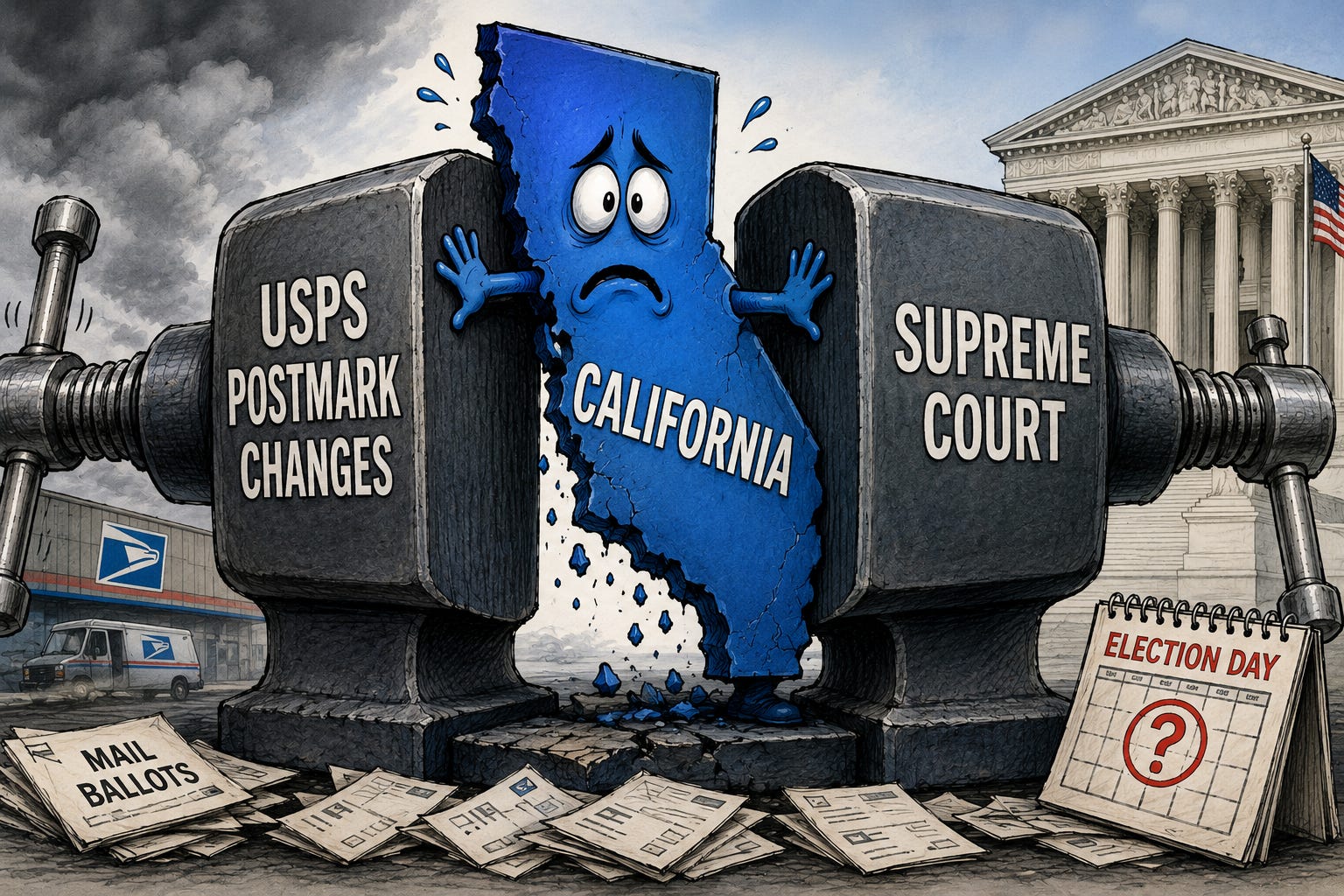
California is still counting ballots from Tuesday’s election, but two major developments could soon force the state to rethink its endless election calendar.

Typically, our afternoon content is either reserved for our paid subscribers or exclusive to those of you who financially support this effort. Today, the column is available to all readers, but below the paywall are several additional “must-see” on-topic political cartoons!
You can subscribe for FREE to get most of our content delivered to your inbox. A PAID subscription is $7 a month or $70 a year, and it gets you access to ALL of my stuff (like this full column). Why subscribe? Because now more than ever, you need someone calling balls and strikes, and who isn’t owned by interest groups.
You can also listen to this post on our podcast feed, So, Does It Matter? SPOKEN. It is available on your favorite podcast app. And here.
🕒 5 min read
Election Day No Longer Means Election Day
Tuesday was Election Day in California.
Or was it?
The polls closed Tuesday night, yet millions of ballots remain uncounted. Some races will not be settled for days. Others may not be settled for weeks. Californians have grown used to this ritual, but that does not make it normal. Election Day has slowly become Election Week, Election Month, and sometimes Counting Month.
California law currently allows vote-by-mail ballots to arrive up to seven days after Election Day and still be counted, so long as they are postmarked by Election Day. For the June 2 primary, that means mailed ballots can arrive as late as June 9. Because every active registered voter automatically receives a live ballot, the volume of mailed ballots is enormous.
The result is a system in which the public is told the election has ended while the decisive work continues long after the polls close.
As voters once again wait for final results, confidence in the process continues to erode. Now California’s system faces two developments that could fundamentally change this waiting game as soon as November. One has already happened. The other could happen within weeks.
The Postal Service Changed The Rules
The first change came from the U.S. Postal Service.
Earlier this year, the Postal Service clarified that mail is not guaranteed to receive a postmark on the day it is deposited. Instead, a postmark may be applied later, when the mail is processed through a postal facility.
That may sound like a technical detail. It is not. California’s election system depends heavily on postmarks. The postmark serves as the legal proof that a ballot was mailed on time. If a voter drops a ballot in the mail on Election Day, but the Postal Service applies the postmark later because of processing delays, the voter may have done everything right while still creating uncertainty about whether the ballot satisfies California’s legal deadline.
This concern is no longer theoretical. In the weeks before the June primary, California election officials warned voters not to wait until Election Day to mail their ballots. KQED put it bluntly: “Don’t Rely on USPS, Officials Say.” The San Francisco Chronicle likewise reported that ballots mailed on Election Day might not receive an Election Day postmark, potentially making them invalid.
Heck, the USPS actually now has this warning in print on their website:
“While we are not changing our postmarking practices, we have made adjustments to our transportation operations that will result in some mailpieces not arriving at our originating processing facilities on the same day that they are mailed. This means that the date on the postmarks applied at our processing facilities will not necessarily match the date on which the customer’s mailpiece was collected by a letter carrier or dropped off at a retail location.”
That is the problem. California relies on postmarks as proof of timeliness. The Postal Service has now made clear that postmarks do not necessarily prove when mail entered the system. When an election deadline depends on a postal practice the Postal Service no longer guarantees, the legal and practical foundation begins to wobble.
And that may not even be the biggest change coming.
The Supreme Court May Soon Change Everything
The second development is now before the United States Supreme Court.
In Watson v. Republican National Committee, the Court is considering whether federal law permits states to count ballots that arrive after Election Day. The case began in Mississippi, where state law allows ballots postmarked by Election Day to be counted even if they arrive several days later.
The Fifth Circuit Court of Appeals ruled that federal law requires ballots in federal races to be received by Election Day. Mississippi appealed, and the Supreme Court agreed to hear the case. A decision is expected this month.
Based on the questions asked during oral argument, the Court appeared skeptical of the idea that federal Election Day can mean one thing for voters who cast ballots in person and something else for ballots arriving later by mail. Several justices seemed focused on the core question: if Congress established a single Election Day for federal elections, can states continue counting ballots that were not actually received until after that day?
That does not guarantee the outcome. The Supreme Court can always surprise people. But the questioning strongly suggested that the justices are taking seriously the argument that Election Day is supposed to be a firm legal deadline, not the beginning of a post-election arrival window.
California Could Be Forced To Choose
If the Court rules that ballots in federal races must be received by Election Day, California could face a dramatic choice.
The state could require all vote-by-mail ballots to arrive by Election Day. Or it could try to run two systems at the same time: one rule for federal contests and another for state and local races.
That would be a mess.
Imagine telling voters that their ballot arrived in time to count for Governor, State Senate, city council, or a ballot measure, but too late to count for President or Congress. That kind of split system would be confusing for voters, burdensome for county election officials, and almost certain to deepen public skepticism.
The larger issue is simple: when does an election actually end?
For generations, Election Day represented a shared civic deadline. The polls closed, voting ended, and the country moved toward a result. California has stretched that concept almost beyond recognition. Ballots are mailed out weeks before Election Day, arrive after Election Day, and are counted for weeks afterward.
That system may soon collide with federal law.
So, Does It Matter?
This matters because California’s election system rests on assumptions that may no longer hold.
It assumes postmarks can reliably prove when ballots were mailed. The Postal Service has already undercut that assumption. It assumes ballots can continue arriving after Election Day and still be counted in federal races. The Supreme Court may soon reject that assumption.
Either change would be significant. Together, they could force California to rethink the structure of its mail-ballot system before the November election.
The point is not that mail voting must disappear. The point is that deadlines matter. Voters deserve a system in which Election Day means something clear, fixed, and enforceable.
Right now, California tells the public the election is over while ballots continue to arrive, totals continue to shift, and confidence continues to decline. If the Postal Service and the Supreme Court are both moving toward a harder deadline, Sacramento may soon have no choice but to confront what many voters already sense: an election system cannot maintain trust forever if Election Day no longer feels like the day the election actually ends.
More Reading…
*Breaking News*SCOTUS Signals, In Hearing This Morning, Major Shift On Mail-In Ballot Deadlines — California’s Loose System Could Be In Trouble

When we put out breaking news, our typical format is to share the hard news above the paywall, and the more detailed news, and of course, our top-notch analysis (what does this mean?) is below the paywall.
New U.S. Postal Service Changes Create a Mail-In Ballot Crisis

Most of our afternoon content is for paid subscribers. Only a small part of this post is available to everyone. To read the rest, you’ll need a paid subscription.
Below Are Three Great Political Cartoons…
For paid subscribers as a thank you!
