

This Week Two People Hold The Fate Of California’s Tax Battles
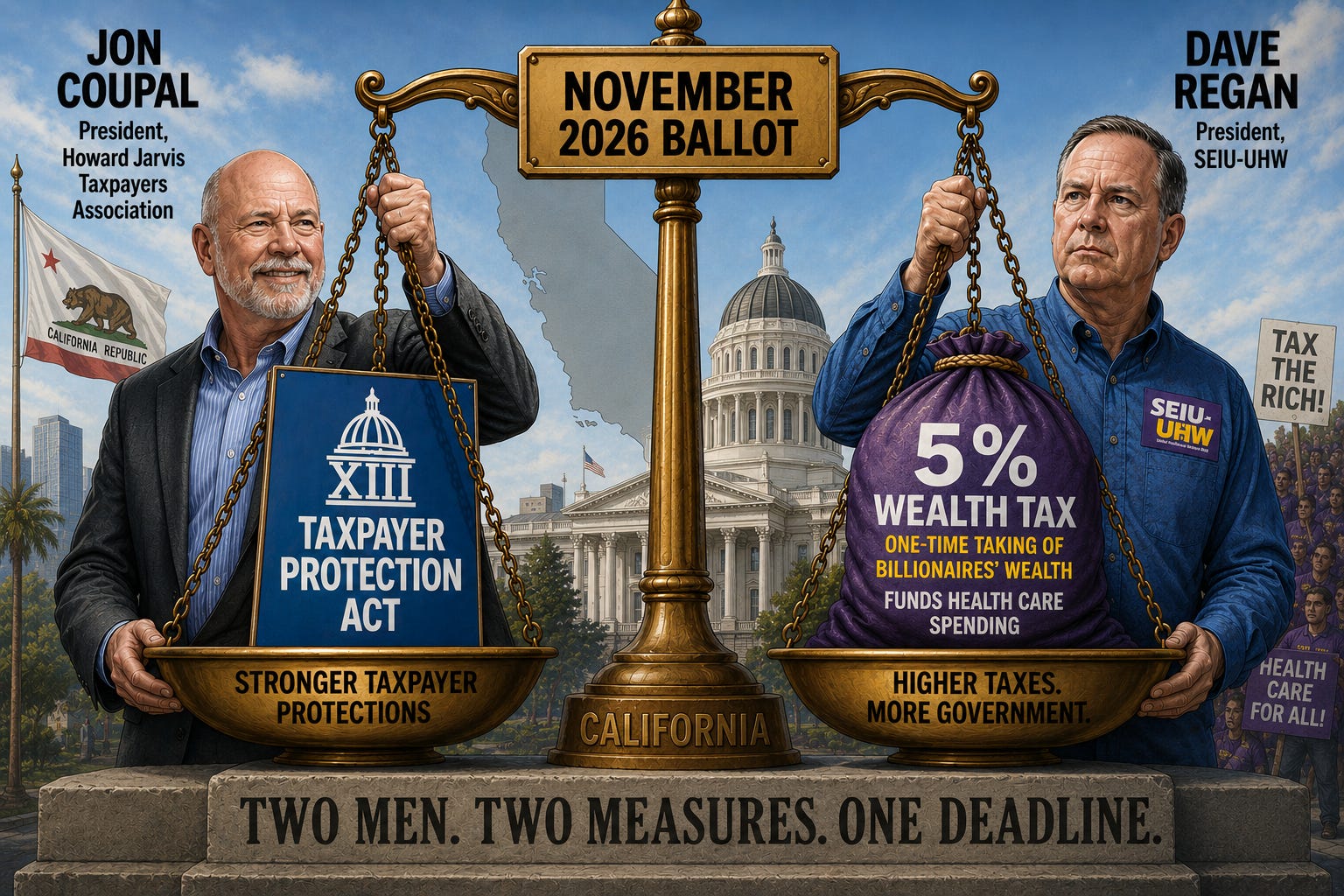
The fate of two major statewide tax measures may be decided this week by two men sitting in private negotiations.

Our morning content is free for all subscribers and guests! Usually our afternoon content is behind a paywall… If you are not yet a paid subscriber, consider upgrading — you are missing a significant portion of what we produce each week, and your support makes it possible. If you want to get it all and support my efforts, please consider a paid subscription!
You can also listen to this post on our podcast feed, So, Does It Matter? SPOKEN. It is available on your favorite podcast app. And you can listen to it here.
⏱️ 5 min read
The Back Room Window
California has entered one of the strangest phases of its initiative process, and most voters have no idea. Two major statewide tax-related ballot measures have already qualified for the November ballot. Petitions have been signed. Campaigns are preparing. Millions of dollars have been spent. Yet both measures could still disappear.
Under California law, initiative proponents have until a statutory deadline to withdraw a qualified measure from the ballot. That deadline is upon us. The fate of two major statewide fights rests not with millions of California voters, but with two men.
One is Jon Coupal, president of the Howard Jarvis Taxpayers Association and the official proponent of the Taxpayer Protection Act. It would restore and strengthen voter-approval protections for local taxes, require a two-thirds vote for special taxes, and shut down real estate transfer-tax schemes like Los Angeles’ Measure ULA. It is a constitutional amendment — meaning the Legislature cannot come back next year and undo it.
The other is Dave Regan, president of SEIU-UHW and the driving force behind the billionaire wealth tax, which would allow California to perform a one-time 5% “taking” of the worldwide net worth of state billionaires, with the proceeds routed mainly to health care spending.
You could hardly find two Californians with more different views about government. One has spent decades protecting taxpayers from Sacramento. The other has spent decades advocating for a larger and more expensive government.
This window between qualification and the deadline is one of Sacramento’s least understood rituals. Suddenly, lawmakers who ignored a problem for years want to negotiate. Too often it happens behind closed doors — the voters who signed petitions are not in the room. Which raises a question: why does Sacramento only become willing to negotiate after citizens force an issue onto the ballot?
The Wealth Tax Wild Card
It is difficult to see what Sacramento could offer Regan. Governor Newsom has already rejected a proposal from his union to enact a smaller wealth tax in exchange for pulling the initiative. Business groups oppose it. Wealthy donors would spend heavily to defeat it. Even many Democrats want nothing to do with it.
That leaves Regan in a curious position. If he withdraws, he receives little in return. If he keeps it on the ballot, he gets a platform for a class-warfare campaign against California’s wealthiest residents. Knowing his history, that may be enough. His politics have never been defined by restraint. They have been defined by confrontation. Which is why a deal appears unlikely.
Why Jon Coupal Is Different
The more interesting story is the other measure. Unlike the wealth tax proposal, the Taxpayer Protection Act addresses a concern shared by millions of Californians: affordability.
At a time when families are struggling with housing costs, utility bills, insurance premiums, fuel prices and taxes, stronger taxpayer protections have obvious appeal. That is why Sacramento’s political establishment has spent so much time fighting it.
Lawmakers have reportedly assembled a package of legislative changes to persuade initiative supporters to stand down. Take part of what you want now rather than risk a campaign for all of it. For many political actors, that might be an attractive offer.
Jon Coupal is not many political actors. For three decades, he has been one of California’s most effective taxpayer advocates. Since becoming president of the Howard Jarvis Taxpayers Association in 1999, he has helped lead the state’s most important fights against tax increases, assaults on Proposition 13, and efforts to weaken voter protections. I have known Jon for a long time. He is smart, steady, principled, and hard to pressure into a bad deal — because Sacramento’s favorite tactic is to offer partial relief today while preserving the ability to take it away tomorrow.
It is worth noting that over the years Jon has forged a strong working relationship with the state’s business community — especially the California Taxpayers Association, California Business Roundtable and California Business Properties Association — to defeat not one or two but three split roll ballot measures since 2004. That coalition not only defeated Prop 15 in 2020 but also convinced proponents to abandon two earlier split-roll measures. Over the last few days, Jon has had to endure unfortunate badgering from individuals in the business community who fail to look at the big picture and lack the wisdom that comes from decades of engagement in these sorts of battles… Who apparently do not understand with whom they are dealing.
His reputation is not that of a dealmaker. It is that of a taxpayer advocate who understands exactly how Sacramento works. That is why his role matters.
The Difference Between A Law And A Constitutional Amendment
The strongest argument for keeping the Taxpayer Protection Act on the ballot is practical, not merely ideological. Whatever the Legislature gives today can be taken away tomorrow. A future Legislature can amend, weaken, or repeal what a previous one passed. A constitutional amendment approved directly by voters cannot be rewritten whenever political winds change. That distinction matters.
Taxpayers have watched Sacramento make promises before. They have watched temporary taxes become permanent, voter-approved safeguards come under constant attack, and politicians claim they are solving a problem only to return asking for more money and more authority. Skepticism, given that history, is not cynicism. It is common sense.
Which is one reason Politico’s report that Coupal responded to the proposed compromise with “I doubt it” should surprise nobody. For those who know Jon, it sounds exactly like something he would say — and exactly what taxpayers should want to hear.
So, Does It Matter?
The withdrawal deadline arrives this week. Perhaps Regan surprises everyone and strikes a deal. Perhaps he fights on until November. We will know soon enough.
As for Jon Coupal, I would not bet on a retreat. Taxpayer advocates rarely get opportunities like this. California voters are frustrated. Affordability is dominating political discussions. Confidence in Sacramento’s stewardship of taxpayer dollars is not exactly soaring.
Ironically, the biggest threat to Regan’s wealth tax may not be the measure itself. The campaign to defeat it would focus on California’s spending habits, budget gimmicks, waste, fraud and abuse — and become a broader argument about whether California government deserves more money at all. Once voters start asking that question, the argument won’t stay confined to the wealth tax. It could just as easily sink the proposed permanent extension of the state’s top income tax bracket, along with expensive statewide and local measures on the ballot.
That may ultimately be the billionaire tax’s biggest political legacy: not that it passes, but that the campaign to defeat it turns the entire ballot into a referendum on Sacramento’s big-spending habits.
For now, the decision rests with two men. One wants Californians to pay more. The other has spent most of his adult life trying to make sure they don’t.
And if taxpayers are going to have someone representing them in Sacramento’s final round of negotiations, they could hardly ask for a better advocate than Jon Coupal.
Additional Reading…

SEIU Prepares To Bankroll A New California Billionaire Tax To Feed A Liberal Addiction to Spending

Our afternoon content is typically for our paid subscribers. But usually at the end of the week we offer a “Friday freebie” for all subscribers. Though there is special content at the end of this column that is below the paywall.

Thank you Jon for informing us. This "one-time" tax is NOT just a "one-time" thing. I can see it becoming a permanent thing AND extending further to the harm every taxpayer in the state. SEIU is as corrupt as the mafia.