

The Four Biggest Factors That Could Determine Whether Democrats Are Locked Out of the Top Two in the Governor’s Race
The odds are still long, but it says something when we are now in April and we are still talking about this at all.

Our afternoon columns typically have content for our paid subscribers. Either this column has a preview for all subscribers, but the bulk is below the paywall - OR - like today, there is exclusive content below the paywall to thank our paid subscribers. Some additional great cartoons you won’t want to miss! Paid subscribers just scroll down. If you’re a free subscriber, you get a one-time free pass - use it. Or a one-week free trial, try that! Or jump in and upgrade, and support this project!
You can listen to this post on our podcast feed, So, Does It Matter? SPOKEN. It’s available on your favorite podcasting app, or you can find it here.
Can Bianco and Hilton Take The Top Two Spots?
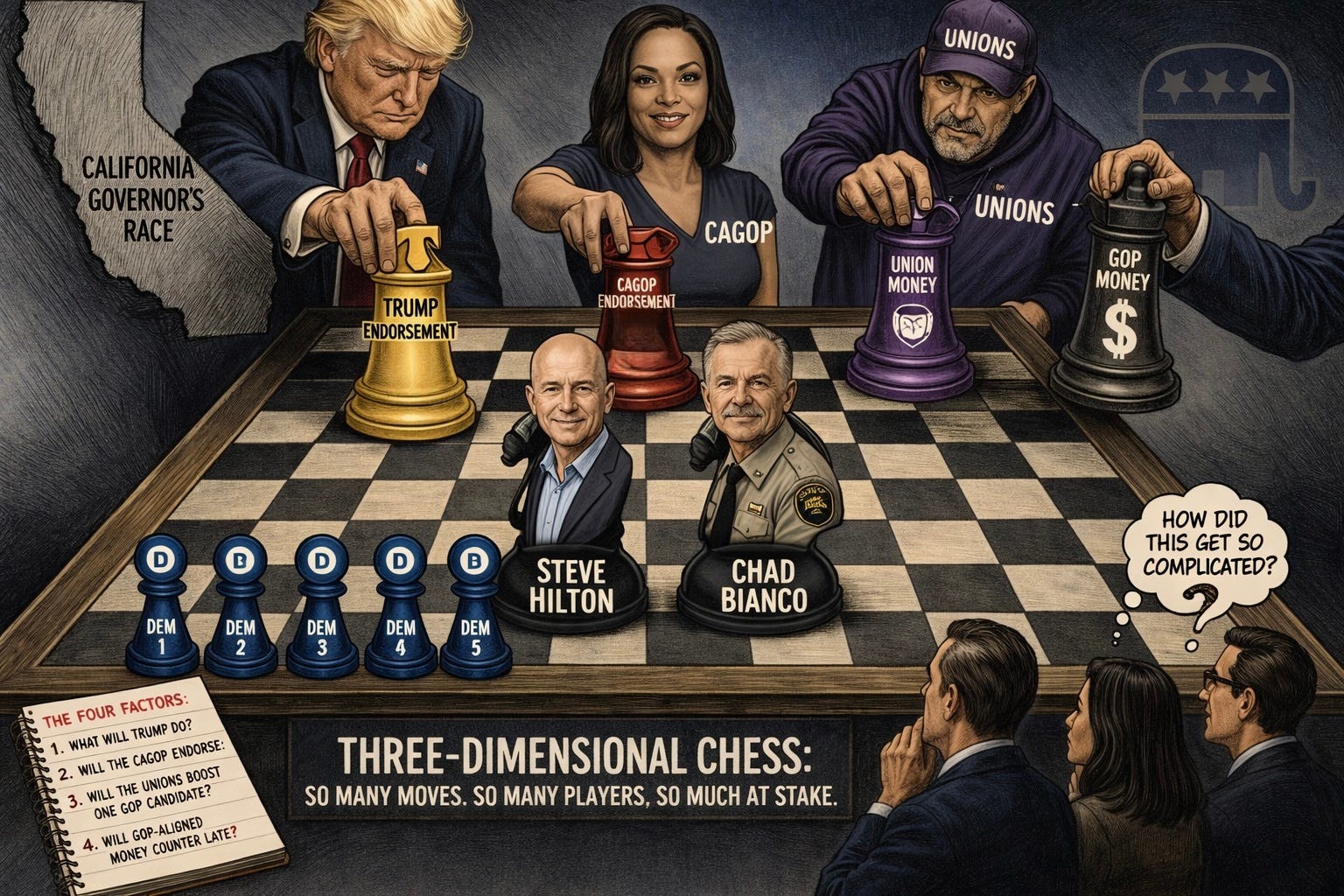
California’s top-two primary system creates unusual strategic incentives, and in a crowded field, outcomes can turn on factors that most voters never see. One of those scenarios—however remote—is that former Fox News host Steve Hilton and Riverside County Sheriff Chad Bianco could both advance to the general election, effectively locking Democrats out of the runoff entirely. That possibility may be a long shot, but it is not implausible, and it demands a closer look at what could actually drive it.
Here are the four factors that matter most.
1) WWTD? What, If Anything, Will President Trump Do?
President Trump has never been shy about weighing into Republican-on-Republican contests, though he has been selective about when and where he engages. Notably, he has stayed out of the U.S. Senate GOP runoff in Texas between Senator John Cornyn and Attorney General Ken Paxton. In California, he has also, at least so far, declined to endorse either Riverside County Sheriff Chad Bianco or Steve Hilton.
There are several possible explanations for that restraint. Trump may be reluctant to inject himself into a race in a state where he remains deeply unpopular with the broader electorate, or he may simply have relationships with both candidates and prefer not to choose. It is also possible that conversations have taken place privately, with no public signal yet given.
What is clear is that if Trump does weigh in, it would materially shift the Republican side of the race. Both Bianco and Hilton have enough resources to communicate that endorsement to likely GOP voters, and the earned media alone would amplify its impact. In a fragmented field, that kind of signal could be decisive in determining which Republican consolidates support.
2) Will the California Republican Party Endorse?
In less than two weeks, delegates to the California Republican Party State Central Committee will gather in San Diego for their only convention of 2026. Both Bianco and Hilton are seeking the party’s endorsement, which requires a 60 percent vote—a high threshold that is not easily reached.
If one candidate does secure that endorsement, it would provide a meaningful, if not overwhelming, advantage. While not as powerful as a Trump endorsement, it still carries weight with engaged Republican voters and can help unify party activists and donors around a single candidate.
At the same time, there is a strategic tension here that is hard to ignore. The party’s most realistic path to winning in November may depend on shutting Democrats out of the top two entirely. From that perspective, an argument can be made that the optimal move for the party is not to pick a side at all, but to allow both Republican candidates to advance as far as possible. In that sense, doing nothing may be the most strategically coherent choice. (Seems rather obvious to this delegate.)
3) Will Democrat-Aligned Efforts Spend Big to Boost One GOP Candidate?
There is now a clear track record of Democrats and their allies intervening in Republican primaries when it serves their broader strategic interests. The most recent example came in 2024, when Adam Schiff’s Senate campaign spent millions to boost Republican Steve Garvey, effectively blocking Katie Porter from advancing to the general election. The strategy worked, and it worked decisively.
In this race, the same playbook is readily available. While Tom Steyer is the only candidate in the field with the personal resources to execute such a strategy directly, the real financial muscle lies with organized labor and allied interests. The California Teachers Association, SEIU, the California Labor Federation, the California Medical Association, the California Hospital Association, and the prison guards union, among others, have the capacity to deploy significant independent expenditures.
Any one of these entities—or a coordinated effort among them—could choose to elevate one Republican while suppressing the other, shaping which candidate emerges as the stronger GOP contender. If a Trump or CAGOP endorsement enters the equation, it would only provide additional material for these efforts to exploit. Meanwhile, independent expenditures backing San Jose Mayor Matt Mahan are already reaching into the millions, though those efforts may be more focused on lifting their own candidate rather than engineering the Republican field.
4) If It’s Close Late, Will GOP-Aligned Dollars Show Up?
Finally, there is the question of whether Republican-aligned financial resources would engage if the race tightens in a way that makes a two-Republican runoff plausible. This is a narrow scenario, but it is not inconceivable.
In that moment, outside groups—from the Republican Governors Association to political committees connected to the President—could decide to step in. Even a fraction of the broader network of GOP-aligned funding could have an outsized impact if deployed strategically in the closing weeks.
If that happens, it would amount to a form of political jiu-jitsu, countering union-backed efforts with targeted spending designed to preserve or expand the Republican share of the vote. The window for this kind of intervention is small, but the effect could be significant if the race is sufficiently competitive.
So, Does It Matter?
The likelihood of Bianco and Hilton both advancing to the general election—and guaranteeing a Republican governor next January—remains relatively low. But the factors outlined above are the ones that could move the race in that direction, and they are worth watching as the campaign develops.
What makes this moment particularly interesting is the continued fragmentation on the Democratic side. A failure to consolidate behind a single candidate creates the opening, however narrow, for an unconventional outcome under the top-two system. If that fragmentation persists, the dynamics of this race could shift in ways that would have seemed unlikely at the outset.
It would be a historic result if it happened. For now, it remains a long shot—but one shaped by a set of strategic decisions that are still very much in play.
It is, in many ways, a game of three-dimensional chess.
Additional Reading…
California Unions May Decide Which Republican Advances In The Governor’s Race — And Which One Doesn’t

Our morning columns are available to all subscribers and guests. You can also listen to this content. Search for it on your favorite podcasting app. Or go here.
More Cartoons - And They Are Great!
As a thank you to our paid subscribers, check out these extra cartoons that are right below the paywall!
