

Has California Made Voting Too Easy?
California Democrats built an election system around convenience and ballot inclusion. Now we wait weeks for results while bigger questions about trust, scrutiny, and citizenship go unanswered.

Our morning content is free for all subscribers and guests! This morning, as a thank you to our paid subscribers, we have three more great political cartoons below the column! Upgrade today! You can subscribe for FREE to get most of my content delivered to your inbox. A PAID subscription is $7 a month or $70 a year, and it gets you access to ALL of my stuff (about 35% more). Why subscribe? Because now more than ever, you need someone calling balls and strikes, and who isn’t owned by ANYONE.
You can also listen to this post on our podcast feed, So, Does It Matter? SPOKEN. It is available on your favorite podcast app. And here.
⏱️ 6 minute read
Weeks, Not Days
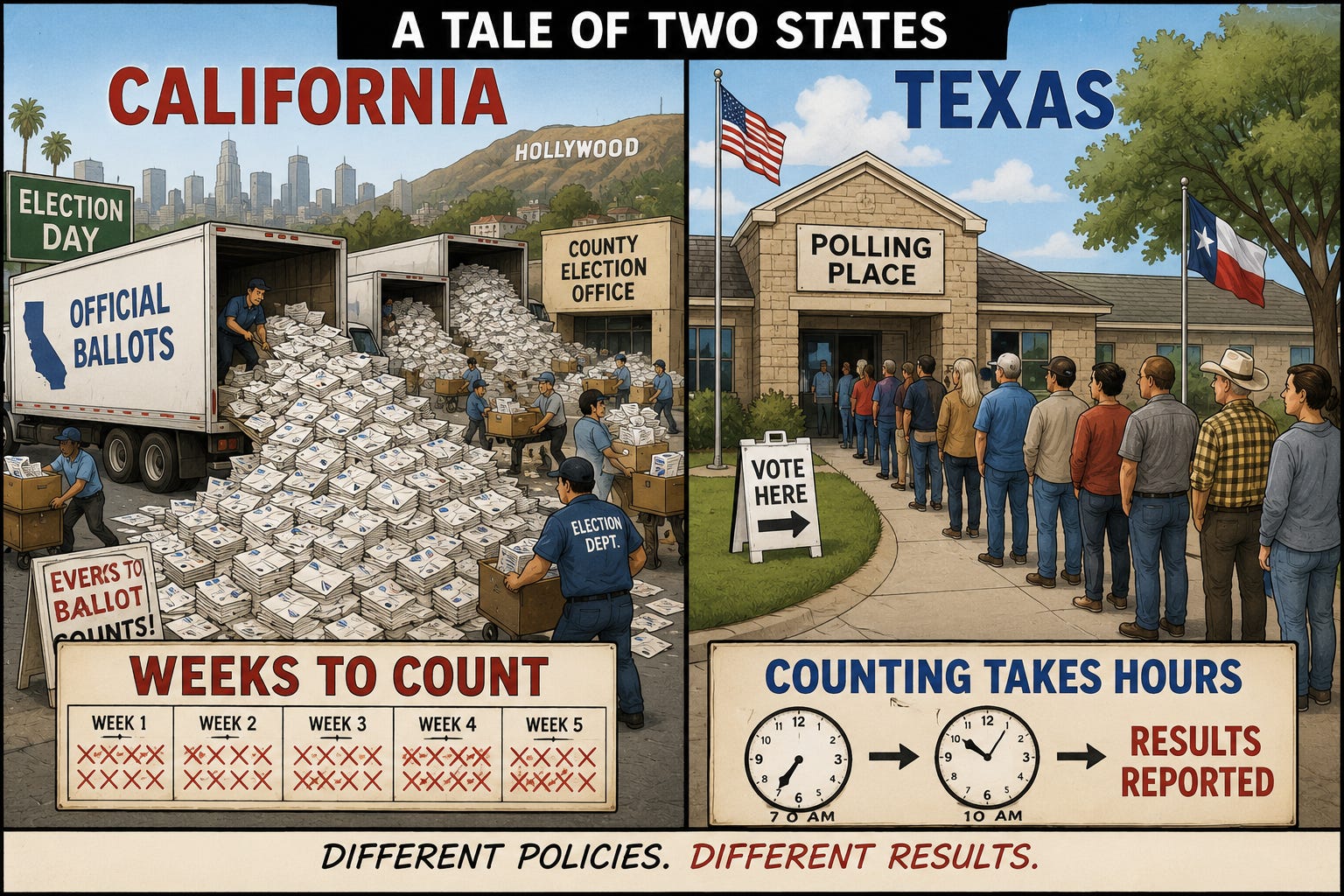
Every election cycle, Californians watch much of the country find out who won while our own races drag on for days or weeks. The familiar excuse is that California is big. True enough. But size is not the real story.
The real reason California takes so long to count votes is that Democratic policymakers spent decades building an election system designed to accept, review, fix, route, and count as many ballots as possible. The long count is not a bug. It is the predictable result of the rules Sacramento wrote.
Today, more than 80% of California voters cast ballots by mail. Every active registered voter receives a live ballot, with return postage paid, that can be mailed, dropped in a box, or delivered to a vote center. Ballots arriving after Election Day can still count if they meet state law. Signature problems, provisional ballots, and ballots submitted in the wrong county can all require post-election review.
California is not merely different from Texas and Florida. It is unusual among large states generally. New York and Illinois rely far less on mailed ballots than California does. Florida counts quickly because its mail ballots generally must be received by Election Day. California sits near the far edge of American election practice.
Election Day is no longer really a day.
One Law At A Time
Supporters call this voter access. Why should a working parent stand in line after work? Why should a senior citizen travel to a polling place?
California Democrats answered by removing obstacle after obstacle. Absentee voting became permanent absentee voting. Then came no-excuse vote-by-mail. Then came the current system, where a live ballot automatically arrives in nearly every voter’s mailbox.
These changes were largely enacted by Democratic legislators, frequently over Republican objections, and signed by Democratic governors. Universal mailed ballots, prepaid postage, expanded ballot curing, extended receipt windows, and tighter limits on meaningful ballot challenges all point in the same direction: make voting easier, even if the result is slower counts and less finality.
Many Californians complain that election results take weeks. But those delays flow from laws deliberately written to make voting easier. Sacramento Democrats chose this.
Just Trust Us
Convenience is not the only value elections must protect.
For most of American history, voting happened in controlled settings. Voters appeared at polling places. Officials verified eligibility. Observers watched. Ballots stayed largely under election officials’ supervision.
Universal vote-by-mail changes that. Millions of live ballots are sent to homes, apartment buildings, dormitories, assisted-living facilities, and other places outside official control. Most voters use those ballots honestly. But that is not the only test. The question is whether the system creates more opportunities for fraud, coercion, ballot harvesting, or administrative error.
California also relies heavily on trust in election officials. Once a mail ballot is accepted, election workers separate the ballot from the identifying envelope to preserve ballot secrecy. That protects voter privacy. It also means that once separated, there is generally no practical way to identify which voter cast which ballot.
If questions arise later, voter-specific challenges become extraordinarily difficult. The key decisions must be made before the envelope and ballot are separated. After that, the system depends heavily on the assumption that officials got it right.
That may protect ballot secrecy. It does not necessarily inspire public confidence.
More Than A Utility Bill
The deeper issue is not administrative. It is civic.
For generations, Americans understood voting as something that required effort. Citizens registered. They learned about candidates and issues. They traveled to a polling place. The process itself reminded people that the decision mattered.
California Democrats have moved the state in a very different direction. Today, a voter can receive a live ballot automatically, fill it out at the kitchen table, and return it with no postage required. In many cases, voting now takes little more effort than paying a utility bill.
Some will call that progress. Maybe it is.
But voting is not a consumer transaction. It is one of the central responsibilities of citizenship in a self-governing republic. Does democracy become stronger when voting is made nearly effortless? Or is there value in requiring citizens to make some affirmative commitment to participate?
That question deserves a serious debate.
So, Does It Matter?
California’s lengthy vote count is not the result of incompetence. County election workers are operating the system Sacramento gave them. The delays come from decades of laws that prioritized ballot access, convenience, and inclusion above speed, scrutiny, and finality.
The debate may soon become more than theoretical. The U.S. Supreme Court is expected to rule this month in Watson v. Republican National Committee, a case over whether federal law permits states to count mail ballots that arrive after Election Day. A ruling requiring ballots in federal races to be received by Election Day could affect California’s federal elections and put pressure on the state’s broader practices.
But even that would not settle the larger debate. Millions of live ballots would still be mailed automatically to voters. Signature curing would remain. Voter-specific ballot challenges would still be difficult after ballots are separated from identifying envelopes.
So the next time Californians wonder why election results take so long, they should not blame county election workers. They should look to Sacramento.
Even if the Supreme Court changes the rules for late-arriving ballots, California will still face the bigger question: what kind of voting system — and what kind of voting culture — do we want?
ADDITIONAL READING…
Tired Of This Endless Waiting? Supreme Court And Postal Service Changes Could Upend California’s Mail Ballot System

Typically, our afternoon content is either reserved for our paid subscribers or exclusive to those of you who financially support this effort. Today, the column is available to all readers, but below the paywall are several additional “must-see” on-topic political cartoons!
THERE’S MORE!
Below are three more great political cartoons on the topic of this column, exclusively for our paid subscribers…
