



So you didn't get any afternoon content from me yesterday because I messed up and only sent it to our 640 or so paid subscribers. So you are getting this as a third piece of content today, with my apologies!
Typically, our afternoon content is behind a paywall — or there is something extra for our paid subscribers. If you are not one, please consider upgrading. You are missing a significant portion of what we produce each week, and your support makes it possible. If you want it all and want to support my efforts, please consider a paid subscription! T
Our written content is converted, for your auditory pleasure, into our podcasting channel, So, Does It Matter? SPOKEN. It’s available on all of your favorite podcast apps, and you can listen to this post here.
⏱️ 6 minute read
⏱️ 6-minute read
$40,000,000,000,000
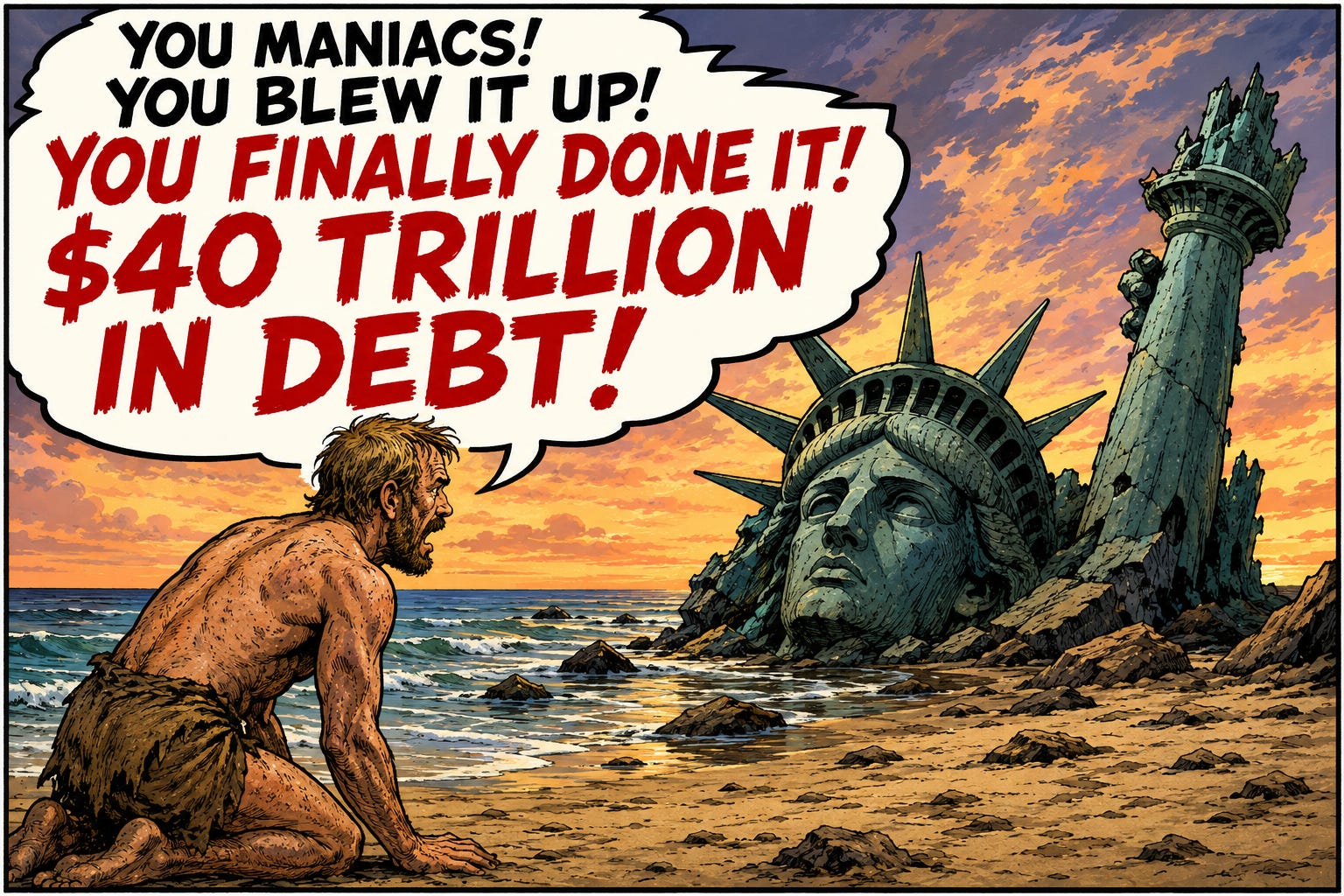
Happy $40 Trillion National Debt Day — for those who celebrate.
Yesterday, the United States crossed that threshold. The gross national debt reached $40 trillion. The Committee for a Responsible Federal Budget has the details here. It took nearly 200 years for the country to accumulate its first $1 trillion in debt, reaching that mark in 1981. We added the most recent $1 trillion in less than five months. The gross national debt has doubled in ten years and quadrupled in less than twenty.
Think about a family that has maxed out its credit cards. More of every paycheck goes to interest, leaving less for everything else. A responsible family stops charging and starts paying down the balance. Washington opens another line of credit.
This is not wartime borrowing or emergency spending during a depression. CBO projects a $1.9 trillion federal deficit this fiscal year, equal to 5.8 percent of the economy. We are running extraordinary deficits during pretty ordinary times. The federal government is not literally a household, but the basic problem is the same: you cannot keep spending far more than you take in while the interest bill gets bigger every year.
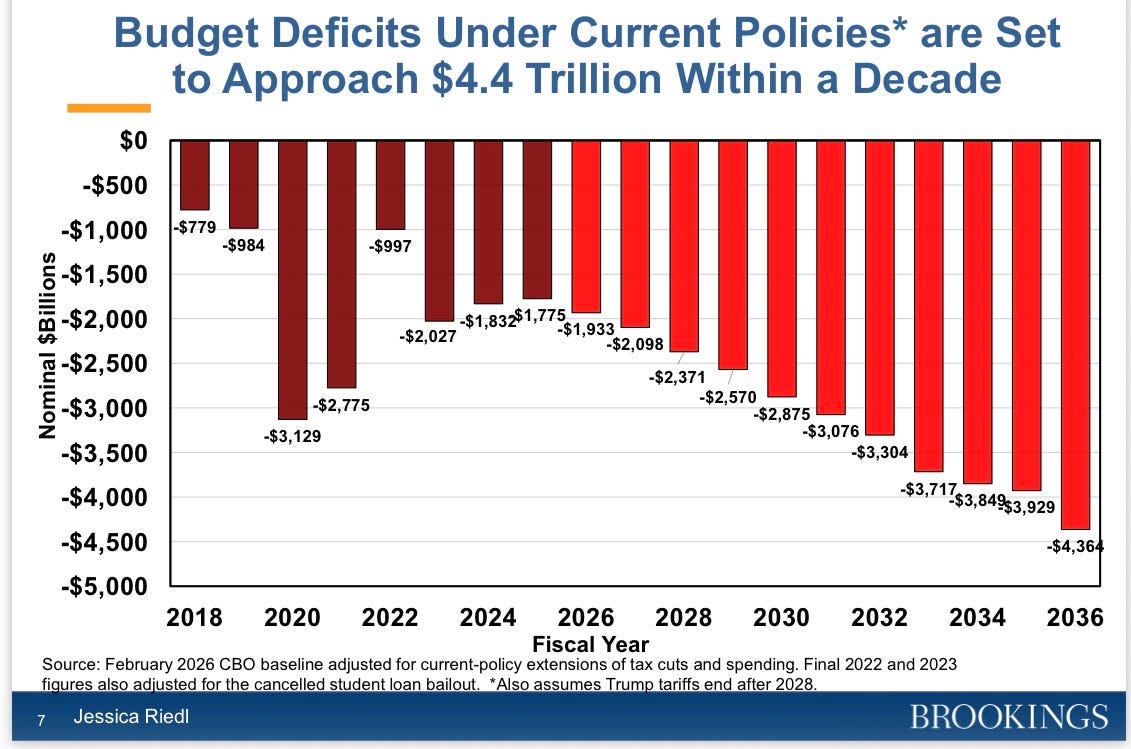
Everybody Did This
This is not a Democratic debt or a Republican debt. It is an American debt, accumulated under presidents and Congresses controlled by both parties.
There has always been a reason: wars, recessions, the financial crisis, COVID, tax cuts, emergency spending, new benefits and old benefits nobody wants to touch. Every administration has an explanation for its part of the pile. The pile is still $40 trillion.
A small group of Republicans still talks about deficits, and some have fought spending increases. But they remain a minority even within their own party, and the rhetoric has not produced fiscal discipline from a Republican-controlled Congress. Just last month, the House Budget Committee advanced a budget framework that would allow roughly $95 billion in additional deficit spending without requiring offsetting cuts or revenue.
Voters are not innocent bystanders either. Americans say they worry about the debt. Then ask whether they want meaningful reductions in Social Security or Medicare benefits, a higher retirement age, serious spending cuts or higher taxes, and the concern fades quickly. We say we want balanced budgets, but not necessarily the decisions required to get one. Politicians know that.
First, Stop Digging
The $40 trillion debt did not show up overnight, and it is not going away overnight either. The first goal is simple: stop making it bigger.
Washington needs to balance annual spending and revenue. Until that happens, talk about “paying down the debt” is fantasy. We cannot claim to be reducing the debt while borrowing another couple of trillion dollars every year.
Once the budget is balanced, the country can run surpluses and slowly reduce the debt over decades.
You cannot get out of a hole until you stop digging. Washington is still digging.
The Interest Bill Is Here
For years, politicians could treat the debt as something that would eventually become our children’s or grandchildren’s problem. That time is over.
CBO projects net interest costs of just over $1 trillion this year. By 2036, the annual interest bill is projected to reach roughly $2.1 trillion — nearly as much as all federal discretionary spending combined.
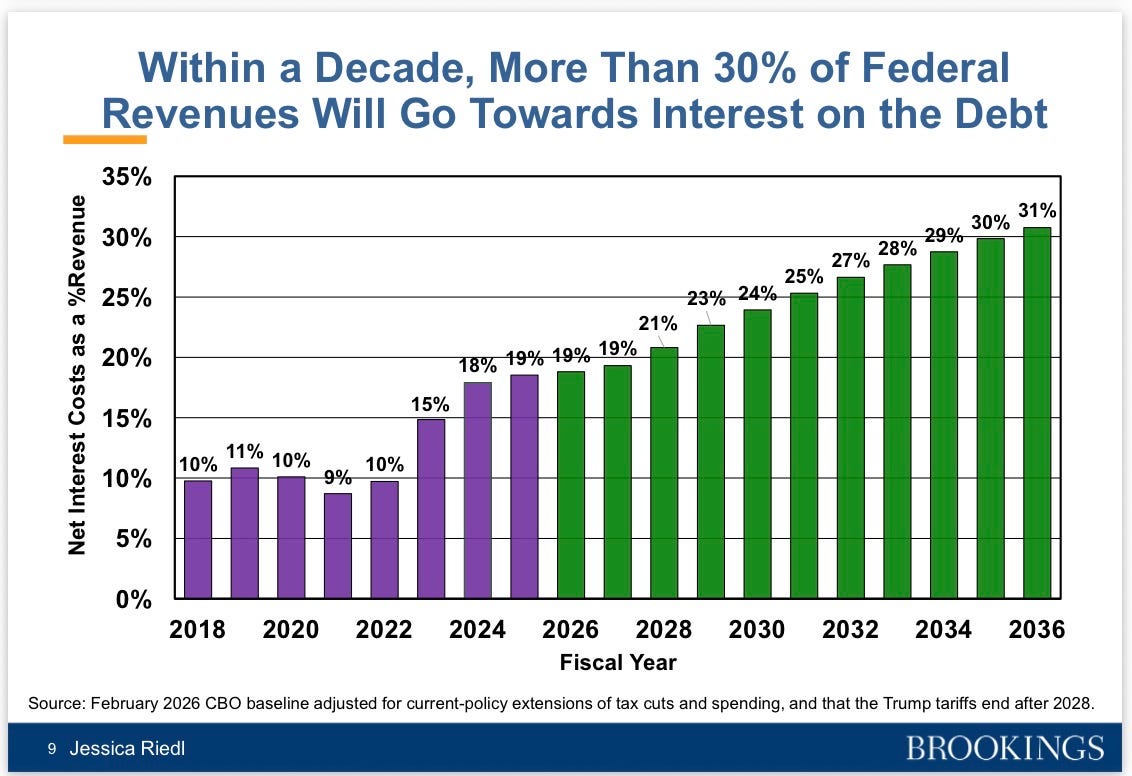
And what do we get for that money? No roads. No military readiness. No Social Security check. No medical care. It is the carrying cost of money Washington already borrowed.
Then the problem feeds on itself. More debt means more interest. Higher rates make new debt more expensive and old debt more expensive as it gets refinanced. Higher interest costs mean larger deficits, which means still more borrowing.
There is no flashing red line at $41 trillion or $45 trillion where somebody can tell us the system breaks. Nobody knows where that line is. That should bother us.
The Bills We Refuse To Face
The Social Security trustees project that the trust fund paying retirement and survivor benefits will exhaust its reserves in 2032. Without congressional action, incoming revenue would cover only about 78 percent of scheduled benefits. The Medicare trustees project that the trust fund paying Medicare Part A hospital benefits will exhaust its reserves in 2033, when dedicated revenue would cover about 89 percent of scheduled costs.
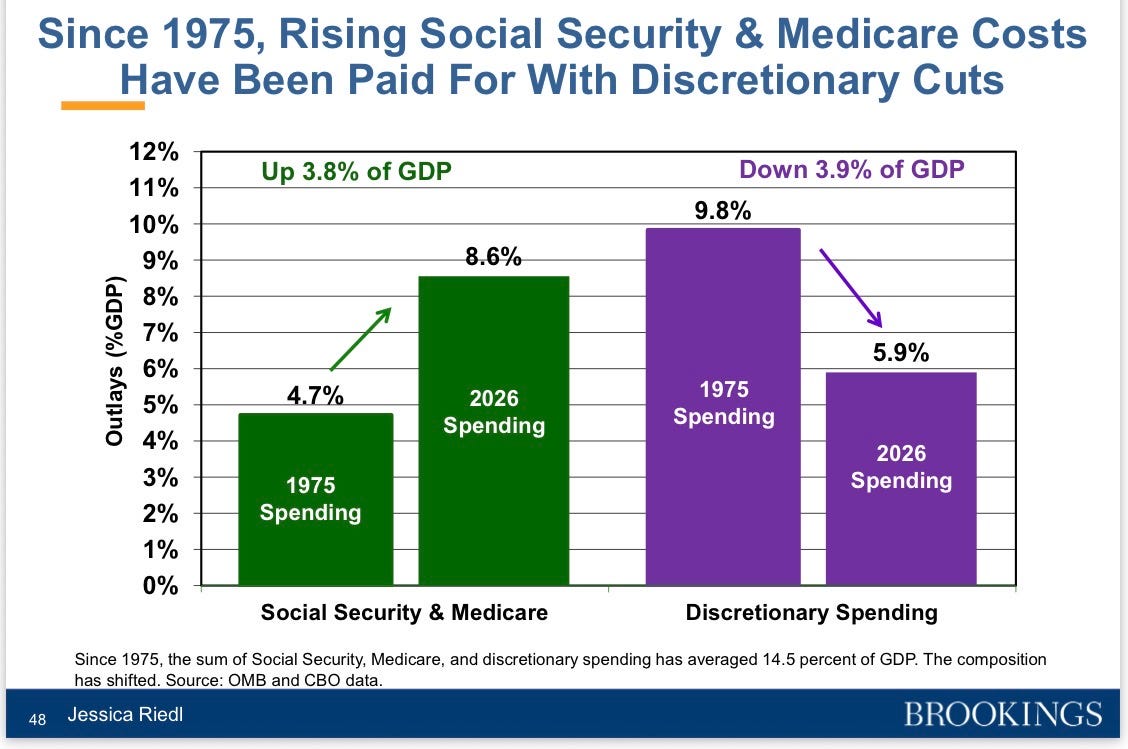
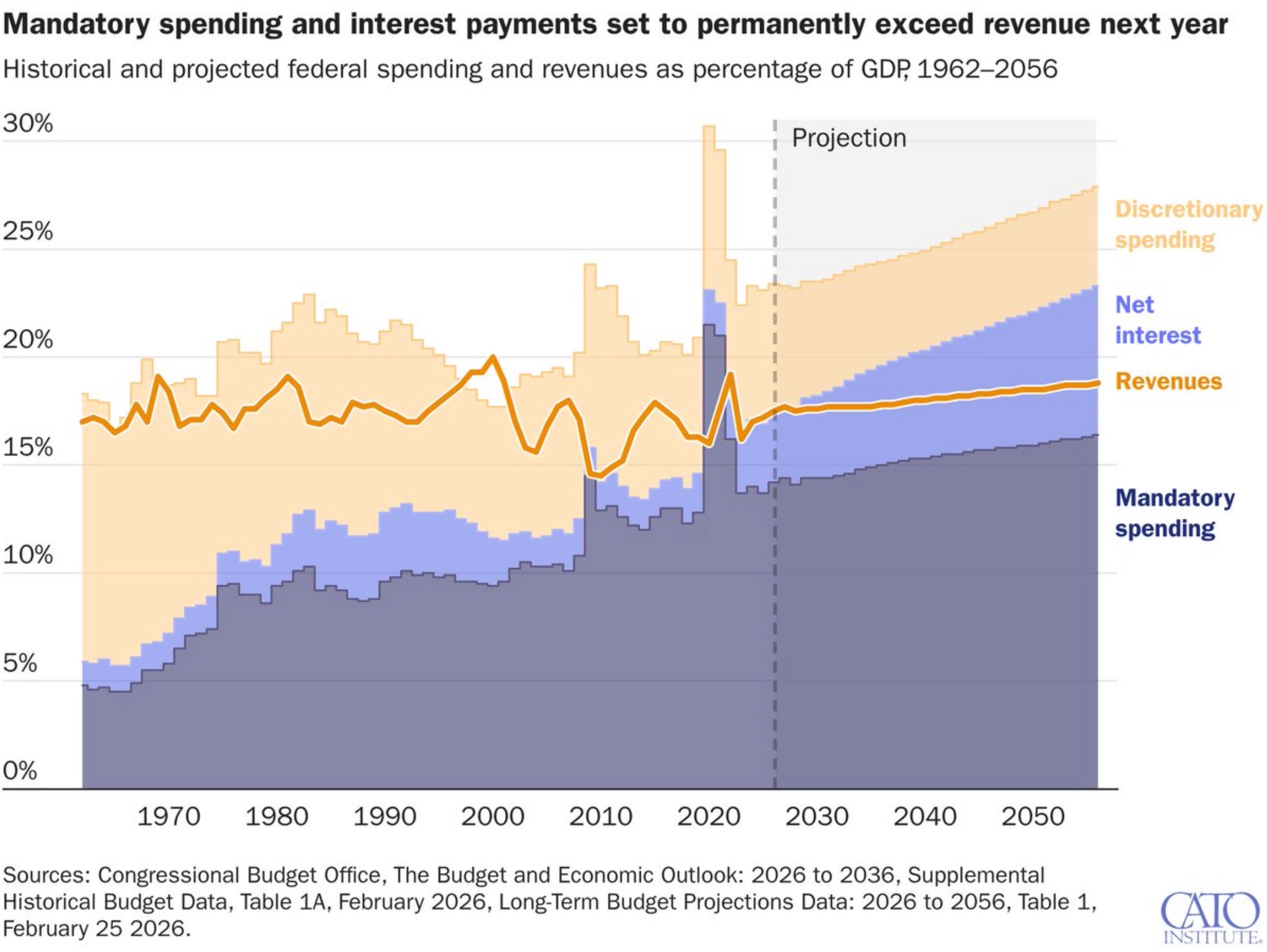
But there is another number that may be even more alarming. Beginning next year, CBO’s projections show mandatory spending plus interest consuming roughly all federal revenue and then moving above it. CBO lays out those projections here. That is before Washington spends one dollar on the Pentagon, highways, the FBI, national parks, education or any other program Congress funds through the annual budget process.
The spending Congress has largely put on autopilot — principally Social Security, Medicare and other mandatory programs — plus interest will eat up every dollar Washington collects and then some. The federal government will already be in deficit before Congress even gets to the rest of the budget.
We are not going to balance the budget by trimming agencies, cutting foreign aid, rooting out waste or even taking a meat cleaver to the rest of federal spending. Some of those cuts are worth making. They still do not solve the problem.
Eventually we have to deal with the big programs that run automatically, interest costs and revenue. Growth and cutting waste help, but neither comes close to solving it. The solution will almost certainly involve some combination of spending restraint, changes to entitlement programs and higher revenue.
None of that is politically pleasant. So Washington keeps borrowing.
So, Does It Matter?
For most of American history, Washington was not expected to finance or administer nearly every major domestic concern. The Constitution created a federal government with specifically assigned powers and, as the Tenth Amendment makes clear, left the rest to the states or the people. The New Deal and the national programs that followed changed that relationship enormously.
We ought to ask whether some of it has to move back the other way. States should assume more responsibility for domestic policy, allowing Californians, Texans and Floridians to make different choices about what government provides — and forcing their voters to deal more directly with what those choices cost. Federalism can impose fiscal discipline.
The federal government cannot be everything to everyone forever while borrowing the difference. Maybe nothing dramatic happens at $41 trillion, $45 trillion or $50 trillion. America may be able to muddle along for quite a while.
But not forever.
Eventually markets, interest costs or plain old arithmetic will force decisions that voters and politicians have spent years refusing to make.
We did not create a $40 trillion debt overnight, and we will not erase it overnight. The immediate job is simpler: stop making it worse. Balance what Washington spends with what Washington collects. Then begin the long process of reducing what generations of politicians — with the acquiescence of generations of voters — have accumulated.
Better to make those decisions while they are still ours to make than wait until circumstances make them for us.
With that, time to go find a cake that can hold 40 trillion candles…
Not Freaked Out Enough Yet? Read On!
More additional reading — and also more about the Brookings Institution’s Spending Taxes and Deficits Chart Book (three of the charts come from there). It’s a labor of love from Jessica Reidl, who has forgotten a lot more about the inner-workings of federal finance, taxing and spending than pretty much anyone will ever learn.
