

Election Day Has Arrived (Thank God) -- What I Am Watching Here in California
California’s top-two primary system, late-counted ballots, and several chaotic races could make Tuesday night messy — and politically revealing.


Our morning content is free for all subscribers and guests! This morning, as a thank you to our paid subscribers, we have three more great political cartoons below the column! Upgrade today! You can subscribe for FREE to get most of my content delivered to your inbox. A PAID subscription is $7 a month or $70 a year, and it gets you access to ALL of my stuff (about 35% more). Why subscribe? Because now more than ever, you need someone calling balls and strikes, and who isn’t owned by ANYONE.
You can also listen to this post on our podcast feed, So, Does It Matter? SPOKEN. It is available on your favorite podcast app. And here.
First And Foremost… A Lot Is Being Decided, But Don’t Expect Quick Results
California voters head to the polls Tuesday, and there is a lot to watch.
Polls close at 8 p.m. Pacific Time. But this is California, which means Election Night is usually more like Election Week, and sometimes Election Month.
This chart by Rob Pyers of the California Target Book really tells you what you need to know: historically, we get about 50-60% of the total California votes counted by the end of tomorrow night (which can go into the wee hours). The remainder comes painfully slowly through updates over a few weeks… Seriously. So any close races truly cannot be called any time soon.
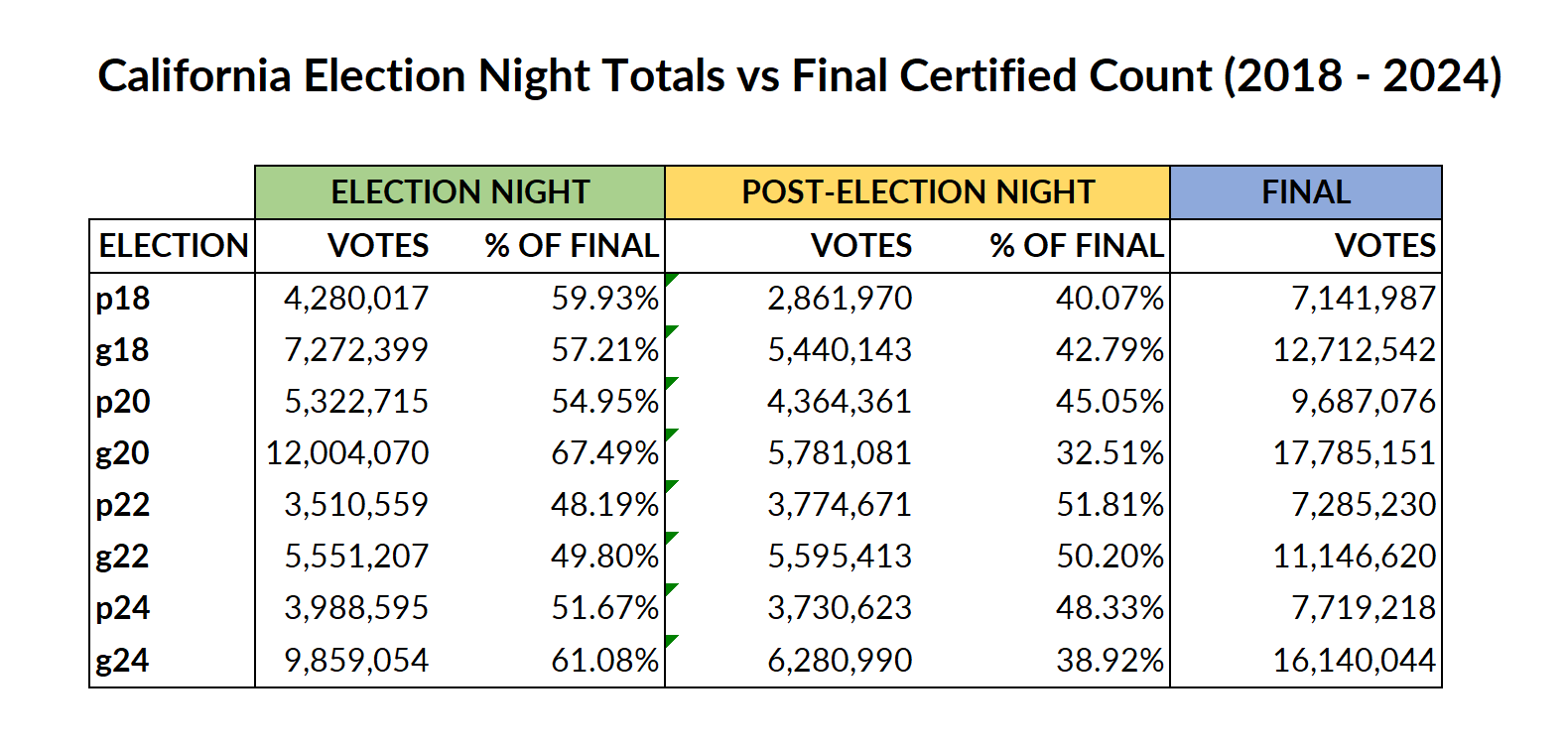
Because so many voters cast ballots by mail, the first numbers reported tonight can be misleading. Early returns often tilt more Republican, while later-counted ballots can move in a Democratic direction. That has particularly been the case this election.
That said, the first returns will tell us a lot.
Here is what I will be watching…
The Governor’s Race

This is the marquee contest.
California’s open governor’s race has gone through more plot twists than a Netflix political thriller.
For months, Democrats worried that their crowded field could split the vote so badly that two Republicans might advance to November. That would have been political malpractice on an almost artistic level.
Then Donald Trump endorsed Steve Hilton, which helped consolidate Republican support around the former Fox News host and weakened Riverside County Sheriff Chad Bianco.
Then Eric Swalwell, once one of the leading Democrats in the race, dropped out after sexual misconduct allegations and resigned from Congress. That scrambled everything.
Now the race appears to be centered around three major candidates: former Biden HHS Secretary Xavier Becerra, billionaire environmentalist Tom Steyer, and Hilton. Becerra has moved from also-ran to frontrunner territory. Steyer has spent an extraordinary amount of money. Hilton has become the main Republican option.
The question is simple: Which two survive?
If Hilton and one Democrat advance, the race becomes a traditional blue-state general election (overwhelmingly favoring the Democrat in November). If Becerra and Steyer both advance, Republicans are shut out, and California gets a Democrat-versus-Democrat food fight through to November.
This is the closest race for Governor I can remember… Literally late voters, undecided going into election day, could decide which two candidates advance…
The Statewide Undercard
California voters are also deciding a full slate of constitutional offices Tuesday. Most will produce predictable top-two outcomes, and I won’t pretend otherwise. But two races are genuinely worth watching.
The Lieutenant Governor’s race is the first. State Treasurer Fiona Ma enters as the clear frontrunner — she leads in polling and holds a commanding fundraising advantage. The intrigue is in the second slot, and it is real intrigue. Former Stockton Mayor Michael Tubbs has benefited from more than $5 million in independent expenditures from a single San Francisco donor, with the total potentially reaching $10 million. Josh Fryday carries Newsom’s endorsement and the California Teachers Association. And then there is Gloria Romero — a former Democratic State Senate majority leader, the first woman to hold that position, who switched to the Republican Party in 2024 and is running aligned with Steve Hilton. With multiple Democrats splitting the vote, Romero does not need to win over many voters to sneak into second place.
The Insurance Commissioner race deserves attention too — and not just as a footnote. Incumbent Ricardo Lara is term-limited, leaving an open seat that may be one of the most consequential statewide offices on the ballot. Wildfires have turned what was once a sleepy regulatory post into a front-line job, with homeowners across California struggling to find coverage at any price. Five candidates have drawn the most attention: Democrats State Senator Ben Allen, former State Senator Steven Bradford, former San Francisco Supervisor Jane Kim, Patrick Wolff, and Republican Stacy Korsgaden. The top-two outcome here matters — whoever advances will be shaping California’s insurance market response to wildfire risk for years to come.
Los Angeles Mayor

Mayor Karen Bass is in trouble. I don’t know anyone who thinks she can get over 50% of the vote and win this outright. Bass has been battered by criticism over the Palisades fire, homelessness, public safety, and basic city competence. Her numbers are weak for an incumbent mayor of Los Angeles. But weakness is not the same as defeat.
The key question is who joins her in a likely runoff. Spencer Pratt, the Republican reality-TV figure whose home was destroyed in the fire, has become a surprising factor. Special interest groups (unions) in the city appear happy to elevate him because he would be much easier for her to beat in November than a serious Democrat. Remember, fewer than 20% of the city’s registered voters are Republican.
The candidate Bass probably does not want to face is Councilwoman Nithya Raman, who comes from the city’s activist left. You see, if Raman drops, most of her votes end up with Bass, I would think. If Pratt didn’t make it, hard to tell what happens with his voters (if they vote at all in the runoff).
There is also a slimmer but fascinating possibility: Raman could outpace Bass and head into a runoff against Pratt. If that happens, Raman would likely become the frontrunner in deep-blue Los Angeles — but she would be drawing to an inside straight to get there. And this would surely provide a (narrow) opening for Pratt.
Los Angeles City Council
The mayor’s race is not the only Los Angeles contest worth watching. Several City Council races feature DSA-aligned challengers taking on incumbent councilmembers — contests that will help show whether the activist left is still gaining ground at City Hall, or whether Los Angeles voters are beginning to pull back after years of disorder, homelessness, crime, and political dysfunction. These races may not drive the same headlines as the mayor’s race, but they will shape how Los Angeles is governed long after the mayoral storyline fades.
The Congressional Map After Prop. 50
One important reminder before getting into the House races: with the passage of Proposition 50, there are fewer true Democrat-versus-Republican congressional battlegrounds in California than there used to be. That was the point. The new map was designed to reduce Republican opportunities and dramatically shrink the number of competitive congressional seats.
So while there are still House races worth watching, the interesting contests come in different flavors — intraparty fights, top-two maneuvering, candidate-quality tests, and a handful of genuine partisan battlegrounds. Keep that lens handy as the results come in.
CA-01 — Can Republican Assemblyman James Gallagher win the special election outright and avoid a runoff? That would give Republicans another vote in the narrowly divided House. There is also the regular election in the newly redrawn district, where Democrat Mike McGuire appears positioned to emerge as the November favorite after Prop. 50 made it a very safe Democratic seat.
First And Foremost… A Lot Is Being Decided, But Don’t Expect Quick Results
California voters head to the polls Tuesday, and there is a lot to watch.
Polls close at 8 p.m. Pacific Time. But this is California, which means Election Night is usually more like Election Week, and sometimes Election Month.
This chart by Rob Pyers of the California Target Book really tells you what you need to know: historically, we get about 50-60% of the total California votes counted by the end of tomorrow night (which can go into the wee hours). The remainder comes painfully slowly through updates over a few weeks… Seriously. So any close races truly cannot be called any time soon.
Because so many voters cast ballots by mail, the first numbers reported tonight can be misleading. Early returns often tilt more Republican, while later-counted ballots can move in a Democratic direction. That has particularly been the case this election.
That said, the first returns will tell us a lot.
Here is what I will be watching…
The Governor’s Race
This is the marquee contest.
California’s open governor’s race has gone through more plot twists than a Netflix political thriller.
For months, Democrats worried that their crowded field could split the vote so badly that two Republicans might advance to November. That would have been political malpractice on an almost artistic level.
Then Donald Trump endorsed Steve Hilton, which helped consolidate Republican support around the former Fox News host and weakened Riverside County Sheriff Chad Bianco.
Then Eric Swalwell, once one of the leading Democrats in the race, dropped out after sexual misconduct allegations and resigned from Congress. That scrambled everything.
Now the race appears to be centered around three major candidates: former Biden HHS Secretary Xavier Becerra, billionaire environmentalist Tom Steyer, and Hilton. Becerra has moved from also-ran to frontrunner territory. Steyer has spent an extraordinary amount of money. Hilton has become the main Republican option.
The question is simple: Which two survive?
If Hilton and one Democrat advance, the race becomes a traditional blue-state general election (overwhelmingly favoring the Democrat in November). If Becerra and Steyer both advance, Republicans are shut out, and California gets a Democrat-versus-Democrat food fight through to November.
This is the closest race for Governor I can remember… Literally late voters, undecided going into election day, could decide which two candidates advance…
The Statewide Undercard
California voters are also deciding a full slate of constitutional offices Tuesday. Most will produce predictable top-two outcomes, and I won’t pretend otherwise. But two races are genuinely worth watching.
The Lieutenant Governor’s race is the first. State Treasurer Fiona Ma enters as the clear frontrunner — she leads in polling and holds a commanding fundraising advantage. The intrigue is in the second slot, and it is real intrigue. Former Stockton Mayor Michael Tubbs has benefited from more than $5 million in independent expenditures from a single San Francisco donor, with the total potentially reaching $10 million. Josh Fryday carries Newsom’s endorsement and the California Teachers Association. And then there is Gloria Romero — a former Democratic State Senate majority leader, the first woman to hold that position, who switched to the Republican Party in 2024 and is running aligned with Steve Hilton. With multiple Democrats splitting the vote, Romero does not need to win over many voters to sneak into second place.
The Insurance Commissioner race deserves attention too — and not just as a footnote. Incumbent Ricardo Lara is term-limited, leaving an open seat that may be one of the most consequential statewide offices on the ballot. Wildfires have turned what was once a sleepy regulatory post into a front-line job, with homeowners across California struggling to find coverage at any price. Five candidates have drawn the most attention: Democrats State Senator Ben Allen, former State Senator Steven Bradford, former San Francisco Supervisor Jane Kim, Patrick Wolff, and Republican Stacy Korsgaden. The top-two outcome here matters — whoever advances will be shaping California’s insurance market response to wildfire risk for years to come.
Los Angeles Mayor
Mayor Karen Bass is in trouble. I don’t know anyone who thinks she can get over 50% of the vote and win this outright. Bass has been battered by criticism over the Palisades fire, homelessness, public safety, and basic city competence. Her numbers are weak for an incumbent mayor of Los Angeles. But weakness is not the same as defeat.
The key question is who joins her in a likely runoff. Spencer Pratt, the Republican reality-TV figure whose home was destroyed in the fire, has become a surprising factor. Special interest groups (unions) in the city appear happy to elevate him because he would be much easier for her to beat in November than a serious Democrat. Remember, fewer than 20% of the city’s registered voters are Republican.
The candidate Bass probably does not want to face is Councilwoman Nithya Raman, who comes from the city’s activist left. You see, if Raman drops, most of her votes end up with Bass, I would think. If Pratt didn’t make it, hard to tell what happens with his voters (if they vote at all in the runoff).
There is also a slimmer but fascinating possibility: Raman could outpace Bass and head into a runoff against Pratt. If that happens, Raman would likely become the frontrunner in deep-blue Los Angeles — but she would be drawing to an inside straight to get there. And this would surely provide a (narrow) opening for Pratt.
Los Angeles City Council
The mayor’s race is not the only Los Angeles contest worth watching. Several City Council races feature DSA-aligned challengers taking on incumbent councilmembers — contests that will help show whether the activist left is still gaining ground at City Hall, or whether Los Angeles voters are beginning to pull back after years of disorder, homelessness, crime, and political dysfunction. These races may not drive the same headlines as the mayor’s race, but they will shape how Los Angeles is governed long after the mayoral storyline fades.
The Congressional Map After Prop. 50
One important reminder before getting into the House races: with the passage of Proposition 50, there are fewer true Democrat-versus-Republican congressional battlegrounds in California than there used to be. That was the point. The new map was designed to reduce Republican opportunities and dramatically shrink the number of competitive congressional seats.
So while there are still House races worth watching, the interesting contests come in different flavors — intraparty fights, top-two maneuvering, candidate-quality tests, and a handful of genuine partisan battlegrounds. Keep that lens handy as the results come in.
CA-01 — Can Republican Assemblyman James Gallagher win the special election outright and avoid a runoff? That would give Republicans another vote in the narrowly divided House. There is also the regular election in the newly redrawn district, where Democrat Mike McGuire appears positioned to emerge as the November favorite after Prop. 50 made it a very safe Democratic seat.
CA-03 — Ami Bera is running in a very different district than the one that elected him. Only about one-third of his current constituents are in the new Sacramento-area seat, and he faces intraparty challengers arguing the district deserves a more progressive representative who actually lives within its new borders. Bera is still favored, but the question is whether the new map has made him more vulnerable than people assume.
CA-04 — Veteran Congressman Mike Thompson faces a surprisingly well-funded challenge from venture capitalist Eric Jones. Jones is making Thompson’s age and longevity the issue, even using a “past his expiration date” argument against the 75-year-old incumbent. Does the generational-change attack actually move voters, or does it only work against incumbents who are already politically weakened?
CA-06 — Rep. Kevin Kiley’s decision to run as an independent has created one of California’s more unusual congressional contests. The big question is which Democrat emerges from a crowded field to challenge him. And, of course, does Kiley have trouble beating out the Republican?
CA-07 — Can Sacramento Councilwoman Mai Vang break through against longtime incumbent Doris Matsui? Or does Matsui’s strategy of elevating a Republican candidate succeed in blocking Vang from the general election?
CA-11 — Nancy Pelosi is leaving Congress, and San Francisco politics is getting a rare open-seat brawl. Three serious Democrats are competing: state Sen. Scott Wiener, Supervisor Connie Chan, and Saikat Chakrabarti, the wealthy former operative best known for helping launch Alexandria Ocasio-Cortez. Wiener appears to be the frontrunner. Chan has Pelosi’s backing. Chakrabarti has money and an outsider message, but not AOC’s endorsement. The question is who gets the second slot — and it is a window into San Francisco’s Democratic future: machine politics, progressive politics, or tech-funded insurgency.
CA-14 — Does state Sen. Aisha Wahab capitalize on institutional support, or does BART Board President Melissa Hernandez continue her momentum in the race to replace Swalwell?
CA-17 — Rep. Ro Khanna’s challenge from tech-backed entrepreneur Ethan Agarwal could reveal whether Silicon Valley’s dissatisfaction with Khanna has real electoral consequences. It may not. But it is worth watching.
CA-22 — Republican Rep. David Valadao sits in one of California’s most competitive districts, and the real fight is on the Democratic side. Assemblywoman Jasmeet Bains is the establishment-backed moderate. Randy Villegas is the progressive, backed by Sanders and AOC. Republicans have also meddled, apparently hoping Villegas advances because they think he is easier for Valadao to beat. Democrats have to decide whether they want a candidate tailored to the Central Valley or one designed to excite the base — and this primary will tell us a lot about how that general election goes.
CA-32 — Democrat Jake Levine has framed his challenge to Congressman Brad Sherman as a generational-choice election. The question is whether enough Democratic voters agree.
CA-40 — One of the strangest races in California. Republican incumbents Ken Calvert and Young Kim are running against each other in a district redrawn to be more Republican. Calvert has more of the new district’s current constituents and is portraying himself as the most Trump-aligned candidate. Kim has raised serious money and is working hard to present herself as the stronger Trump-aligned candidate. Trump never weighed in. Meanwhile, Democrat Esther Kim Varet has benefited from spending by a group that may be trying to manipulate the top-two outcome. Do Calvert and Kim both advance, or does a Democrat sneak into the general? This is not just a congressional race — it is a stress test of how brutal intra-party incumbent-versus-incumbent politics can get under California’s top-two system.
CA-41 — Linda Sanchez is running in a newly drawn district where less than half the voters come from her old seat, and she faces a familiar opponent in former Assemblyman Hector De La Torre, whom she defeated in her first congressional race back in 2002. Sanchez is still favored, but this is another test of whether long-serving incumbents can simply transfer their political standing into new districts without much turbulence.
CA-48 — Prop. 50’s map, followed by Rep. Darrell Issa’s retirement, turned this seat into a major open-seat target. Republicans have rallied around San Diego County Supervisor Jim Desmond. Democrats have a crowded field, including Ammar Campa-Najjar, Marni von Wilpert, and Brandon Riker. The nightmare scenario for Democrats is not simply picking the wrong nominee — it is somehow failing to get a serious Democrat into November at all. That seems unlikely. But in California’s system, unlikely is not the same as impossible.
A few others worth a quick check: In CA-13, Adam Gray will likely draw former Stockton Mayor Kevin Lincoln. In CA-26, Jacqui Irwin appears on a glide path to replace Julia Brownley. In CA-34, Jimmy Gomez faces challengers from the left. In CA-38, Hilda Solis is attempting a return to Congress. In CA-41, Linda Sanchez faces Hector De La Torre again. And in CA-43, Maxine Waters faces yet another generational-change challenge, though she is still expected to move forward easily.
Two Legislative Races Worth Watching
State Senate District 4
Four years ago, Marie Alvarado-Gil won this seat as a Democrat in a district that Donald Trump carried comfortably — only because four Republicans split the vote in the top-two primary, guaranteeing two Democrats advanced to the general. She won. Since then, she has switched parties and is now seeking reelection as a Republican, with her main challenger being Alexandra Duarte, an almond farmer and the wife of former Congressman John Duarte.
The question of whether Alvarado-Gil’s conversion reflects genuine political evolution or simple electoral survival is one only she can fully answer. But Republican voters get a say Tuesday too — and how they receive an incumbent who arrived in the party through a mid-term switch rather than a traditional path makes for genuinely fascinating political theater.
State Senate District 40
Republican Senate Leader Brian Jones is termed out in San Diego County, and he has endorsed Santee Councilman Ed Musgrove as his preferred successor. Much of the traditional GOP establishment has lined up behind Musgrove. But Musgrove faces a serious challenge from Kristie Bruce-Lane, who has become the candidate of choice for many grassroots conservatives and has drawn strong support from Assemblyman Carl DeMaio and his political network.
This race echoes a broader fight inside California Republican politics. Last year, DeMaio went to war with much of the party establishment and won. The question is whether that energy is transferable — or whether the traditional party structure still carries more weight than its critics believe.
Of course there are a bunch of other state legislative races playing out, but too many to go into here!
Local Ballot Measures Worth Watching
There are 113 local ballot measures across California on Tuesday. I am not going to weigh in on all of them, but four are worth noting.
San Francisco Measures C and D. Both deal with the city’s “overpaid CEO tax” — an additional levy on businesses whose highest-paid executive earns more than 100 times the median employee’s pay. Labor unions put Measure D on the ballot to raise that tax significantly, projected to generate $200 to $300 million a year for a city facing a serious budget deficit. Business leaders responded with Measure C — a more modest version written to nullify D if it gets more votes. Mayor Lurie opposes both. If D wins, the progressive-labor coalition still controls San Francisco’s direction. If C wins, the business-friendly reformers do. Simple as that.
Contra Costa County Measure B. Contra Costa voters are being asked to approve a five-eighths-cent sales tax for five years, projected to raise $150 million annually for healthcare and essential services. But this one comes with extra baggage. A Superior Court judge ruled that the ballot language written by the Board of Supervisors was biased toward a yes vote and ordered it rewritten — with phrases designed to frighten voters about hospital closures struck as prejudicial and argumentative. Opponents also note this tax stacks on top of a half-cent sales tax already in effect through 2041. When a judge has to rewrite your ballot language before the election even happens, you have already handed the opposition a talking point.
Los Angeles County Measure ER. A half-cent sales tax increase for five years, projected to generate roughly $1 billion annually for county healthcare services, with six clinics already closed due to federal Medicaid cuts. Polling has it underwater even among LA city voters, running 47% against and 45% in favor. A measure that can’t carry Democratic Los Angeles is a measure in real trouble.
San Diego Measure A. An $8,000 annual tax on second homes left vacant more than half the year, rising to $10,000 from 2028, with extra surcharges on corporate-owned properties. Opponents point to a San Francisco court that struck down a similar tax on constitutional grounds. Whether it survives legally or not, it tells you where San Diego’s housing politics are heading.
The Bottom Line
I have been watching California elections for a long time, and I can tell you with confidence: go to bed early, or don’t. But don’t expect to get answers on close or moderately close races tomorrow night.
The first returns Tuesday night will be real, but they will not be the whole story. They rarely are in this state. The mail ballots counted after midnight — and after Wednesday, and sometimes after next week — have a way of rewriting what looked like settled conclusions.
What I will be tracking as the night unfolds: whether Republicans consolidate where they need to, whether Democrats avoid top-two self-inflicted disasters, whether incumbents show the kind of weakness that tends to compound, and whether any of the races I have flagged here produce a genuine surprise.
And yes — because I am from Orange County and I cannot help myself — I will be watching the Board of Supervisors races too. There are two races, Districts 4 & 5, where the partisan majority is at stake.
The first returns matter. The final count matters more. And in California, the most interesting story is usually the one still unfolding as you are shopping for your Thanksgiving dinner!
CA-06 — Kevin Kiley’s decision to run as an independent has created one of California’s more unusual congressional contests. The big question is which Democrat emerges from a crowded field to challenge him. And, of course, does Kiley have trouble beating out the Republican?
CA-07 — Can Sacramento Councilwoman Mai Vang break through against longtime incumbent Doris Matsui? Or does Matsui’s strategy of elevating a Republican candidate succeed in blocking Vang from the general election?
CA-11 — Nancy Pelosi is leaving Congress, and San Francisco politics is getting a rare open-seat brawl. Three serious Democrats are competing: state Sen. Scott Wiener, Supervisor Connie Chan, and Saikat Chakrabarti, the wealthy former operative best known for helping launch Alexandria Ocasio-Cortez. Wiener appears to be the frontrunner. Chan has Pelosi’s backing. Chakrabarti has money and an outsider message, but not AOC’s endorsement. The question is who gets the second slot — and it is a window into San Francisco’s Democratic future: machine politics, progressive politics, or tech-funded insurgency.
CA-14 — Does state Sen. Aisha Wahab capitalize on institutional support, or does BART Board President Melissa Hernandez continue her momentum in the race to replace Swalwell?
CA-17 — Rep. Ro Khanna’s challenge from tech-backed entrepreneur Ethan Agarwal could reveal whether Silicon Valley’s dissatisfaction with Khanna has real electoral consequences. It may not. But it is worth watching.
CA-22 — Republican Rep. David Valadao sits in one of California’s most competitive districts, and the real fight is on the Democratic side. Assemblywoman Jasmeet Bains is the establishment-backed moderate. Randy Villegas is the progressive, backed by Sanders and AOC. Republicans have also meddled, apparently hoping Villegas advances because they think he is easier for Valadao to beat. Democrats have to decide whether they want a candidate tailored to the Central Valley or one designed to excite the base — and this primary will tell us a lot about how that general election goes.
CA-32 — Democrat Jake Levine has framed his challenge to Congressman Brad Sherman as a generational-choice election. The question is whether enough Democratic voters agree.
CA-40 — One of the strangest races in California. Republican incumbents Ken Calvert and Young Kim are running against each other in a district redrawn to be more Republican. Calvert has more of the new district’s current constituents and is portraying himself as the most Trump-aligned candidate. Kim has raised serious money and is working hard to present herself as the stronger Trump-aligned candidate. Trump never weighed in. Meanwhile, Democrat Esther Kim Varet has benefited from spending by a group that may be trying to manipulate the top-two outcome. Do Calvert and Kim both advance, or does a Democrat sneak into the general? This is not just a congressional race — it is a stress test of how brutal intra-party incumbent-versus-incumbent politics can get under California’s top-two system.
CA-48 — Prop. 50’s map, followed by Rep. Darrell Issa’s retirement, turned this seat into a major open-seat target. Republicans have rallied around San Diego County Supervisor Jim Desmond. Democrats have a crowded field, including Ammar Campa-Najjar, Marni von Wilpert, and Brandon Riker. The nightmare scenario for Democrats is not simply picking the wrong nominee — it is somehow failing to get a serious Democrat into November at all. That seems unlikely. But in California’s system, unlikely is not the same as impossible.
A few others worth a quick check: In CA-13, Adam Gray will likely draw former Stockton Mayor Kevin Lincoln. In CA-26, Jacqui Irwin appears on a glide path to replace Julia Brownley. In CA-34, Jimmy Gomez faces challengers from the left. In CA-38, Hilda Solis is attempting a return to Congress. In CA-41, Linda Sanchez faces Hector De La Torre again. And in CA-43, Maxine Waters faces yet another generational-change challenge, though she is still expected to move forward easily.
Two Legislative Races Worth Watching
State Senate District 4
Four years ago, Marie Alvarado-Gil won this seat as a Democrat in a district that Donald Trump carried comfortably — only because four Republicans split the vote in the top-two primary, guaranteeing two Democrats advanced to the general. She won. Since then, she has switched parties and is now seeking reelection as a Republican, with her main challenger being Alexandra Duarte, an almond farmer and the wife of former Congressman John Duarte.
The question of whether Alvarado-Gil’s conversion reflects genuine political evolution or simple electoral survival is one only she can fully answer. But Republican voters get a say Tuesday too — and how they receive an incumbent who arrived in the party through a mid-term switch rather than a traditional path makes for genuinely fascinating political theater.
State Senate District 40
Republican Senate Leader Brian Jones is termed out in San Diego County, and he has endorsed Santee Councilman Ed Musgrove as his preferred successor. Much of the traditional GOP establishment has lined up behind Musgrove. But Musgrove faces a serious challenge from Kristie Bruce-Lane, who has become the candidate of choice for many grassroots conservatives and has drawn strong support from Assemblyman Carl DeMaio and his political network.
This race echoes a broader fight inside California Republican politics. Last year, DeMaio went to war with much of the party establishment and won. The question is whether that energy is transferable — or whether the traditional party structure still carries more weight than its critics believe.
Of course there are a bunch of other state legislative races playing out, but too many to go into here!
Local Ballot Measures Worth Watching
There are 113 local ballot measures across California on Tuesday. I am not going to weigh in on all of them, but four are worth noting.
San Francisco Measures C and D. Both deal with the city’s “overpaid CEO tax” — an additional levy on businesses whose highest-paid executive earns more than 100 times the median employee’s pay. Labor unions put Measure D on the ballot to raise that tax significantly, projected to generate $200 to $300 million a year for a city facing a serious budget deficit. Business leaders responded with Measure C — a more modest version written to nullify D if it gets more votes. Mayor Lurie opposes both. If D wins, the progressive-labor coalition still controls San Francisco’s direction. If C wins, the business-friendly reformers do. Simple as that.
Contra Costa County Measure B. Contra Costa voters are being asked to approve a five-eighths-cent sales tax for five years, projected to raise $150 million annually for healthcare and essential services. But this one comes with extra baggage. A Superior Court judge ruled that the ballot language written by the Board of Supervisors was biased toward a yes vote and ordered it rewritten — with phrases designed to frighten voters about hospital closures struck as prejudicial and argumentative. Opponents also note this tax stacks on top of a half-cent sales tax already in effect through 2041. When a judge has to rewrite your ballot language before the election even happens, you have already handed the opposition a talking point.
Los Angeles County Measure ER. A half-cent sales tax increase for five years, projected to generate roughly $1 billion annually for county healthcare services, with six clinics already closed due to federal Medicaid cuts. Polling has it underwater even among LA city voters, running 47% against and 45% in favor. A measure that can’t carry Democratic Los Angeles is a measure in real trouble.
San Diego Measure A. An $8,000 annual tax on second homes left vacant more than half the year, rising to $10,000 from 2028, with extra surcharges on corporate-owned properties. Opponents point to a San Francisco court that struck down a similar tax on constitutional grounds. Whether it survives legally or not, it tells you where San Diego’s housing politics are heading.
The Bottom Line
I have been watching California elections for a long time, and I can tell you with confidence: go to bed early, or don’t. But don’t expect to get answers on close or moderately close races tomorrow night.
The first returns Tuesday night will be real, but they will not be the whole story. They rarely are in this state. The mail ballots counted after midnight — and after Wednesday, and sometimes after next week — have a way of rewriting what looked like settled conclusions.
What I will be tracking as the night unfolds: whether Republicans consolidate where they need to, whether Democrats avoid top-two self-inflicted disasters, whether incumbents show the kind of weakness that tends to compound, and whether any of the races I have flagged here produce a genuine surprise.
And yes — because I am from Orange County and I cannot help myself — I will be watching the Board of Supervisors races too. There are two races, Districts 4 & 5, where the partisan majority is at stake.
The first returns matter. The final count matters more. And in California, the most interesting story is usually the one still unfolding as you are shopping for your Thanksgiving dinner!
Post-Election-Day Round Up Live Show Tomorrow!

Join me tomorrow morning at 10:30 a.m. right here on this page for So, Does It Matter? Live. I will be joined by Lance Christiansen of the California Policy Center, Susan Shelley of the Howard Jarvis Taxpayers Association, and Matt Klink of Klink Campaigns to review the results we have so far. You do not want to miss it. The link to it is here.
This entire election has me stressed! Thank you for your assessments of the situation. We will see what happens and what we have to live with as a result.