


[Publishing Note: With the three-day weekend, look for our weekly winners and losers to publish probably Tuesday morning of next week, covering this week, unless I get motivated to do it sooner!]
Typically, our afternoon content is either reserved for our paid subscribers or exclusive to those of you who financially support this effort. Today, below the paywall, is an exclusive video commentary (🕐 4-min) that you’ll watch to watch!
You can subscribe for FREE to get most of our content delivered to your inbox. A PAID subscription is $7 a month or $70 a year, and it gets you access to ALL of my stuff (like this full column). Why subscribe? Because now more than ever, you need someone calling balls and strikes, and who isn’t owned by interest groups.
You can listen to this post on our podcast feed, So, Does It Matter? SPOKEN. It’s available on your favorite podcasting app, or you can find it here.
🕐 4-minute read
Something Strange Is Happening In California’s Early Vote
California’s early vote numbers are showing a surprisingly sharp shift — and one Democratic data expert believes it may reflect real hesitation inside the Democratic electorate.
Paul Mitchell, the president of Democratic data firm Political Data Inc. and one of California’s best-known voter data analysts, posted a fascinating chart on X this morning comparing current ballot returns to the same point in the 2022 cycle. The numbers are striking. Among Democrats age 65 and older, ballot returns are down dramatically compared to the same point in the last gubernatorial election cycle. Meanwhile, older Republicans are returning ballots at significantly higher rates.
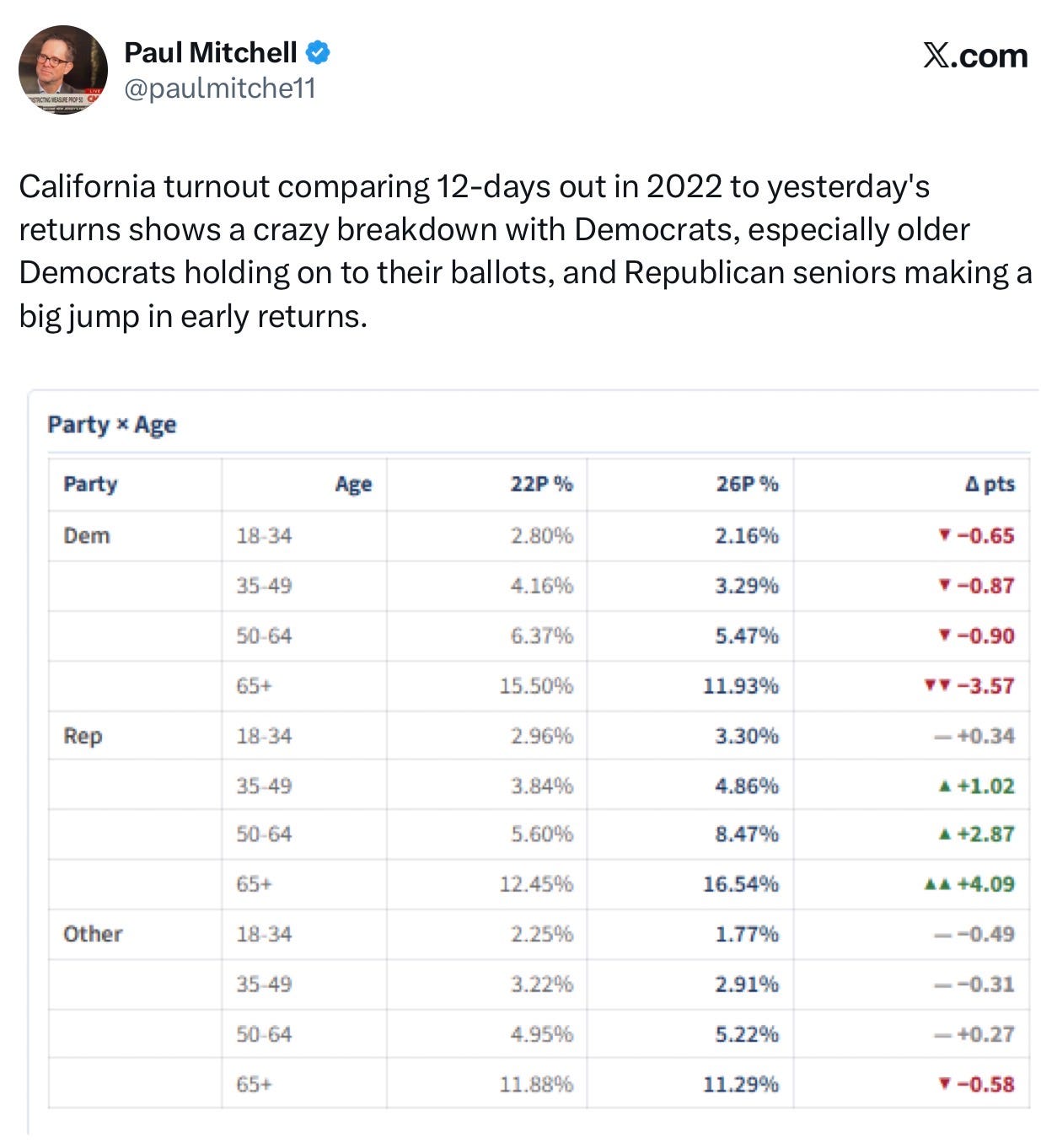
Mitchell’s chart shows how each demographic group compares to the overall returned-ballot universe at the same point in the 2022 cycle.
Under that measure, Democratic voters over 65 fell from 15.5% of returned ballots to 11.93% — roughly a 23% decline in relative share.
Republican voters over 65, meanwhile, rose from 12.45% to 16.54% — roughly a 33% increase in relative share.
That is a remarkably large behavioral shift in early vote patterns.
In other words, older Republicans currently make up a significantly larger share of returned ballots than they did at this stage four years ago, while older Democrats make up a significantly smaller share.
And when viewed internally within each party’s own turnout universe, the behavioral shift may actually be even more dramatic.”
That is not a small fluctuation. And it raises an obvious question: why are older California Democrats waiting to vote?
My Chat With With Paul
After seeing the chart, I spoke with Mitchell on the phone about what may be driving these numbers, and our conversation kept circling back to one central point: many Democratic voters — particularly older, high-propensity voters — may simply still be undecided. That uncertainty appears especially tied to the governor’s race.
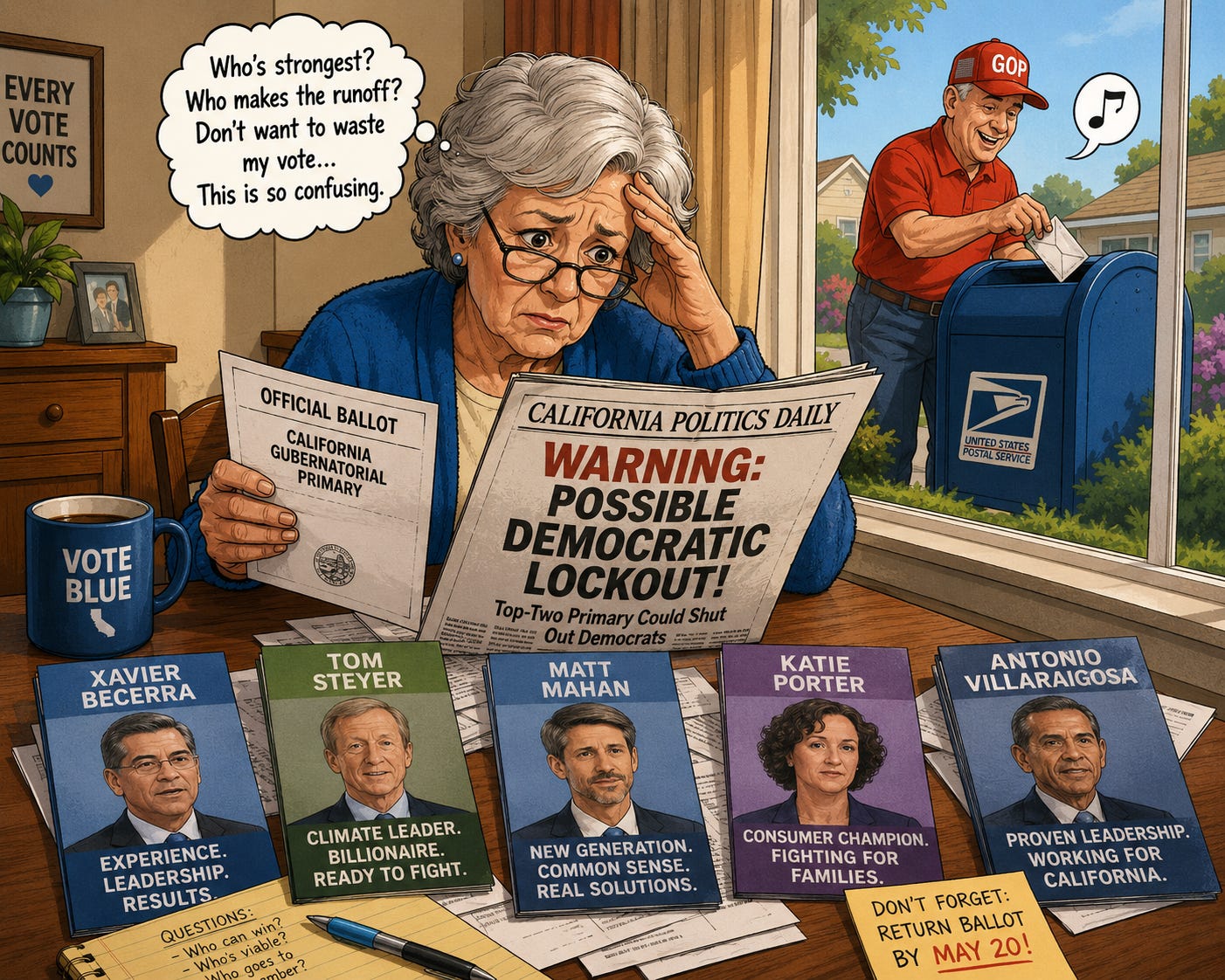
Unlike past California Democratic primaries, where one candidate clearly emerges as the dominant favorite, this race still feels unsettled enough that some Democratic voters may not yet know what to do. Mitchell and I discussed how months of media coverage about a possible “Democratic lockout” scenario in California’s top-two primary system may also be contributing to the hesitation. This theory is strengthened by the fact that these shifts have not been taking place in other states.
For politically engaged Democratic voters — especially older habitual voters — the race may simply feel unsettled.
Who is strongest?
Who can actually make the runoff?
Who gives Democrats the safest path to November?
Should Democratic voters consolidate behind one candidate?
Instead of creating urgency, those questions may be creating delay. And the turnout data appears to support that theory.
Particularly among older Democrats.
(Before you ask me, yes, it’s that Paul Mitchell, the architect of the Prop. 50 extreme gerrymandered lines - as I said, he’s a Democratic data guy.)
Republicans May Be Returning To Their Old Voting Habits
Mitchell and I also discussed another possible explanation — one that has less to do with Democratic hesitation and more to do with changing Republican behavior.
Before Donald Trump reshaped Republican attitudes toward voting, GOP voters were often associated with early absentee voting. Democrats, meanwhile, often relied more heavily on Election Day turnout.
That dynamic changed significantly after years of Trump repeatedly warning Republicans to distrust mail voting, ballot harvesting, the postal system, and election administration generally. Those messages clearly changed Republican voting behavior nationwide.
But now, California Republicans may be gradually reverting back to the way they voted before the Trump era. After several cycles of watching Democrats dominate ballot harvesting and early vote operations, Republicans have spent years rebuilding their own ballot-chasing efforts and encouraging voters to return ballots earlier.
And this may be the first sign that those efforts are starting to pay off.
None of this means Republicans are suddenly on the verge of winning statewide office. But it does suggest voter behavior inside both parties may be shifting again.
And campaigns in both parties are likely paying attention.
So, Does It Matter?
Probably yes — but maybe not in the way some Republicans hope.
The most important caveat here is that many of these hesitant Democratic voters are still high-propensity voters. These are not disengaged occasional voters who may disappear entirely from the electorate. They are much more likely to vote eventually.
The real question may not be whether they vote, but when.
Still, timing matters politically. Early returns shape the media narrative, campaign spending, and campaign strategy. If Republicans continue banking ballots earlier while Democrats delay decisions deeper into the cycle, it changes how California elections look and feel — even if the final outcome ultimately ends up familiar.
There is also a practical campaign implication here. Modern campaigns spend enormous amounts of money and manpower “chasing” ballots — repeatedly contacting voters who have received ballots but have not yet returned them.
To the extent Republicans are increasingly banking ballots earlier again, GOP campaigns can spend fewer resources tracking down those voters later in the cycle. Democrats, meanwhile, may continue spending heavily trying to push these still-hesitant voters to return their ballots right up until Election Day.
That may not ultimately change who wins statewide races in California. But on the margins, it absolutely affects campaign strategy, resource allocation, and cost. Remember that people who vote now tend to reflect, in some measure, the current state of the race. So when they hold onto their votes, it means there's a greater chance that projected outcomes could change, at least a bit.
At a minimum, the numbers suggest something politically unusual is happening inside the Democratic electorate right now.
And in California politics, unusual is usually worth paying attention to.
Video Commentary For Paid Subscribers…
Below the paywall is something extra for our site supporters. A video commentary that supplements this column!
If you haven’t already, please consider an upgrade. This is the way that you help me to produce more content! And you get so much more — every week there is a bunch of content that is only available to our paid subscribers…
