

California’s Bullet Train May Not Even Reach Downtown Bakersfield - You Can’t Make This Up
Gavin Newsom’s high speed rail boondoggle is being downsized again — and the Legislature’s own analysts are calling it out.

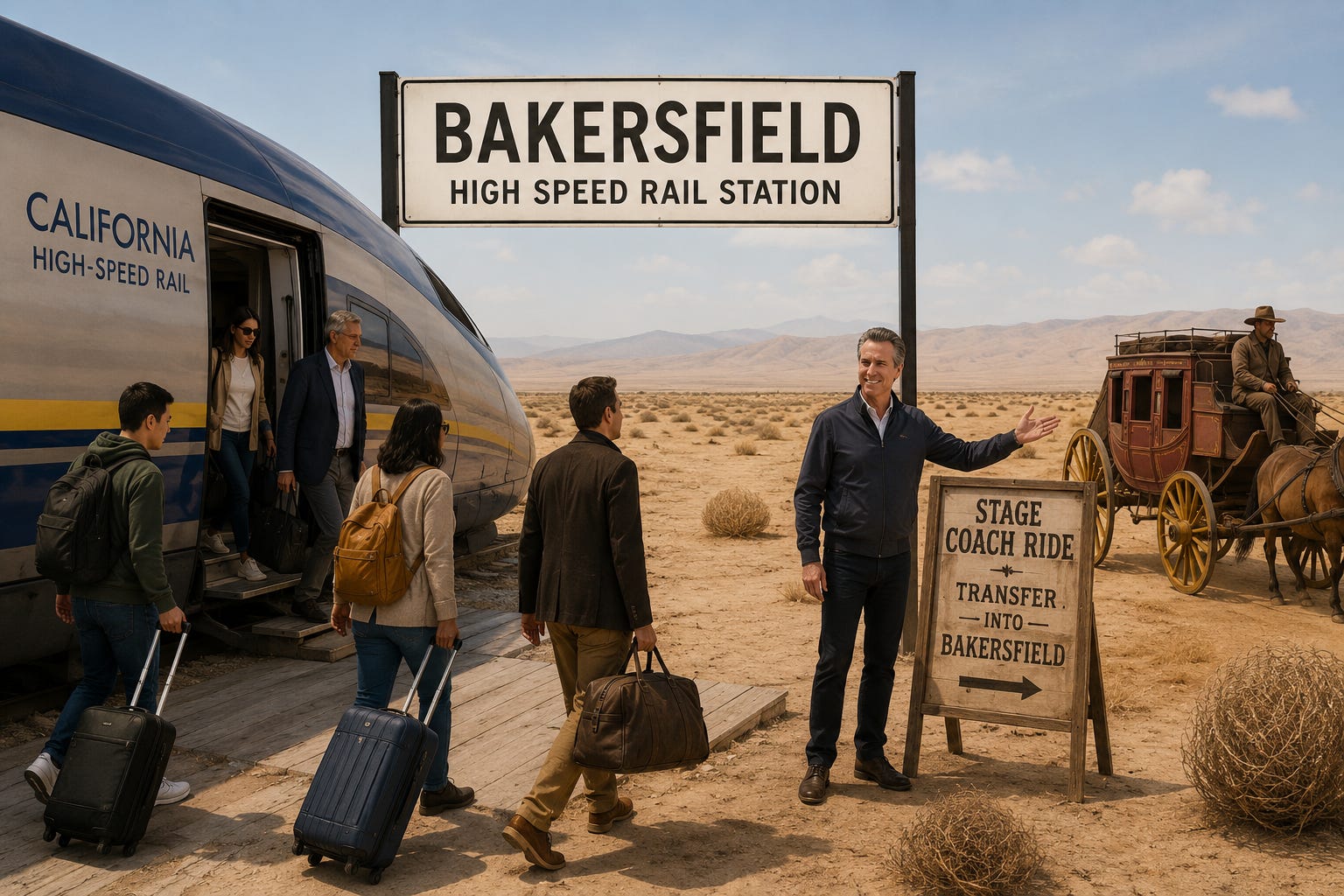
Typically, our afternoon content is either reserved for our paid subscribers or exclusive to those of you who financially support this effort. Today it is the latter, with three additional hard-hitting editorial cartoons located below the paywall. You will not want to miss them!
You can subscribe for FREE to get most of my content delivered to your inbox. A PAID subscription is $7 a month or $70 a year, and it gets you access to ALL of my stuff (about 35% more). Why subscribe? Because now more than ever, you need someone calling balls and strikes, and who isn’t owned by interest groups.
You can listen to this post on our podcast feed, So, Does It Matter? SPOKEN. It’s available on your favorite podcasting app, or you can find it here.
⏰ 5 min read
The Shrinking Train To Nowhere
California’s infamous “train to nowhere” has somehow become even more ridiculous.
According to a new report from the Legislative Analyst’s Office reviewing the California High-Speed Rail Authority’s Draft 2026 Business Plan, Gavin Newsom’s bullet train project may not even reach downtown Merced or downtown Bakersfield. The report says the northern end would stop roughly 3.5 miles south of downtown Merced, while the southern end would land about six miles north of the previously planned Bakersfield station.
That is not a punchline. That is the plan.
And remember, this is already the scaled-down version.
California voters were promised a sleek bullet train connecting San Francisco to Los Angeles and Anaheim. Then came the delays, lawsuits, cost overruns, and quiet political retreat. Eventually, the statewide vision shrank into a much smaller Central Valley line between Merced and Bakersfield.
Now, even that reduced version is being trimmed back.
At this point, the only thing moving quickly in California’s high-speed rail project is the ambition — in reverse.
Single Tracks, Smaller Stations, Bigger Excuses
The station problem is only the beginning.
The Legislative Analyst’s Office report says 144 of the planned 162 miles could now operate on a single track. In real-world terms, trains traveling in opposite directions may have to wait for one another at sidings rather than running continuously on dual tracks.
California’s “world-class” bullet train is starting to sound like a one-lane country road with better branding.
The report also notes that the stations themselves are being simplified into “at-grade stations with single-side platforms” — bureaucratic language for another downgrade.
Why? Because the costs have gotten so absurd that Sacramento is now trying to cheapen the project enough to keep pretending it is still viable.
When voters approved Proposition 1A in 2008, Californians were told they would get a statewide bullet train system for roughly $33 billion.
Today, the High-Speed Rail Authority’s own estimates acknowledge the original statewide vision could cost roughly $231 billion under legacy projections. Even the authority’s reduced and “optimized” version of the system still exceeds $126 billion.
Meanwhile, the much smaller Merced-to-Bakersfield segment alone is now projected to cost roughly $35 billion.
So California is preparing to spend about what voters were told the entire system would cost just to complete a shortened 162-mile segment between stations outside downtown Merced and Bakersfield.
That is not a cost overrun. That is a civic humiliation.
Now, The Project May Not Even Follow State Law
The newest problem with high-speed rail is not just that it is late, expensive, and shrinking. It is possible that the latest version may not even comply with California law.
State Inspector General Benjamin Belnap recently warned that the rail authority’s proposed changes may conflict with statutory requirements established by SB 198 and AB 377. Those laws required dual-track service and connections to downtown stations for the Merced-to-Bakersfield segment.
The Legislative Analyst’s Office also criticized the authority for obscuring major project reductions by describing them vaguely as “optimization measures.”
That matters. California officials are no longer merely defending a wildly over-budget project. They are trying to shrink the project in ways that may violate the laws passed to sustain it.
Even more revealing, the Legislative Analyst’s Office report notes that the rail authority’s current financial assumptions depend on future legislative changes to help with financing, permitting, environmental streamlining, and litigation management.
In other words, the authority’s own plan already assumes Sacramento may need to rewrite laws to keep the project alive.
So, Does It Matter?
At some point, California’s bullet train stopped being a transportation project and became a case study in how this state governs.
The promise was grand: modern infrastructure, environmental progress, technological prestige, and a gleaming rail system that would show the country how the future was supposed to work.
The reality is a lot uglier: shortened routes, downgraded stations, single-track compromises, exploding costs, endless delays, and now legal questions over whether the project still fits the rules written for it.
And through it all, Gavin Newsom has chosen to own the project.
First, the statewide route shrank into a Central Valley segment. Then the stations moved outside the cities they were supposed to serve. Then came the single-track compromises. Now Sacramento may need to change the law to bless the retreat.
And, of course, that is exactly what they will do.
These are the same political class who just advanced legislation to shield some high-speed rail oversight records from public scrutiny. When the law gets in the way of the train, Sacramento’s answer is to move the law.
California’s bullet train was once sold as the future. Increasingly, it looks like a monument to political denial.
I will end this column by saying that I caught up with State Senator Tony Strickland (R-Huntington Beach), who had this to say…
“Sometimes leadership is not about doubling down on a bad investment. Sometimes it is about recognizing reality, cutting losses, and moving on. At some point, responsible leadership means admitting when a project has failed. As vice chair of the Senate Transportation Committee, I have been calling for the Legislature to make the difficult decision to pull the plug on this rail fail.”
Must be tough for Strickland in the big-spending State Capitol. What is that saying? “Nobody likes the guy in the bar that doesn’t drink.”
More Reading On This Site


There More Great Political Cartoons On This Mess
Right below the paywall. If you are not yet a paid subscriber, I would like to encourage you to sign up. Times are changing, and if you value the kind of work I do, please consider supporting it, or you will one day be unable to find it. Plus, it’s a great value as we constantly have content reserved just for our premium subscribers. At $70/year or $7/month, it won’t break the bank, either!
Keep reading with a 7-day free trial
Subscribe to So, Does It Matter? On CA Politics! to keep reading this post and get 7 days of free access to the full post archives.