


Our afternoon columns typically have content for our paid subscribers. But it’s Spring Break for the kids, so all subscribers benefit, as I am skipping the creation of exclusive content on this to get back to the family!
You can listen to this post on our podcast feed, So, Does It Matter? SPOKEN. It’s available on your favorite podcasting app, or you can find it here.
⏱️ 5-minute read
The Story California Media Avoided
Seventeen years ago, California voters approved a $33 billion high-speed rail system connecting Los Angeles and San Francisco in under three hours. Today, there is no completed system. Instead, the California High-Speed Rail Authority now estimates that the full San Francisco-to-Los Angeles Phase 1 system will cost roughly $126 billion, nearly four times the $33 billion presented to voters in 2008. The project is now centered on an initial Central Valley operating segment between Merced and Bakersfield.
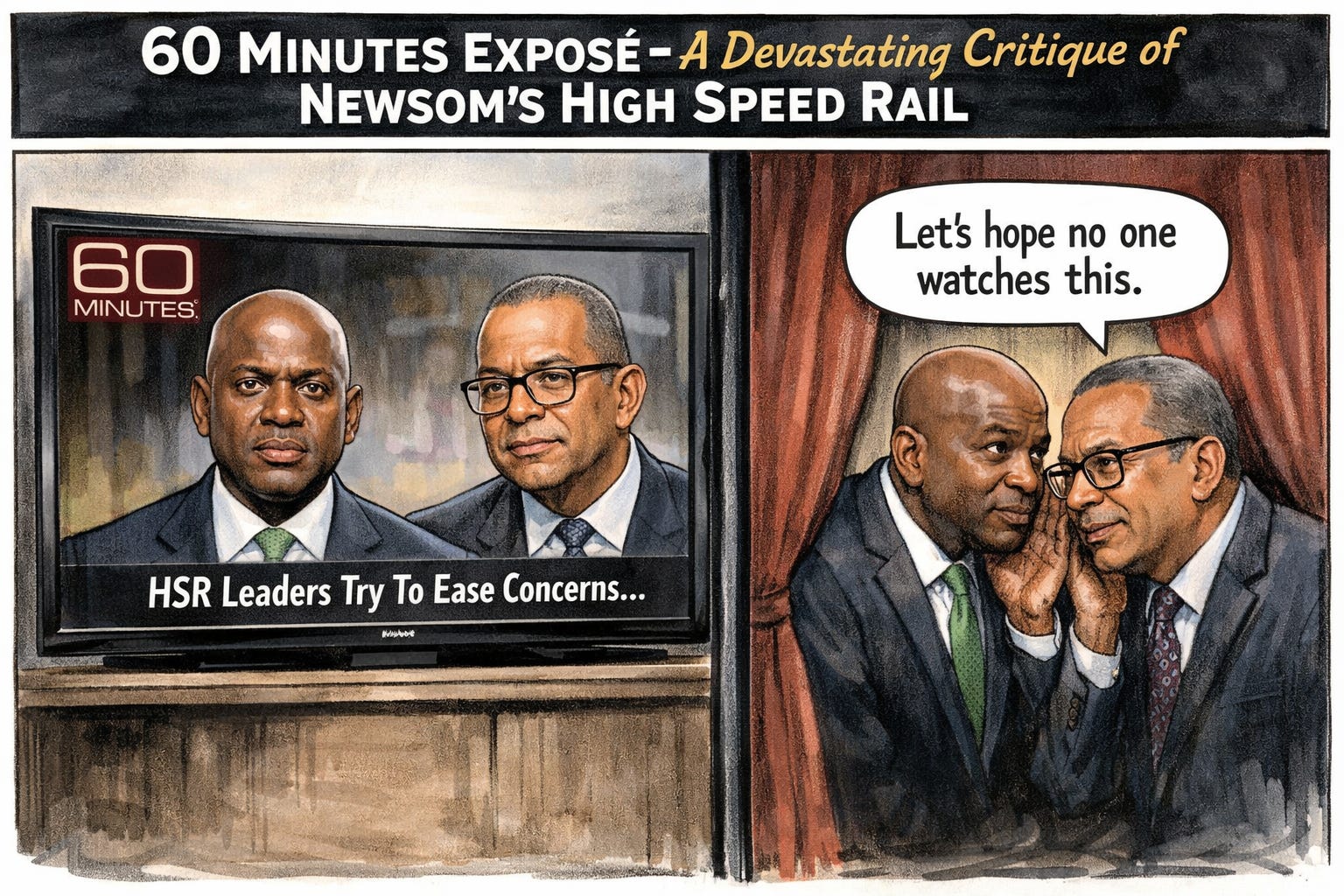
That is the reality. This weekend, 60 Minutes laid it out for a national audience, not through partisan framing, but through one of the most widely trusted news programs in the country. What emerged was not just a troubled infrastructure project, but a clear demonstration of what happens when political ambition outruns execution.
The Promise vs. The Reality
The most effective part of the segment was also the simplest. It showed what voters were promised and what has actually happened. In 2008, voters approved a statewide system with a projected cost of roughly $33 billion and a target completion date of 2020. Seventeen years later, that system no longer exists. There are no tracks, there are no trains.
The current plan focuses on an initial Central Valley segment, with officials now pointing to a possible 2033 timeline for partial service, which still depends on securing additional funding that has not yet been identified. The cost has more than tripled. That gap between promise and outcome is not incidental. It is the defining fact of the project.
When the Project’s Own Defenders Say It
What makes the 60 Minutes segment especially damaging is that it does not rely primarily on outside critics. It includes admissions from those involved in the project itself. California Transportation Secretary Toks Omishakin acknowledged that “mistakes were made” and that criticism of the project is “very fair,” while California High-Speed Rail Authority board member Anthony Williams acknowledged that the project moved forward without fully secured funding.
Rep. Vince Fong described the original plan as “very theoretical,” reflecting how little of the operational and financial detail had been resolved at the outset. These are not partisan attacks. They are acknowledgments from individuals directly connected to the project or its oversight.
How It Went Off the Rails
The segment identifies several structural challenges. California’s environmental review process has led to years of litigation and delays; land acquisition requires negotiating with thousands of parcels; and construction costs in the United States remain significantly higher than in peer countries. Those factors are real, but they do not fully explain what happened.
The deeper issue is that the project was approved before the critical elements were in place. The route was not finalized, the funding was not secured, the timeline was overly optimistic, and the risks were not clearly communicated to voters. The political decision came first. Execution followed. As those gaps became clear, the project began to contract.
What voters approved was a statewide high-speed rail system. What is currently being built is an initial segment in the Central Valley. Even supporters acknowledge that extending the line to San Francisco and Los Angeles will require tens of billions of dollars in additional funding that has yet to be identified. This is not a minor adjustment. It is a fundamental shift.
The Political Reality
No California politician is more politically tied to the project’s continued survival than Governor Gavin Newsom. Under his watch, the state narrowed its focus to the Central Valley segment and continued to back the project with budget support, even as costs rose and timelines slipped. He has repeatedly supported funding for high-speed rail in state budgets, keeping the project moving forward despite its unresolved challenges.
That context matters beyond California. 60 Minutes is not a local program. It reaches a national audience, including the political and donor networks that shape presidential campaigns. When a project of this scale is presented in such stark terms, with missed deadlines, ballooning costs, and acknowledged planning failures, it invites questions that are difficult to dismiss, not just about the project itself, but about the leadership behind it.
So, Does It Matter?
This project is not just about rail. It reflects how major decisions are made in California. A statewide infrastructure system was approved based on projections that proved unreliable. Costs have escalated dramatically. Timelines have slipped by more than a decade. The scope has narrowed significantly.
And yet, the project continues, not because it has met expectations, but because reversing course would require acknowledging how far the outcome has diverged from the original promise. That has broader implications. It affects how voters evaluate future infrastructure proposals, shapes trust in government projections, and raises questions about whether large-scale public projects in California can be executed as described.
The 60 Minutes segment did not introduce new facts. It assembled them in a way that is difficult to ignore. And once those facts are viewed together, the conclusion is hard to avoid:
What voters approved in 2008 is not what is being delivered today.
The 60 Minutes Segment
If you’ve invested the time to read about this segment, it’s time to watch it… It’s about 13 minutes of “must-see” TV….