

California Public Schools: Spending More, Serving Fewer, Achieving Less
California’s education system is shrinking—and still failing to deliver better results.

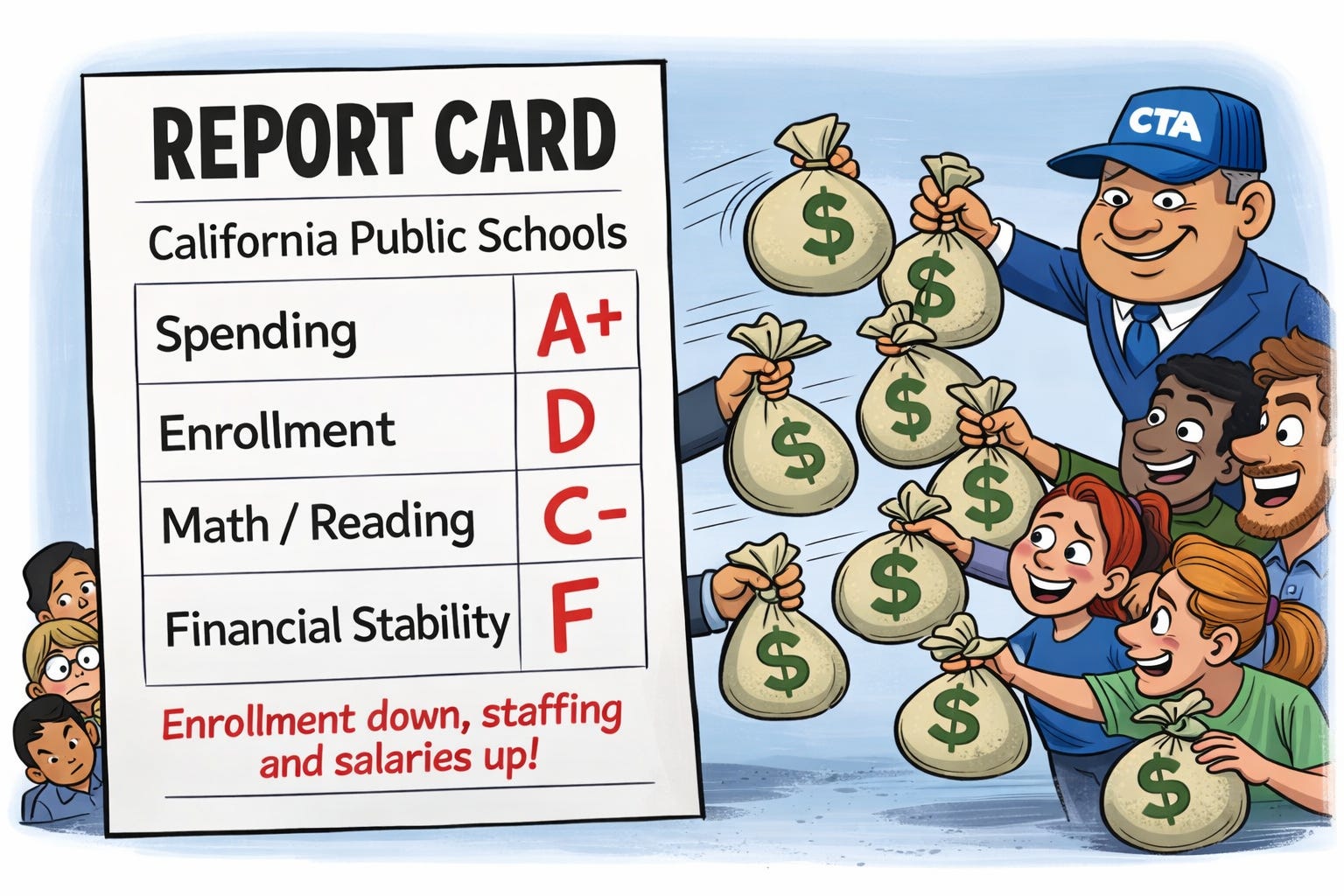
Our afternoon columns typically have content for our paid subscribers. Either this column has a preview for all subscribers, but the bulk is below the paywall - OR - like today, there is exclusive content below the paywall to thank our paid subscribers. I have a hard-hitting video commentary that you will not want to miss! Paid subscribers just scroll down. If you're a free subscriber, you get a one-time free pass - use it. Or a one-week free trial, try that! Or jump in and upgrade, and support this project!
You can listen to this post on our podcast feed, So, Does It Matter? SPOKEN. It’s available on your favorite podcasting app, or you can find it here.
⏱️ 7 min read
Fewer Students, Less Money — The Reality No One Can Avoid
California’s public school system is getting smaller. This isn’t a projection or a short-term fluctuation—it’s a trend that has been building for years and shows no real sign of reversing.
A decade ago, California educated roughly 6.2 million K–12 students. Today, that number is closer to 5.8 million, a loss of more than 400,000 students. Year after year, the numbers continue to edge downward. The reasons are straightforward: fewer children are being born, families are leaving high-cost regions, and many students who left the system during the pandemic have never returned.
Because California funds its schools largely based on student attendance, fewer students mean less revenue. That’s not controversial—it’s just how the system works. What’s harder to explain is why that reality isn’t shaping decisions in many districts.
The Financial Squeeze Is Already Here
School districts across California are already feeling the pressure. Declining enrollment, combined with the expiration of federal COVID-era funding, has created a structural budget problem that can’t be solved with temporary fixes.
What makes this more difficult to square is the level of spending. California now invests roughly $125 billion a year in K–12 education—about $20,000 per student—yet districts are still running deficits, cutting programs, and warning of long-term instability. The issue isn’t simply how much is being spent. It’s whether the system still fits the conditions it’s operating under.
Nowhere is that clearer than in Los Angeles. Los Angeles Unified once enrolled roughly 750,000 students in the early 2000s. Today, that number is closer to 390,000—a drop of more than 40 percent since 2004. This didn’t happen overnight, and it didn’t start with COVID. It’s been unfolding for two decades, steadily reshaping the district’s financial base.
The consequences are already visible. The district is facing a budget deficit approaching $200 million, with projections pointing to even larger shortfalls if trends continue. Schools are preparing for cuts of up to 15 percent, even as the district continues to spend more annually than it takes in. San Francisco Unified offers a similar picture, operating with a roughly $1.3 billion budget while facing a deficit of about $100 million after already cutting more than $100 million in spending and eliminating around 500 positions.
A funding model built on growth doesn’t hold together when the population it depends on is shrinking.
These are not isolated examples. They point to a broader pattern.
At the Same Time, Costs Are Going Up
Given those conditions, the expected response would be straightforward: tighten budgets, consolidate where necessary, reduce staffing, and align long-term costs with reality.
That isn’t what’s happening.
In San Francisco, even with a nine-figure deficit and recent staffing cuts, the district agreed to a labor contract adding more than $180 million in new long-term costs through raises and expanded benefits. A system already under strain is taking on additional obligations that will not be easy to unwind.
This dynamic is playing out elsewhere. Districts facing declining enrollment are still agreeing to compensation increases that lock in higher long-term costs even as their revenue base shrinks. Because labor makes up the bulk of district spending, those decisions carry long-lasting consequences.
You don’t need a complicated model to see where that leads.
A Coordinated Strategy, Not Coincidence
At the same time, the broader context matters. Recent reporting shows that teacher labor actions across California are not simply a series of isolated local disputes. Contract timelines have been aligned across multiple districts, so negotiations occur simultaneously, increasing leverage and drawing public attention.
That doesn’t mean every decision is dictated from the top, but it does mean districts are negotiating under coordinated pressure rather than in isolation. The environment surrounding these agreements is anything but neutral.
Why Do School Boards Keep Saying Yes?
If the financial pressures are clear, the obvious question follows: why do school boards keep approving agreements that make those pressures worse?
Politics is a large part of the answer. Public employee unions, particularly the California Teachers Association, play a significant role in school board elections through endorsements, funding, and organized support. In many cases, the officials approving contracts were elected with that backing.
Even where the connection is less direct, the pressure remains. School board members know that opposing organized labor can bring well-funded opposition and sustained public campaigns. Under those conditions, approving the agreement often becomes the easier path, even if it creates larger problems down the road.
Deferring the problem doesn’t solve it—it just raises the stakes later.
More Money, Worse Results — The Outcome Problem
If higher spending were producing better results, there would at least be a case that the system is delivering, even if inefficiently. But the results don’t support that argument.
California spends roughly $20,000 per student, yet performance has not meaningfully improved. In key areas, it has declined. On national assessments, California students continue to score below the national average in both math and reading.
What makes this more striking is the comparison with states that historically lagged far behind California. Mississippi and Louisiana have made measurable gains in recent years, particularly in early reading. In demographically adjusted analyses of the Nation’s Report Card, Mississippi now ranks at or near the top nationally in both reading and math—outperforming states with far greater resources.
That is a fundamental reversal of expectations.
California has more resources, spends more per student, and yet claims that once-trailing states now match or exceed its outcomes. The idea that funding alone will drive improvement doesn’t hold up under that comparison.
A System Built for Growth, Operating in Decline
California’s public school system was built during decades when enrollment was expanding, and revenues were rising alongside it. That model made sense in a growing state.
It no longer fits.
Enrollment is declining, revenue growth is constrained, and yet many decisions still assume a return to expansion. California may be the most visible example, but the same pattern is beginning to appear elsewhere: fewer students, rising costs, and reluctance to adjust.
The consequences are already taking shape. Schools are closing, staff reductions are becoming more common, and programs are being cut. In San Diego County, districts have begun consolidating campuses. In Los Angeles and San Francisco, significant reductions are underway.
The trajectory is clear, even if the endpoint isn’t yet.
So, Does It Matter?
This isn’t just about education—it’s about governance.
California’s school system is serving fewer students with fewer resources coming in, yet continues to take on larger long-term commitments. Those trends are structural, not temporary.
At some point, the numbers assert themselves. The longer decisions are delayed, the harder the adjustment becomes.
The state’s public school system is shrinking. The question is whether those responsible for it are willing to operate as if that’s true—or continue acting as though it isn’t.
The victims of this tragedy, of course, are the children. Nothing is more important for a child than a strong education — and it seems like none of the actors in this tragedy are focused on their best interests, only their own.
More reading, from previous columns and a previous podcast:


