

California Democratic Party Wants Candidates To Quit The Governor’s Race — After They've Raised Millions They Have Yet To Spend
The California Democratic Party Chairman Rusty Hicks' pricey new polling effort to “winnow” the field ignores how campaigns actually work

Our morning content is open to all of our subscribers and guests. I have a hard-hitting video commentary on the topic of this column, beneath the paywall for our paid subscribers. You can listen to our written content at "So, Does It Matter? Spoken.” Podcast, on your favorite podcasting app. Or go here.
⏱️ 5 min read
A Rare Gift From The California Democratic Party
As a conservative observer of California politics, it is always something of a treat when the California Democratic Party hands you an example of political lameness so obvious it practically writes the column for you.
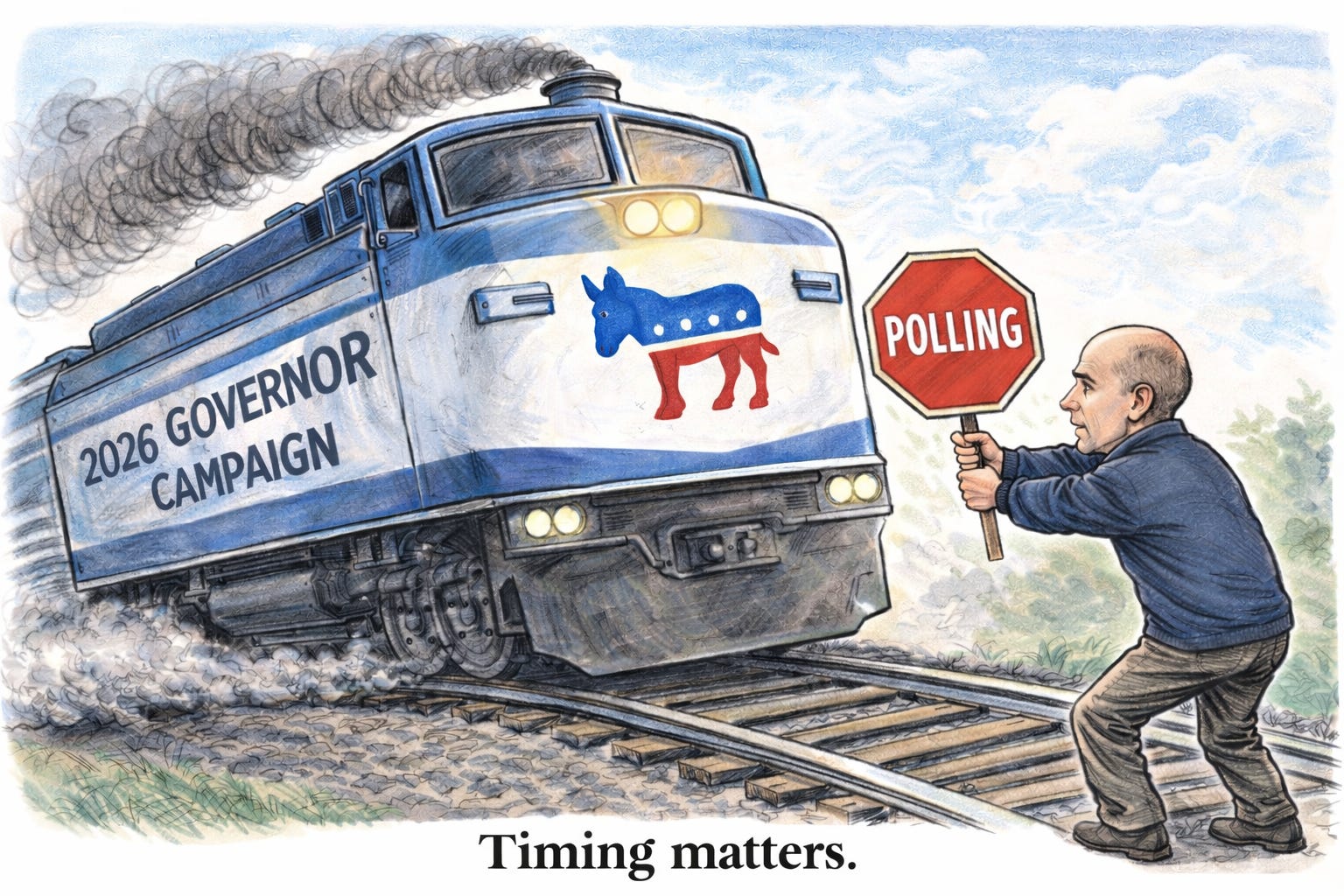
That gift arrived on Tuesday. In a Los Angeles Times story by Seema Mehta and Nicole Nixon, we learned that the California Democratic Party plans to spend hundreds of thousands of dollars on polling designed to evaluate the “viability” of the eight Democrats running to replace term-limited Governor and ersatz President Gavin Newsom.
The idea is straightforward: once the polling results are released, candidates who appear to lack a clear path to victory might reconsider their campaigns and quietly step aside.
On paper, it sounds like a tidy exercise in party management. In reality, it ignores how campaigns actually function.
Campaigns Don’t Spend A Year Just To Quit
Every one of these candidates — with the exception of billionaire Tom Steyer, who can self-fund — has spent months, and in some cases more than a year, building a campaign infrastructure for governor. That means raising money, hiring staff, building digital operations, traveling the state, meeting donors, and courting endorsements.
Campaigns do not invest that level of time and effort simply to quit because a party-sponsored poll suggests they are not currently leading. Right now, most of these candidates are sitting on the resources they have raised and waiting for the moment when voters actually begin paying attention to the race.
Anyone who has been involved in statewide campaigns understands why. If you start communicating with voters too early, you are essentially shouting into the void. Voters simply are not focused on the race yet. The period when campaigns truly engage voters — through paid media, debates, and direct outreach — typically begins much closer to the June election.
In other words, the candidates Rusty Hicks is now encouraging to reconsider their campaigns are precisely at the point where they are preparing to begin making their case to voters.
There is also a practical reality the party leadership appears to be overlooking: these candidates have already raised millions of dollars from donors who expect them to compete. Campaigns do not typically shut down because party officials release a discouraging poll. Once donors have invested in a candidate’s effort, the campaign has a clear obligation to actually run the race.
Polling Won’t Solve The Party’s Problem
The anxiety driving this effort is real. California Democrats are worried about vote-splitting under the state’s top-two system. If enough Democrats divide the vote among themselves, it is theoretically possible that two Republicans — Steve Hilton and Riverside County Sheriff Chad Bianco — could advance to the November runoff.
But polling commissioned by the party will not solve that structural concern. At best, it produces a snapshot of a race months before voters begin paying attention. Early polling in crowded fields is notoriously unstable. Candidates who barely register today can surge once campaigns begin communicating with voters.
Several candidates have already dismissed the effort as misguided, in talking to the Times. Former state controller Betty Yee called it a “very costly poll clearly aimed at narrowing the field.” Tony Thurmond described it as another attempt by party leadership to put its thumb on the scale. Even Antonio Villaraigosa’s campaign questioned why the party would spend money on polling rather than focus on voter turnout.
The Real Strategy Isn’t Polling
The deeper flaw in Rusty Hicks’ plan is that it assumes the Democratic Party itself must manage the field, which I wrote about here, but here is the short version:
The reality is that California politics already has institutions that perform that function — and they are far more powerful than the state party.
Public-employee unions.
If the organizations that dominate California Democratic politics begin to believe there is a genuine risk that Democrats could be shut out of the November runoff, they will not rely on polling to solve the problem. They will intervene directly in the race.
There is precedent for this kind of strategic intervention. In the 2024 U.S. Senate race, Adam Schiff’s campaign spent millions on advertising that elevated Republican Steve Garvey during the primary campaign. The goal was simple: consolidate Republican voters behind Garvey so that the runoff would be Democrat versus Republican rather than an expensive Democrat-on-Democrat fight.
The strategy worked, and the same logic would apply in the governor’s race if Democratic institutions conclude the risk of an all-Republican November is real.
If Riverside County Sheriff Chad Bianco and former Fox News host Steve Hilton remain positioned to possibly grab the two top spots, organized labor will not sit back and hope Democratic vote-splitting resolves itself. They will shape the outcome.
Neither Hilton nor Bianco would be remotely acceptable to organized labor in office. Both would threaten the political and financial ecosystem that dominates Sacramento, where public-employee unions finance Democratic campaigns and then sit across the bargaining table from the very politicians they helped elect.
So, Does It Matter?
Political parties often wish they had more control over crowded elections than they actually do. Rusty Hicks’ polling project is essentially an attempt to impose order on a process that rarely behaves the way party leadership hopes it will.
Campaigns built over months of fundraising, staffing, and political commitments do not suddenly collapse because party officials release a poll. If Democratic institutions conclude there is real danger in the current field configuration, the response will not come from survey results or polite suggestions that candidates reconsider their ambitions. It will come from the same place it always does in California politics: money, messaging, and the institutional muscle of organized labor shaping the field.
This entire episode is also a reminder of something critics warned about when California voters adopted the “top two” election system. The reform was sold as a way to produce moderation and expand voter choice. In practice, it has done the opposite — concentrating power among political institutions and leaving voters with fewer meaningful choices by the time the November ballot arrives.
If nothing else comes of this clown-car of a gubernatorial election, perhaps it will rekindle interest in reconsidering a system that promised more options for voters but too often narrows them.
Jon’s Video Hot Take…
If you are a paid subscriber, you can watch me “go off” on California Democratic Party Chairman Rusty Hicks below… If you haven’t upgraded your subscription yet, now’s a great time. You will unlock so much great additional content over this election season!
