


All of the free written content on this Substack, including this column below, can be listened to on our Podcast Feed: So, Does It Matter: SPOKEN. Listen here (and you can sign up for it in your favorite podcasting app as well. Deets are here.)
Today I have this column running in the Southern California New Group newspapers - an impressive list: The Daily Breeze, The Inland Valley Daily Bulletin, The Press-Telegram, The Los Angeles Daily News, The Orange County Register, The Pasadena Star-News, The Redlands Daily Facts, The Press-Enterprise, The San Bernardino Sun, The San Gabriel Valley Tribune, the Whittier Daily News… and The San Diego Union Tribune!
You can find the column on any of these sites, but here’s the link to it in my local paper, the Orange County Register. But since I wrote it, I am taking some personal privilege to reprint it on my own Substack…
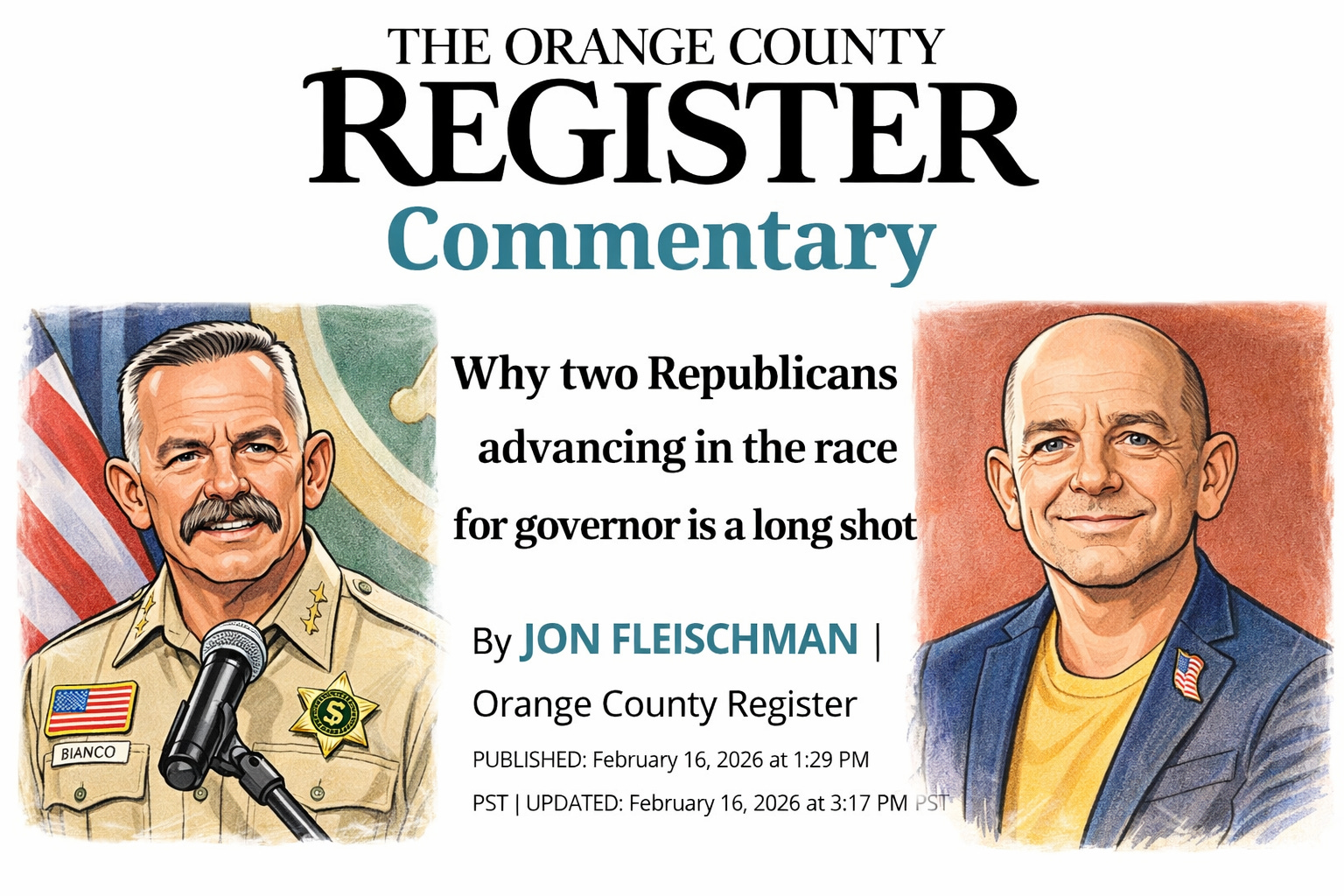
Why Two Republicans Advancing In The Race For Governor Is A Long Shot
By Jon Fleischman
Each election cycle in California, Republicans raise the same argument: Democrats will split their votes so much in the primary that two Republicans end up in the top spots, leading to a Republican-only general election for governor. Since Democrats usually win big here, this theory is tempting. It depicts a November ballot on which Republicans are assured of victory.
The flaw is not arithmetic. It is power.
California elections are shaped by money, organization, and disciplined political institutions that protect their governing coalition. No institution in California politics possesses more deployable capital or strategic coherence than public employee unions.
Public employee unions routinely spend well into nine figures per cycle. Even in 2024, without a governor’s race on the ballot, independent-expenditure committees funded by labor and business interests poured nearly $100 million into legislative contests, including more than $42 million in the final month alone. That level of spending is routine.
Each election cycle in California, Republicans raise the same argument: Democrats will split their votes so much in the primary that two Republicans end up in the top spots, leading to a Republican-only general election for governor. Since Democrats usually win big here, this theory is tempting. It depicts a November ballot on which Republicans are assured of victory.
The flaw is not arithmetic. It is power.
California elections are shaped by money, organization, and disciplined political institutions that protect their governing coalition. No institution in California politics possesses more deployable capital or strategic coherence than public employee unions.
Public employee unions routinely spend well into nine figures per cycle. Even in 2024, without a governor’s race on the ballot, independent-expenditure committees funded by labor and business interests poured nearly $100 million into legislative contests, including more than $42 million in the final month alone. That level of spending is routine.
This is not a scandal. It is how California’s top-two system operates when sophisticated actors are involved.
Shaping the opponent field is not hypothetical. In the 2024 U.S. Senate race, then-Congressman Adam Schiff and allied committees spent millions on advertising that elevated Republican former baseball player Steve Garvey while boxing out Representative Katie Porter — a successful effort to shape the runoff.
In that race, the Democratic frontrunner controlled the board directly.
This cycle presents a different configuration. Aside from billionaire Tom Steyer, no Democrat has established overwhelming financial dominance. That does not eliminate the system’s capacity to intervene. It shifts greater influence on outside organizations — among them, public employee unions, which remain the most consistently well-heeled. The California Policy Center estimates that these public employee unions raise approximately $1 billion annually and spend it in various ways to dominate California’s political and policymaking processes.
Labor is not the only strategic actor intent on preventing an all-GOP November showdown. San Jose Mayor Matt Mahan entered the race with substantial Silicon Valley backing, disclosing roughly $7 million in early direct fundraising support. And millions more were contributed to an independent pro-Mahan committee.
If two Republicans appear positioned to advance, unions and allied committees will not remain passive. They will consolidate behind a Democrat and, in “support” of a Republican, spend what is necessary to secure both in the top two positions. Their objective is risk containment.
The “two Republicans advance” theory depends not just on Democratic vote-splitting but also on inaction by institutions whose influence depends on preventing precisely that outcome.
Such inaction is improbable.
Of course, this begs the question: If outside forces decide to elevate a Republican to shape the general election, which Republican would they select?
According to RealClearPolitics polling averages this month, Republican Riverside County Sheriff Chad Bianco is polling at roughly 15% and Republican former Fox News host Steve Hilton at roughly 13% — placing them among the top overall vote-getters in the field. With the June primary approaching, outside interests can wait until late spring to see whether one candidate separates. If consolidation occurs organically, intervention may be minimal. If not, they will spend heavily to do it. The objective is straightforward: ensure a solitary Republican advance – whichever one will cost them the least to effectuate that outcome.
It’s hard to escape the irony that Hilton and Bianco, in a way, are auditioning to see which of them will earn union “support” for the June election.
Republicans should compete vigorously. They should organize, raise funds, and build support wherever they can. The one sure-fire way to ensure, with 100% certainty, that a Republican cannot be Governor of California, is if there is no Republican on the ballot.
The probability that two Republicans advance is nonzero. But in California politics, institutions rarely leave outcomes to chance. Consider how often a coin lands on its edge.
Below the Paywall Are Some Video Clips and Counterpoint
For our paid subscribers, I have curated three interesting videos on this topic of whether two Republicans can take the top two position going into the November election for Governor. And also one pretty articulate case in disagreement with my take above.
Not a paid subscriber? If you think that a voice like mine should be out here, making a difference, then consider stepping up. It’s a great value that unlocks about 35% of our content that is behind paywalls!
