

Why San Jose Mayor Matt Mahan Is Stuck in the Low Single Digits
For this gubernatorial candidate, trying to appeal to both moderates and progressives at once has left his campaign without a clear lane.

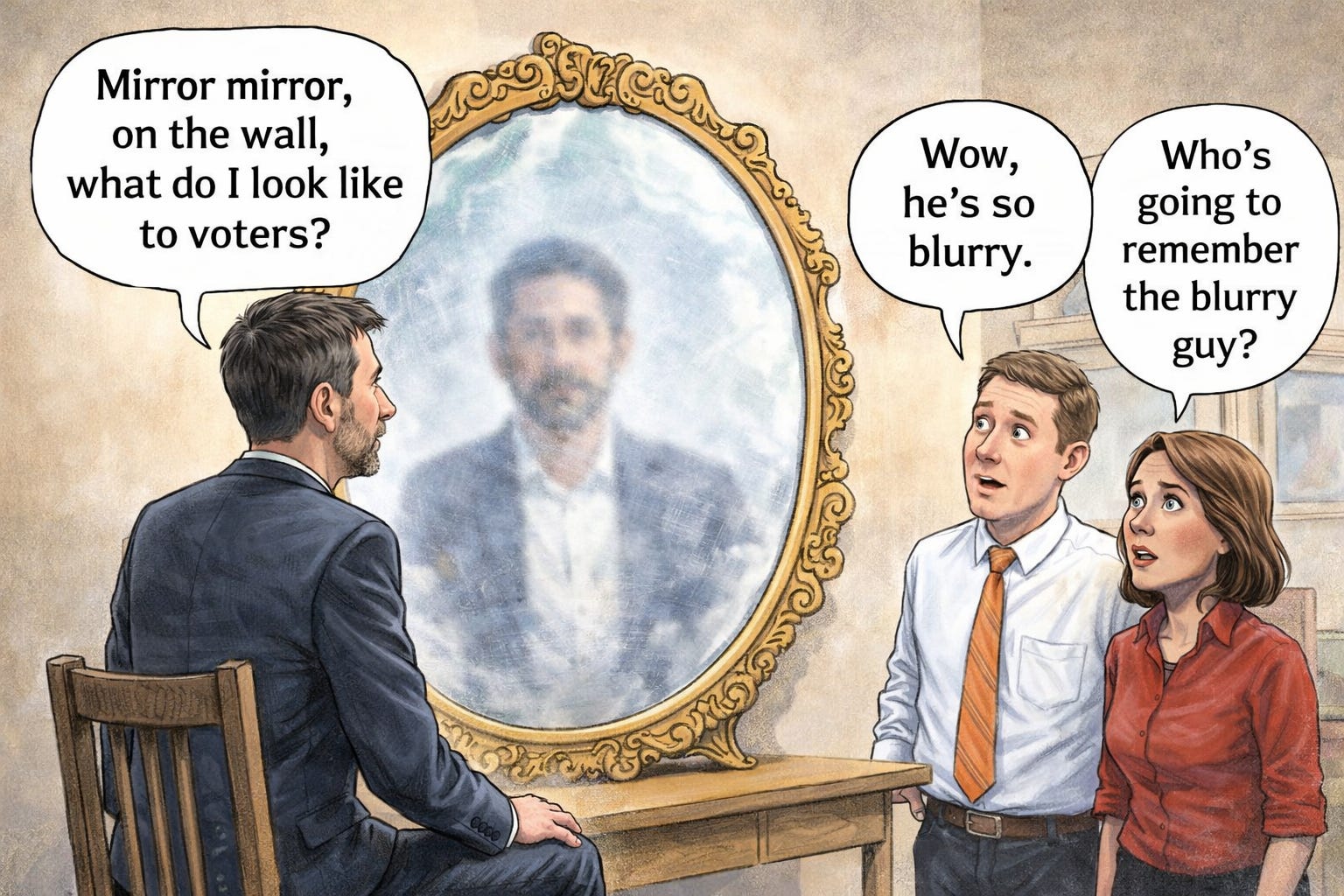
Our morning content is free for all subscribers and guests! You can also listen to this post — along with my California Post column — on our podcast feed, So, Does It Matter? SPOKEN. It’s available on your favorite podcasting app, or you can find it here.
⏱️ 5 min read
The “Sensible” Pitch That Is Not Catching Fire
San Jose Mayor Matt Mahan should, at least on paper, be the kind of candidate who can catch fire in a crowded Democratic field. He is running as a practical Democrat focused on competence, accountability, and getting government to actually deliver results. In a state where voters routinely say things are not working, that ought to be a compelling pitch.
And yet, he remains stuck in the low single digits.
While better-known Democrats are clustered in the low double digits, Mahan has been hovering around three or four percent. That points to something more than a polling issue. It points to a problem with the definition.
California is a blue state, driven by a significant Democratic registration advantage. There are millions of conservative voters, but they are outnumbered by Democrats and Democratic-leaning independents. The result is an electorate that leans liberal overall, even as many voters hold more mixed views on how policy should be implemented.
Surveys from PPIC and other statewide pollsters consistently show support for progressive goals such as addressing climate change and protecting immigrants. At the same time, those same voters express frustration with the cost of living, homelessness, and a sense that government is not delivering. That creates what looks like a natural opening: a Democrat who supports the goals but promises to execute them better.
The Voters Who Agree but Do Not Show Up
The problem is that this group does not behave like a political movement.
They show up in issue polling, when asked directly about policy, but not in candidate support or turnout. These voters tend to be less ideological, less engaged, and less likely to participate in a June election that functions as a de facto primary.
Recent statewide surveys also show unusually large shares of undecided voters in early ballot tests. That reinforces how disengaged much of the electorate remains at this stage.
These voters do not organize or rally around candidates. In a fragmented field, they scatter rather than consolidate. And with so many undecided and disengaged voters in this race, even those inclined toward Mahan’s message may not be paying enough attention to ever hear it.
So even if many voters think the way Mahan does, that does not automatically translate into votes.
Trying to Stand in Two Lanes at Once
The larger issue is that Mahan has not given voters a clear sense of who he is.
His campaign relies on phrases such as back to basics, common sense, and making government work. Those ideas sound appealing, but they are also broad enough that almost any candidate could use them. They do not define a lane or create contrast.
Looking more closely at his positions, the ambiguity becomes clearer.
Mahan is trying to occupy two political spaces simultaneously. On one side, he emphasizes fiscal discipline, accountability, and skepticism about how Sacramento spends money. On the other hand, he embraces core Democratic priorities, including policies such as providing health care coverage to illegal immigrants. That is a politically loaded position in its own right, and it makes his argument for fiscal restraint harder to square. It is a clear example of trying to occupy both lanes at once.
Taken individually, these positions are not unusual. The problem is that he has not explained how they fit together.
There is a real tension here. A campaign built on spending discipline cannot coexist with policies that expand long-term cost obligations without clearly explaining the trade-offs. What gets cut? What gets delayed? What gets prioritized? Without those answers, the idea of spending smarter starts to sound more like a slogan than a governing approach.
Supporting progressive goals while questioning execution may be reasonable, but it is not a compelling political message on its own. It does not tell voters what would actually change or how he differs from his opponents.
The result is a campaign that seeks to validate both the activist left and the pragmatic middle at once, without fully committing to either.
Clear Messages Beat Nuanced Ones
In theory, that sounds like a way to broaden appeal. In practice, it tends to do the opposite.
Progressive voters do not fully trust him. More moderate voters do not feel an urgency to support him. And lower-information voters do not have a simple way to categorize him.
Meanwhile, most of his competitors have taken a clearer approach. They define themselves in part through sharp opposition to Donald Trump, which provides an immediate and emotionally resonant signal to Democratic voters.
That kind of clarity is easier to understand and rally around than a technocratic message about governance and execution. It gives voters a shortcut.
Mahan, by contrast, is asking voters to process a more complicated argument. In a crowded, low-information race, that is a heavier lift.
This reflects a broader reality of California politics. Moderate and pragmatic Democrats exist, but they are not a cohesive, high-turnout bloc. They are less engaged and less likely to vote in lower-profile elections. More ideological voters, by contrast, are more consistent participants and more likely to rally behind candidates who clearly signal their stance.
Even if the overall electorate is mixed, those who actually show up tend to be more ideological.
This brings the race to its next phase.
Mahan has attracted support from wealthy Silicon Valley donors, and independent expenditure committees have formed to back him. That is not surprising. In a state this large, outside money is often necessary to break through.
But it underscores the central challenge.
Independent expenditures can raise his profile and sharpen messaging. They cannot substitute for a clear identity.
At some point, those outside groups will have to decide how to present him. Is he the fiscal realist? The technocrat. The Democrat who supports progressive goals but wants to find more effective ways to implement them.
If the campaign has not answered that, outside groups will have to. And when they do, they risk presenting a version of Mahan that feels constructed rather than authentic.
There is a lane in California for a candidate who says the goals are right, but the system is not working. But that lane requires clarity and definition.
Mahan is not failing because his message is wrong. He is failing because it has not been turned into something voters can recognize and rally behind.
So, Does It Matter?
Right now, the outlook for Mahan is not especially encouraging.
In more than three decades of involvement in California politics and politics more broadly, I have rarely seen an electorate this fractured. At the same time, both political parties continue to push toward their respective extremes, leaving less space for candidates trying to occupy the middle.
Of all the Democrats in this race, Matt Mahan may be among those best positioned, on paper, to actually run state government effectively. But to do that, he first has to get elected.
At this point, he is one of the least well-positioned candidates in the field to accomplish that goal.
If there is a path forward, it is not by continuing to split the difference between competing lanes. It is by choosing one, defining it clearly, and giving voters a reason to rally behind it.
Because politics does not reward candidates who try to be everything to everyone.
As former Los Angeles Dodgers manager Leo Durocher famously said, “Nice guys finish last.”
Right now, Matt Mahan is running as the political equivalent of the nice guy. Reasonable. Balanced. Careful.
But unless he sharpens his message, defines his identity, and draws clearer lines, he is on track to prove that rule true in California politics as well.
Motivating read! There is still time for Matt to turn his message into something that resonates more with voters. Current candidate preference support is razor thin, room for lots of movement. I’m optimistic!