

Why I Traded A Lincoln Navigator Black Label Edition For A Tesla Model Y
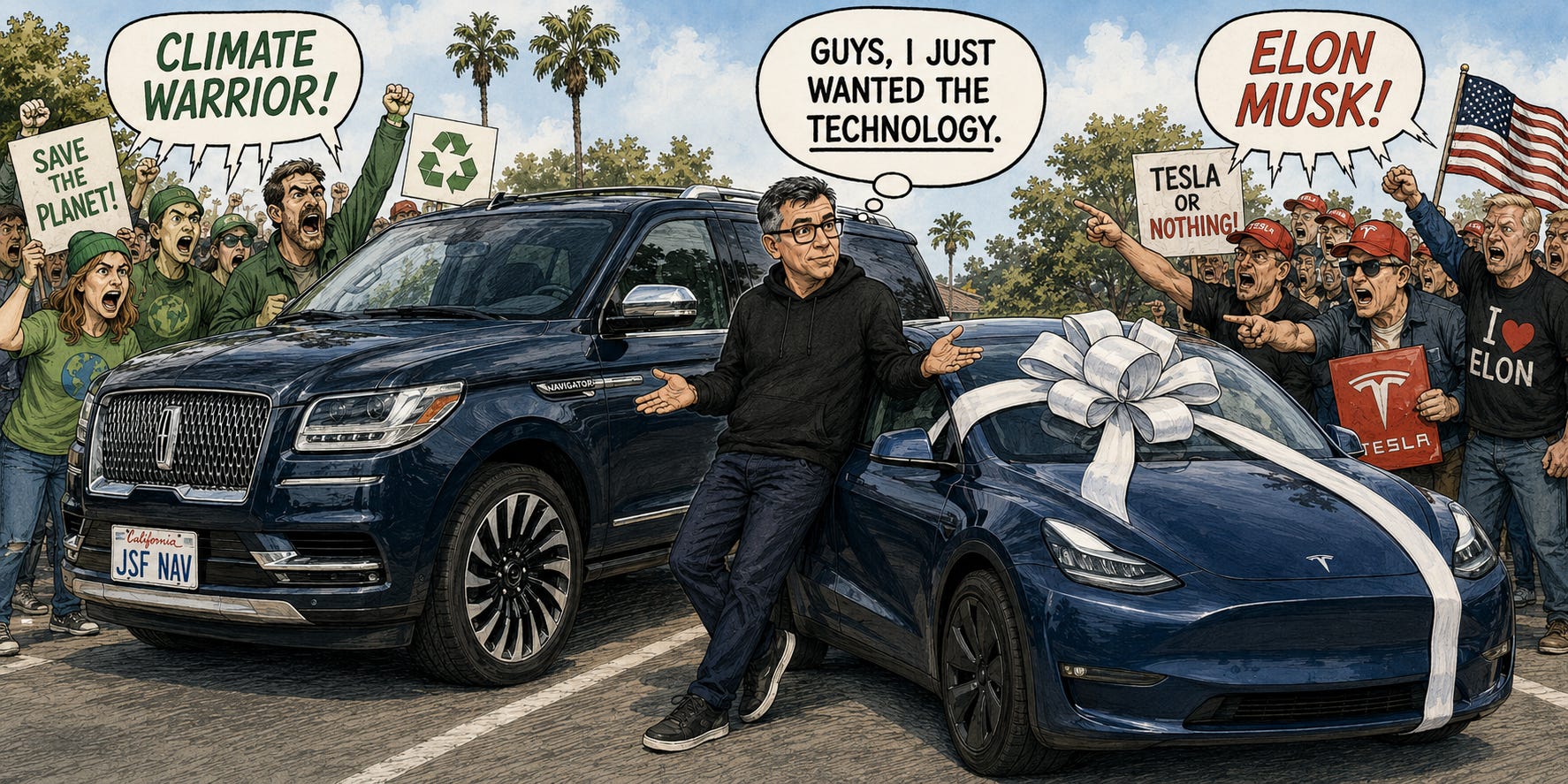
It had nothing to do with saving the planet or supporting Elon Musk. It was for something much more… useful!

Typically, our afternoon content is behind a paywall — or there is something extra for our paid subscribers. If you are not one, please consider upgrading. You are missing a significant portion of what we produce each week, and your support makes it possible. If you want to get it all and support my efforts, please consider a paid subscription!
You can listen to this content on our Podcast — So, Does It Matter, Spoken! - on your favorite podcasting app. Or you can just go listen here.
🕒 5-minute read
Hey, Tesla (The Automaker) shared this article (as it appeared in the CA Post!) See below.
It Wasn’t About The Planet
Let me get something out of the way. I did not buy a Tesla because I suddenly became worried about my carbon footprint, wanted to become a more environmentally sensitive Californian, or felt compelled to do my part to save the planet. If anything, the sanctimonious political culture that grew up around electric vehicles was a modest reason I didn't buy one. Who wants to spend that much money only to be mistaken for someone making a statement about climate change?
I am also not writing this to tell anyone else what kind of car to buy. Buy the vehicle that makes you happy. One of the great advantages of living in America is that we still have an extraordinary abundance of choices, even as the political left increasingly tries to narrow those choices and substitute government preferences for individual judgment. I am not interested in replacing one automotive orthodoxy with another. This is simply why the choice that made sense for me changed so dramatically.
Nor did I buy it because Elon Musk has become one of the progressive left’s most prominent antagonists. I appreciate much of what Musk has done, and there is something undeniably amusing about liberals selling their Teslas just as conservatives are beginning to consider buying them. But I did not spend tens of thousands of dollars to cast a political vote for Elon Musk. I bought a Tesla for a much simpler reason: the technology was better, and it offered features I could not get anywhere else. I bought it because it is the perfect car for me.
What I Walked Away From
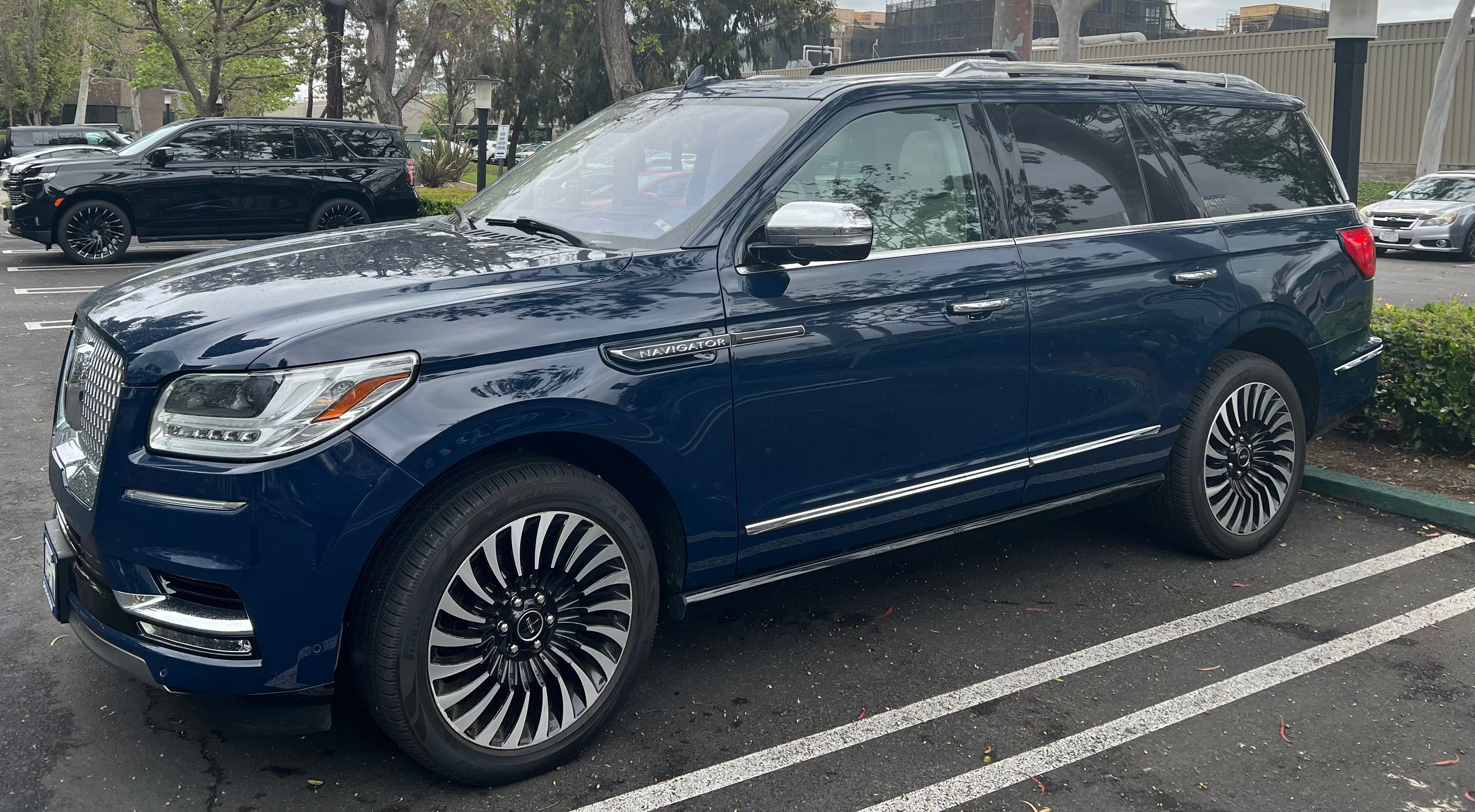
The vehicle I gave up was a Lincoln Navigator Black Label Edition, and it was a spectacular SUV. It represented almost everything Americans have traditionally meant by automotive luxury: enormous size, immense comfort, premium materials, abundant power and the commanding feeling that comes from sitting above nearly everything else on the road. Its twin-turbocharged V6 moved the massive vehicle effortlessly, while its world-class suspension absorbed potholes, rough pavement and speed bumps with almost comic ease.
Inside, the Navigator was quiet, spacious and indulgent. The leather was beautiful, the seats were enormous, and nearly every imaginable comfort had been included. You were cocooned from the road and largely insulated from whatever was happening outside. It was a six-figure luxury vehicle in every traditional sense of the term.
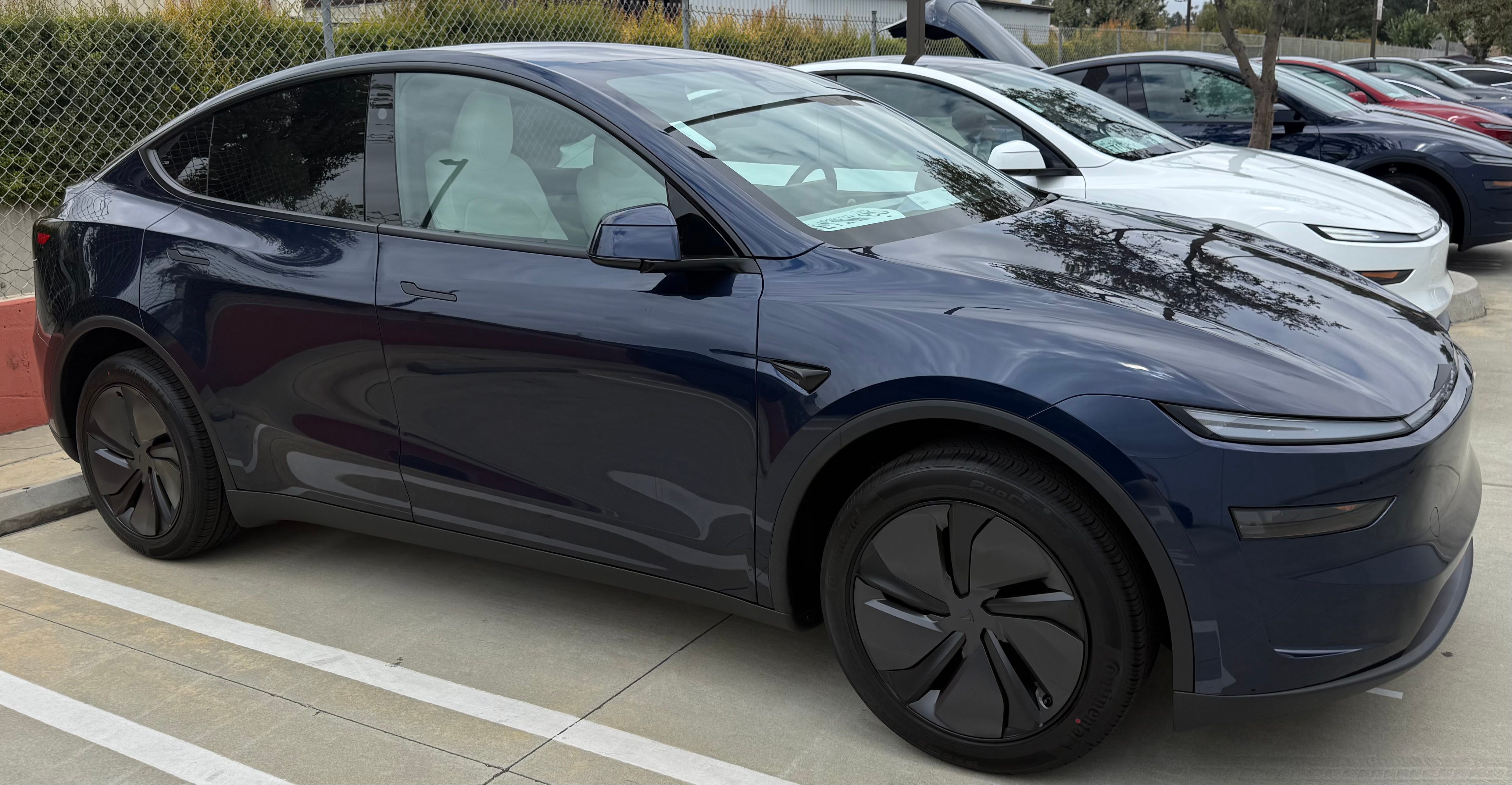
At the end of June, I traded it for a considerably smaller Tesla Model Y with an interior that can initially feel almost austere. Tesla seems to pride itself on minimalism: few buttons, no conventional instrument cluster and almost none of the visual excess associated with a high-end luxury SUV. It would be easy to climb inside, look around and conclude that I had taken a dramatic step backward. But that would depend entirely on how you define luxury.
The Feature That Changed Everything
The single biggest reason I bought the Tesla was Full Self-Driving, supervised. Nothing else was close. Plenty of manufacturers offer adaptive cruise control, lane centering or limited hands-free driving on selected freeways. Tesla offers an integrated system that operates not only on highways but also on city streets, residential roads and ordinary surface streets.
The car follows the navigation route, changes lanes, makes turns, responds to traffic and handles much of the constant decision-making that normally falls on the driver. It is not fully autonomous, and the driver still has to pay attention and remain prepared to intervene. It is also not perfect. But those qualifications do not change how significantly it transforms the driving experience.
(Check out this one-minute video)
In Southern California traffic, on longer trips and during the routine grind of moving from one place to another, the reduction in mental workload is substantial. You remain responsible for the car, but you are no longer personally executing every lane change, speed adjustment, turn, and traffic maneuver. The Navigator made driving exceptionally comfortable. The Tesla makes driving dramatically easier.
The Car As A Technology Platform
Self-driving was the main attraction, but it was not the only one. My phone is the key. The car unlocks as I approach, locks when I walk away (okay, I admit that I have the “lock sound” set to Jarvis from Iron Man saying, “Defense protocol activated, Sir!”) and recognizes which driver has arrived. There is no key to remove from my pocket, no start button to push, and no ritual required to shut the vehicle down.
From the Tesla app, I can cool the interior before leaving a restaurant, monitor the car, manage the charging, and access other functions from virtually anywhere.
Then there is the basic convenience of never having to stop at a gas station. I park in the driveway, plug in the car, and wake up ready to go. When fully charged, my Model Y shows more than 350 miles of estimated range—more than enough for almost anything I am likely to do in a normal day. And on longer trips, the car automatically works charging stops into the route. With Full Self-Driving engaged, it will even pull directly into the charging-station space. All I have to do is get out and plug it in.
The cameras function as an integrated dashcam and security system, while software updates can change or improve the car after I have already purchased it. I already had Tesla solar and Powerwalls at home, so the vehicle also fit neatly into an existing technological ecosystem. Electricity is generated on the roof, stored at the house, and used to charge the car in the driveway. That still was not an environmental statement. It was a convenience statement. The entire system works together, and it requires very little thought or effort from me.
At some point, I realized that buying a car had begun to resemble buying a smartphone. We once compared phones primarily by call quality, battery life, and durability. Then the operating system became the product. Tesla has applied that concept to the automobile. The company is not merely selling transportation. It is selling a technology platform that happens to move you from one location to another.
So, Does It Matter?
Anyone who thinks Tesla became one of the world’s most successful automobile companies because millions of enlightened consumers decided to save the planet is missing the larger story. Elon Musk created a winner by figuring out what consumers wanted and delivering it. People may enjoy describing their purchases as altruistic, but most of us buy what makes our own lives better, easier, or more enjoyable.
Perhaps reduced carbon emissions are an ancillary benefit. I will leave the arguments over battery manufacturing, mining, electrical grids, and lifetime emissions to those who enjoy conducting those calculations. None of it played any meaningful role in my decision. Tesla persuaded me to leave a six-figure luxury SUV and move into a smaller, considerably more modest Model Y because the technology offered me more value than the size, materials, and traditional comforts I was giving up.
That is the part I find most remarkable. I could not be happier with the decision. I have not looked back, and I do not miss my Navigator at all.
I suppose there is only one thing I need to start thinking about. If I upgrade my iPhone every couple of years to keep up with the latest technology, how long will it be before I decide I need another new Tesla?
Don’t you wish your car said this when you lock it? Don’t be envious.
Referral Code (Why Not?)
Tesla has a thing where if you buy a car and input a referral code, you get a discount, and I get a credit. So, if this column in any way influences you to take the plunge (which is easy, you do everything online), feel free to use my code :-)
My code is here: https://ts.la/jon816592
You can just click here to check out the Tesla website (and it registers my referral).
With the code, you get three free months of Supervised Self-Driving ($300 value, as it is $99/mo), and I get $250 in Tesla “store” credit.
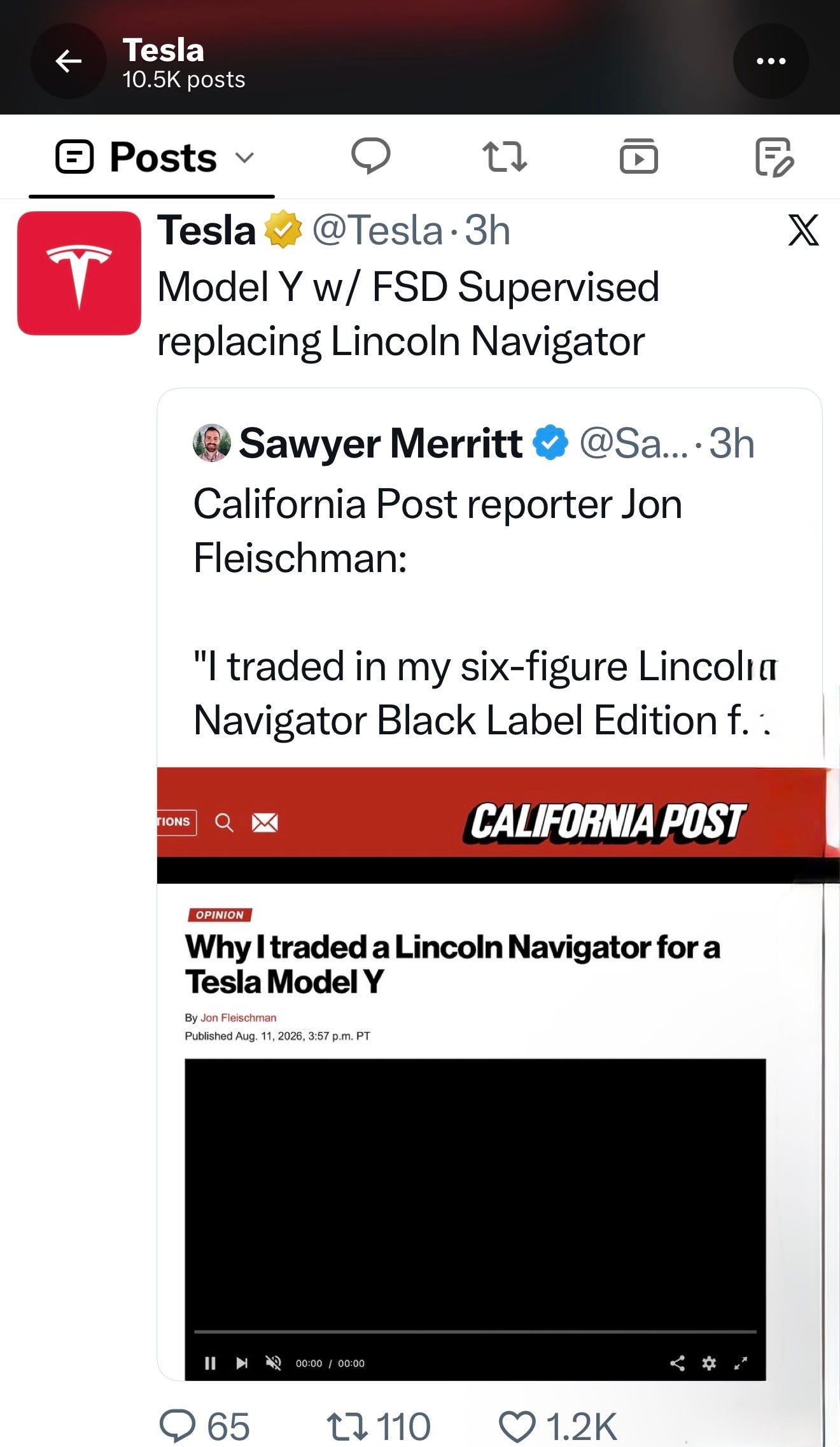
A Shorter Version Of This Column Appears In The California Post!
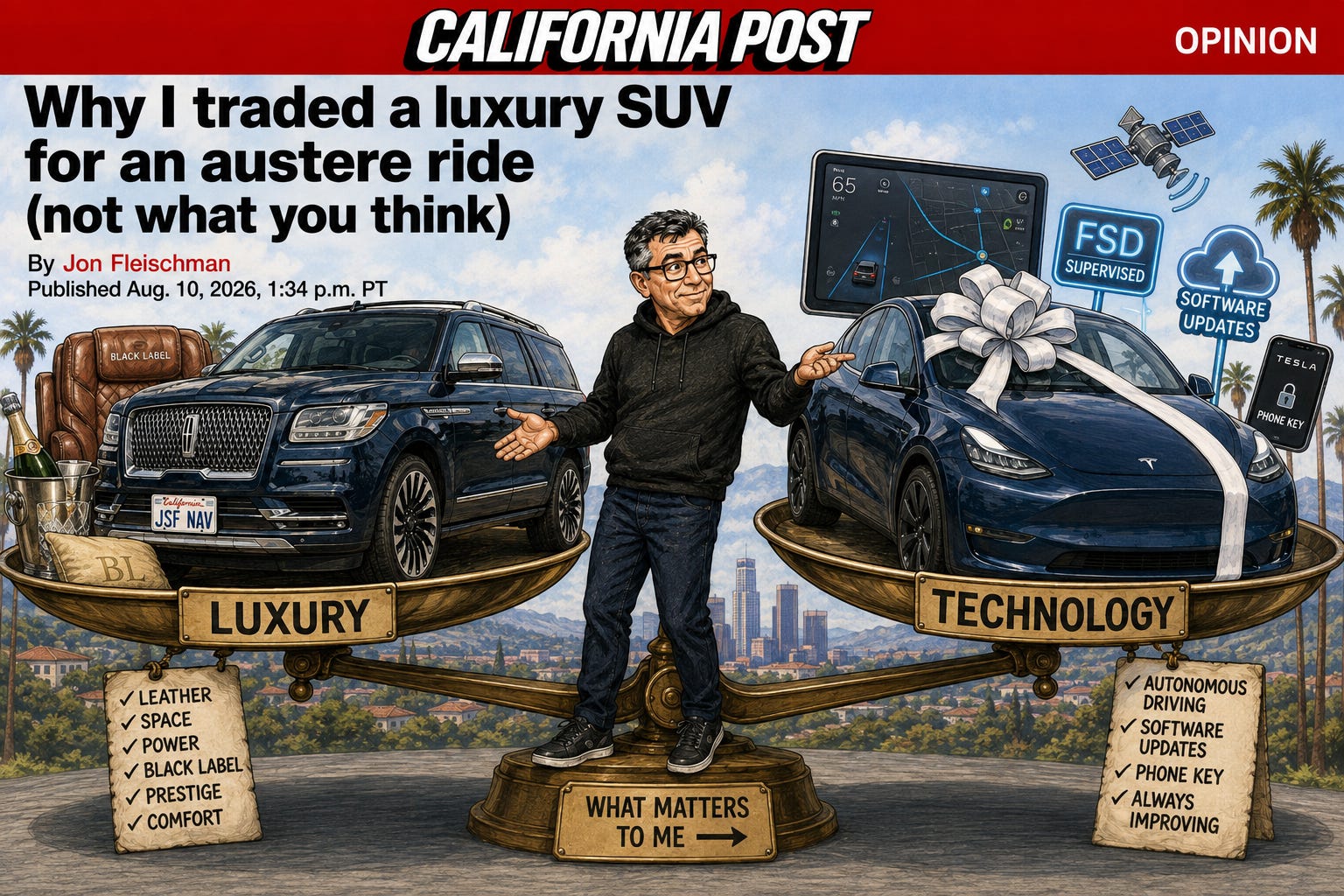
You can read it here.