



For now, this content is available to all subscribers; at some point, this feature may be available only to paid subscribers. What? Aren’t you one? Please consider upgrading — it’s only $70 a year or $7 a month for lots of great additional content, and you help support this project!
You can listen to this content on our Podcast — So, Does It Matter, Spoken! - on your favorite podcasting app. Or you can just go listen here.
⏱️ 8-minute read
Worst Week In California Politics
There are bad weeks in politics, and then there are weeks when federal agents seize your electronics, a senior Capitol staffer turns himself into a penis joke on video, and millions of dollars in outside spending still cannot get you elected to Congress.
Welcome back to the medal stand.
This week brings us a former congressman experiencing one of the more spectacular political implosions California has seen in a while, a highly paid Assembly chief of staff who apparently misplaced his professional judgment somewhere inside the Capitol, and a Bay Area Democrat who came within striking distance of Congress after outside groups spent millions helping her — only to come up short anyway.
We even have an honorable mention for one of California’s largest insurance companies, whose outside lawyers managed to submit imaginary legal authorities to a real court.
As always, the rankings are subjective. Readers are free to rearrange the podium, complain about the judging or nominate someone whose terrible week escaped our attention.
Let’s get to the podium!
Honorable Mention — State Farm Insurance
State Farm missed the medal stand this week, but its lawyers still pulled off something pretty remarkable: asking a real court to rely on cases that did not exist.
The problem came up in a Los Angeles lawsuit brought by a homeowner whose house became uninhabitable after a fire and water damage. State Farm’s outside attorneys filed motions containing case citations, quotations, and legal holdings that opposing counsel later discovered were imaginary.
One of the lawyers eventually admitted that seven case citations across eight filings simply did not exist. She had used an artificial-intelligence legal tool and thought it was checking her work against Westlaw.
To be fair, these were outside lawyers, not State Farm employees, and the lead attorney apologized and accepted responsibility. But when lawyers for one of California’s largest insurance companies start citing imaginary cases to a judge, “the AI did it” is not much of an excuse.
State Farm already has enough problems in California without its lawyers making up case law. For that, the company earns an Honorable Mention.
🥉 Bronze Medal — Ex-Congressman Eric Swalwell

Eric Swalwell’s political collapse has happened with almost breathtaking speed.
Not long ago, he was a sitting member of Congress, a former presidential candidate and one of the better-known Democrats running for governor of California. Then came the sexual-misconduct accusations. His campaign for governor cratered, more women came forward, and by April he had resigned from Congress altogether.
Swalwell denies the accusations, and accusations are not convictions. But politically, it was a complete wipeout. In a matter of months, he went from talking seriously about becoming California’s next governor to becoming a former congressman whose seat suddenly had to be filled in a special election.
And this week, somehow, it got worse.
Federal agents seized Swalwell’s electronic devices at San Francisco International Airport and, the next day, searched his Washington, D.C., home. The investigation involves claims from multiple women, ranging from sexual assault to unsolicited explicit messages and images.
Authorities in New York and Los Angeles have also been looking into accusations involving Swalwell. One former staffer has accused him of sexually assaulting her in New York in 2024, while another California woman has accused him of rape in 2018. Swalwell denies those accusations too.
None of that proves he is guilty of anything. But there is a pretty significant difference between standing at a microphone denying accusations and having federal agents take your electronics at an airport and then show up at your house with a search warrant. Swalwell managed to cover that distance in remarkably little time.
The timing this week was almost too perfect. While federal investigators were searching his home, voters back in California were choosing the person who would finish the congressional term he walked away from. We will get to that special election again when we reach this week’s Gold Medal.
But just look at where things stand. Swalwell’s campaign for governor is gone. His career in Congress is gone. His former constituents are replacing him. And law-enforcement agencies in multiple jurisdictions are investigating serious accusations against him.
There are political bad weeks. There are political bad years. And then there are political implosions.
Eric Swalwell is living through the third kind.
For an astonishing collapse that took him from prominent candidate for governor to disgraced former congressman — and this week brought federal agents seizing his electronic devices and searching his home — Eric Swalwell takes home this week’s Bronze Medal.
🥈 Silver Medal — Terry Schanz - Assemblymember Tina McKinnor’s Chief of Staff
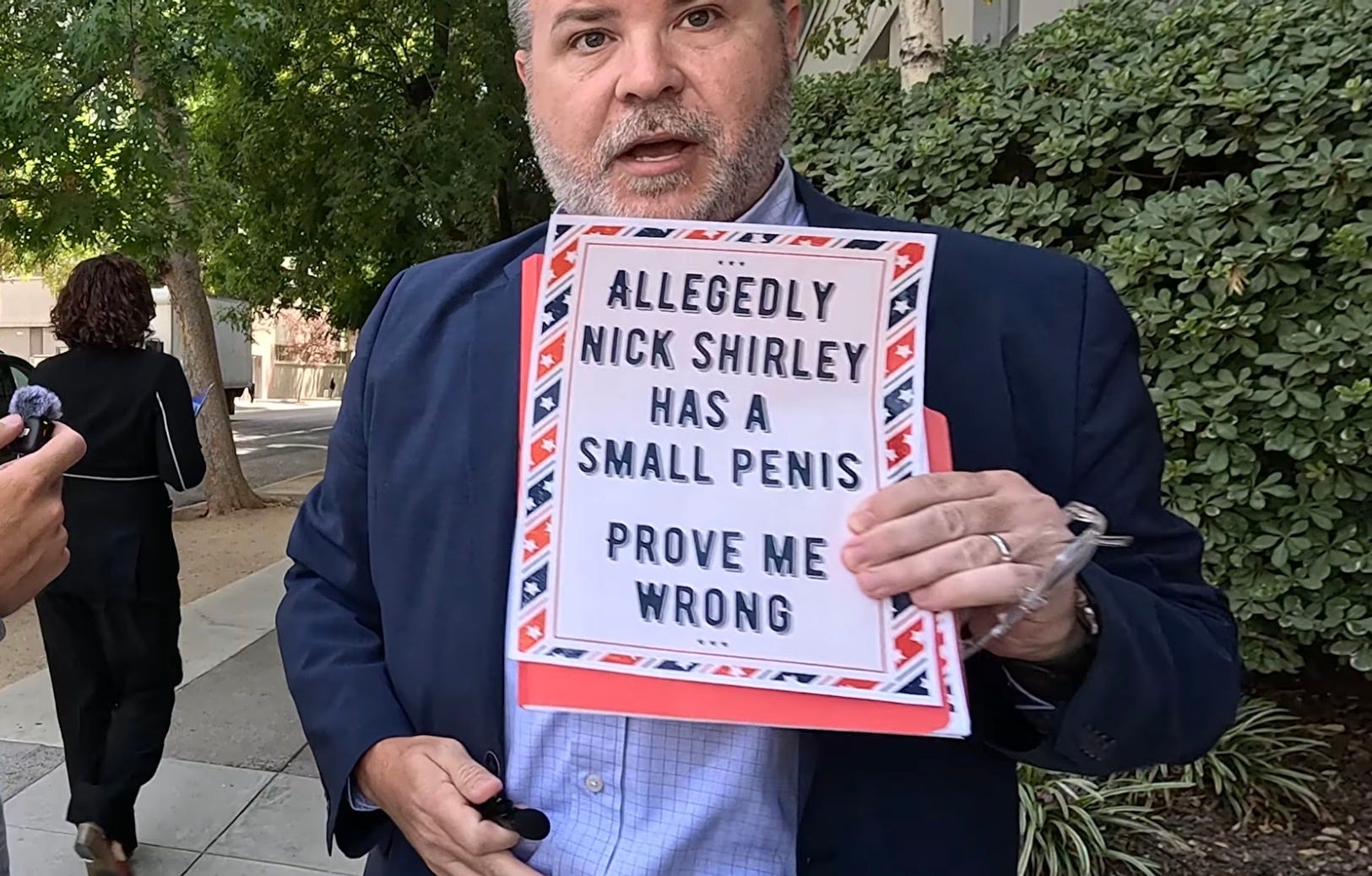
Terry Schanz has spent years working in and around the California Capitol. Apparently, all that experience was building toward the moment when a taxpayer-paid chief of staff earning more than $200,000 a year would interrupt an interview to make jokes about another man’s penis.
Schanz is the chief of staff to Assemblywoman Tina McKinnor, a Democrat who represents a Los Angeles-area district. Official Assembly payroll records list Schanz as McKinnor’s chief of staff at $17,319 a month. He is the senior staffer running a legislative office — the kind of job that normally requires judgment, discretion and at least a passing acquaintance with professionalism.
Nick Shirley was in Sacramento covering Assembly Bill 2624, Democratic legislation that critics say could chill aggressive watchdog reporting. He was discussing the measure with Republican Assemblyman Joe Patterson when Schanz decided to insert himself into the exchange.
The episode was captured on video, which is embedded here, and it is worth watching because the description almost undersells how ridiculous it looks. Rather than argue with Shirley over the legislation, Schanz repeatedly mocked his penis, waved around crude material, and tried to draw other people passing through the Capitol into the joke. He walked into an on-camera exchange involving a sitting Assemblyman and, with remarkable efficiency, made himself the story.
Millions have watched this - you may have seen it. The real stupidity starts at the 12 minute mark on the video.
Shirley is a confrontational citizen journalist who often provokes politicians and public officials. If Schanz thought his reporting was dishonest, unfair, or obnoxious, he had every opportunity to say so on the merits. Instead, a highly paid senior legislative staffer decided that penis jokes were the better argument.
That is what makes this more than merely juvenile. Schanz is not some college intern who got carried away at a rally. He is one of the senior staffers in the California Legislature, drawing more than $17,000 a month from taxpayers while serving as the top aide to an elected Assemblymember. In a matter of minutes, he managed to make Shirley look like the adult in the conversation.
McKinnor herself did not do this, and there is no reason to pretend otherwise. This medal belongs entirely to Schanz. But when your title is chief of staff, your behavior reflects on the office you run, which is one reason people holding jobs like his are normally expected to know when not to behave like a seventh grader.
The most damaging part is that nobody had to characterize Schanz’s conduct for him. He supplied the video. Viewers can watch a senior Capitol staffer voluntarily turn himself into a punchline in real time, and no press release or political spin can make it look dignified afterward.
For being both immature and making a complete jackass of himself, Assemblywoman Tina McKinnor’s chief of staff, Terry Schanz, wins Silver honors this week.
🥇 Gold Medal — House Candidate Melissa Hernandez

There was a special election this week to fill the remainder of disgraced former Congressman Eric Swalwell’s term in the East Bay. The race pitted State Senator Aisha Wahab against Melissa Hernandez, the former mayor of Dublin and current president of the Bay Area Rapid Transit board. Wahab won, which is how Hernandez ended up here.
The repeated matchups take a little explaining. Wahab and Hernandez first faced each other in the June 2 regular primary for the next full congressional term, and both advanced to November. Swalwell’s resignation then triggered a separate special election to finish his current term, which meant another primary on June 16 and Tuesday’s special-election runoff.
That means Hernandez has now lost to Wahab three times this summer — and, remarkably, gets to face her again in November. The first two were not close. Wahab beat Hernandez by 21 points in the regular primary and by 26 points in the special primary. At that point, Hernandez’s path to Congress did not look narrow. It looked fictional.
Then AIPAC arrived with a checkbook.
The American Israel Public Affairs Committee and affiliated outside groups poured roughly $6.3 million into the race, overwhelmingly attacking Wahab. Mailboxes, television screens and digital feeds filled with messages portraying her as too liberal, too soft on crime and too far outside the district’s mainstream. And the spending worked: What had looked like another blowout became a real race.
It almost worked well enough. Hernandez went from losing by more than 20 points to coming within striking distance of Congress. But there is a problem with “almost.” Congress does not have an almost-members caucus.
There was also a larger political story playing out. Wahab sits firmly on the hard progressive wing of the Democratic Party, and the Democratic Socialists of America urged its members to vote for her. Hernandez was the more conventional Democrat, and she now joins a growing list of candidates finding out that the ascendant extreme left inside their party is not just loud. It is increasingly capable of winning.
Hernandez does get one consolation prize: another chance to lose to Wahab in November, when the two meet again for the full two-year term. A bigger electorate could produce a different result. Maybe it will. But that is a problem for another week.
This week, Hernandez had already been beaten badly by Wahab twice, then watched AIPAC and its allies spend roughly $6.3 million helping turn what looked like a blowout into a competitive race. The money made her viable. It did not make her a member of Congress.
For barely losing a high-profile special congressional election, despite millions of dollars in outside spending helping drag her from a blowout into contention, Melissa Hernandez officially had the worst week in California politics, taking home this week’s Gold Medal.
This Week’s “Winners” Collect Their Medals…

State Farm’s lawyers discovered that artificial intelligence can be very helpful, provided nobody checks whether the cases it cites actually exist. Eric Swalwell continued a political implosion that has taken him from candidate for governor to former congressman, with federal agents searching his home. Terry Schanz demonstrated that a $200,000-plus Capitol salary apparently does not guarantee adult behavior.
And Melissa Hernandez learned perhaps the hardest lesson of all: You can lose by 20 points, attract millions of dollars in outside help, make up almost all the ground — and still lose. She gets another shot at Aisha Wahab in November, although after three defeats this summer, perhaps she should avoid asking what the fourth time is supposed to be the charm for.
That is all for this week. The podium is empty again, though California politics rarely leaves it that way for long!
-JSF