

When the Dictionary Takes Sides
How political correctness replaced ordinary English with the Left’s preferred vocabulary

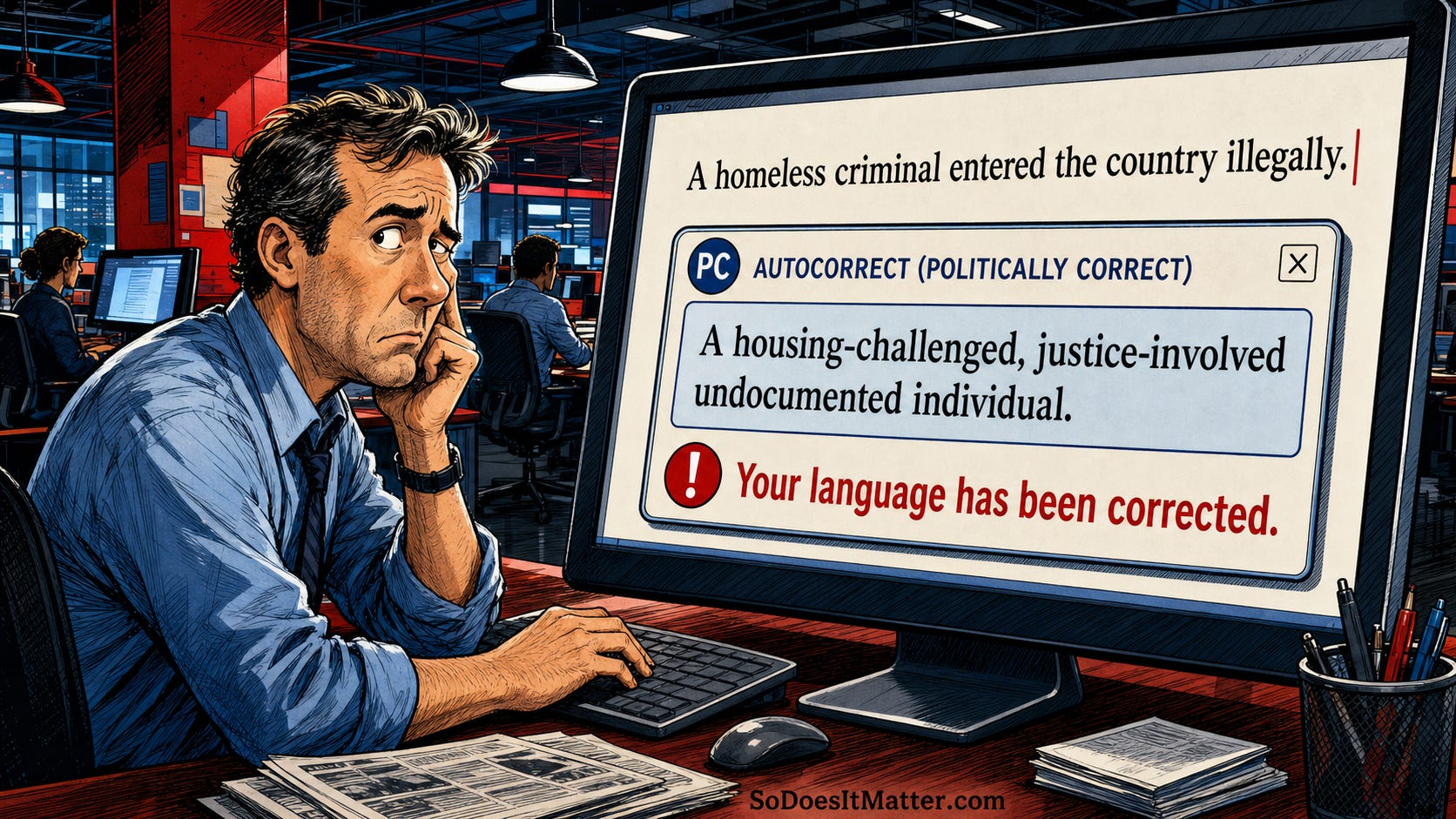
Typically, our afternoon content is behind a paywall — or there is something extra for our paid subscribers. If you are not one, please consider upgrading. You are missing a significant portion of what we produce each week, and your support makes it possible. Often, on Friday afternoons, we do not put up a paywall. This is one of those days! Enjoy.
You can listen to this and all of our content on our podcasting channel, So Does It Matter? SPOKEN! You can find it on your favorite podcasting app, or right here. As we try to get more of you to try the podcasting feature, this entire column can be listened to, even the part under the paywall.
🕒 6-minute read
Political correctness was sold as a matter of courtesy. It became a system for controlling how Americans describe reality.
The strategy is simple: When the facts sound unpleasant, invent a more agreeable term. When a policy is unpopular, give it a compassionate name. When ordinary language points toward personal responsibility, replace it with language that blames society or demands government action.
Left-wing activists and bureaucrats create these expressions. Universities and advocacy organizations legitimize them. Then mainstream newsrooms adopt them as neutral terminology—often through formal style rules that leave reporters little choice.
The facts may remain in the story, but the vocabulary tells readers how to interpret them. Here are ten entries from the Left’s increasingly political dictionary.
When Accountability Becomes Impolite
1. Justice-Involved Individual vs. Criminal
“Justice-involved” sounds as though someone accidentally wandered into a courthouse. If a person was arrested, charged, or convicted, reporters should say which. The euphemism blurs those distinctions while shifting suspicion from the conduct to the justice system.
2. Incarcerated Person vs. Prisoner
A prisoner is unquestionably a person and should be treated humanely. But “incarcerated person” adds syllables without adding information. It pushes the imprisonment—and the conviction that produced it—into the background.
3. Undocumented Immigrant vs. Illegal Alien
“Undocumented” makes unlawful presence sound like a missing-paperwork problem. Did someone cross the border illegally, overstay a visa, or lose legal status another way? Report the facts instead of using a label chosen to soften them.
4. Housing Challenged vs. Homeless
The tents remained. The addiction and untreated mental illness remained. Only the vocabulary improved. “Housing challenged” also embeds the Left’s preferred policy conclusion: housing is the defining problem, and another government housing program is therefore the answer.
When Government Expansion Gets a Makeover
5. Equity vs. Equality
Equality means applying the same rights and standards to everyone. Equity seeks predetermined outcomes, sometimes by treating people differently. Those are competing principles. The Left’s linguistic trick is to present equity as a kinder, more modern form of equality.
The distinction becomes even clearer when we place words in front of them. For example — put “racial” in front of each. Racial equality asks government to treat citizens without regard to race. Racial equity asks government to sort outcomes by race and intervene when they differ. Unequal treatment does not become equality simply because “equity” sounds benevolent.
6. Affordable Housing vs. Low-Income Housing
Everyone favors housing people can afford. In government, however, “affordable housing” often refers to subsidized projects, below-market units, rent restrictions, or income-restricted units. Tell taxpayers who qualifies, who pays, and what is actually being built.
7. Healthcare Access vs. Medical Care
Access is not care. An insurance card does not guarantee a doctor is available or a timely appointment. Politicians celebrate expanded “access” because it measures government activity. Patients care whether they can actually receive competent treatment.
8. Food Insecurity vs. Hunger
“Food insecurity” is a technical category broad enough to support almost any expansion of government assistance. Are people hungry, skipping meals, or worried about grocery prices? Ordinary English provides perfectly good ways to tell us.
When Euphemism Settles the Moral Debate
9. Reproductive Rights vs. Abortion Rights
When a story is about abortion, call it abortion. “Reproductive rights,” “reproductive freedom” and “reproductive healthcare” move the act itself out of sight while declaring one side’s preferred moral and legal conclusion.
10. Gender-Affirming Care vs. Sex Change Procedures
“Gender-affirming care” announces approval before identifying the treatment. It can include puberty blockers, hormones, and irreversible surgery—very different interventions with serious consequences. Reports should name the actual drug or procedure rather than conceal it under a comforting ideological umbrella.
This Is Not Neutral Language
These expressions did not replace ordinary words because they are clearer. They replaced them because ordinary words evoke realities the Left would rather reframe.
Political correctness is not merely etiquette. It is an effort to establish which ideas may be expressed, which assumptions must be accepted and which conclusions should appear morally respectable.
Mainstream news organizations have too often become the enforcement mechanism. They take the vocabulary of activists, academics and progressive government agencies and present it as objective language. A reporter may work diligently to include both sides, yet the story still leans left because every important subject is described using the Left’s preferred words.
Readers notice. That is one reason center-right Americans—and plenty of moderates—no longer trust mainstream news.
We do not need approved language. We need plain English.
Jon... you are absolutely ON POINT! I agree with you to the nth degree. Thank you for stating the obvious. We need to return to PLAIN English.
Progressive vs Liberal.
Changed to progressive when the left started losing elections running liberal candidates.