

When Heritage Embraces Big Government—and Rejects Its Own Heritage
A conservative’s response to the Heritage Foundation’s new family policy proposals

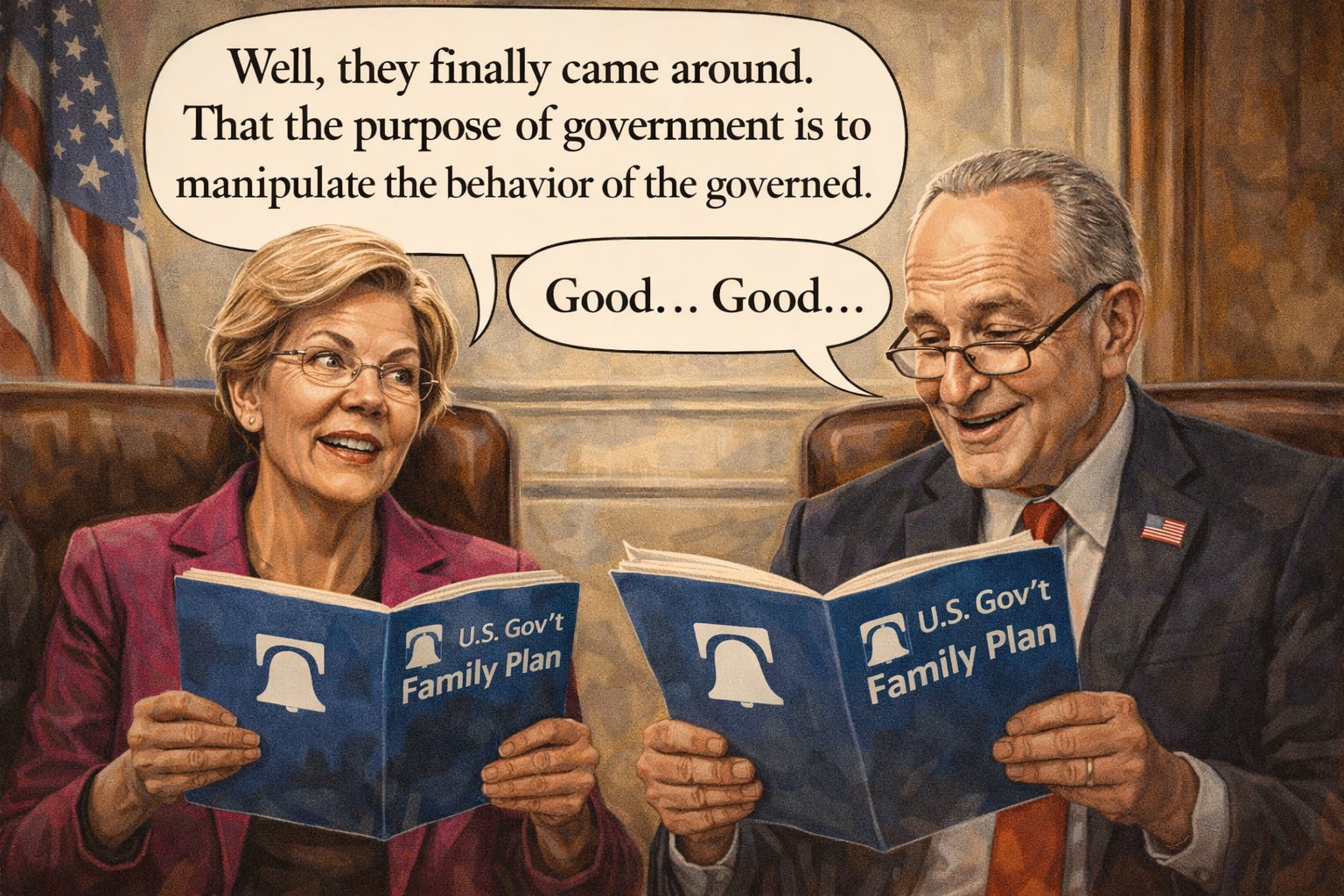
Our morning columns are available to all subscribers and site visitors. Our afternoon content is typically reserved for our premium subscribers. However, at the bottom of this column, under the paywall, are three amazing cartoons that almost made it to the top above. You don’t want to miss them.
⏱️ 8 min read
When First Principles Are Replaced by Good Intentions
The Heritage Foundation recently put out policy proposals that openly support the use of federal power to influence family life. This shift should make conservatives stop and think.
To understand why this moment matters, recall what kind of institution the Heritage Foundation has historically been.
Founded in the early 1970s, Heritage rose to prominence during the Reagan years by translating conservative principles into actionable policy. Heritage’s recommendations guided large portions of the Reagan administration’s agenda, particularly on taxes, regulation, national defense, and the limits of federal power.
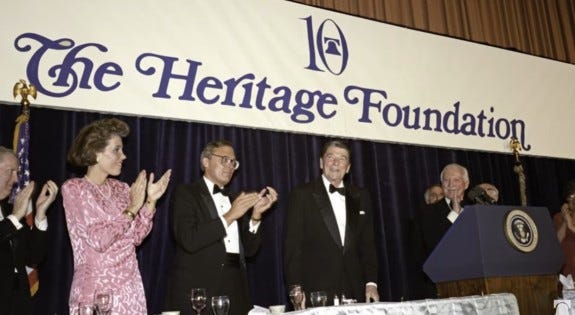
President Ronald Reagan’s relationship with the Heritage Foundation was substantive, not merely symbolic. Upon taking office, Reagan distributed Heritage’s Mandate for Leadership, a policy agenda with more than 2,000 specific proposals, to every member of his cabinet. Roughly 60 percent of those recommendations were implemented or initiated during Reagan’s first year. Reagan later described the Heritage Foundation as a “vital force” in Washington, reflecting the influence its research and policy work had within his administration.
For decades, Heritage served as a bulwark against the idea that social problems could be engineered away by Washington. It argued that strong families and civil society were not products of federal design, but of culture, community, and freedom. Its credibility rested on a willingness to say no to expansive government, even when political incentives pointed the other way.
That history matters now. When an institution with that pedigree begins advocating policies built around new federal programs, Washington-designed incentives, and centralized review of family life, this is not just another policy proposal. It is a philosophical pivot that should give conservatives pause.
“Government is not the solution to our problem, government is the problem.”
— President Ronald Reagan, First Inaugural Address, 1981
Why Heritage’s Recent Conduct Signals a Deeper Problem
Some readers may recognize the Heritage Foundation not from its historic role, but from a column I wrote about two months ago criticizing the organization and its president for publicly defending Tucker Carlson after his unchallenged interview with Nick Fuentes, a known racist and antisemite. Carlson himself made remarks during that interview that should have raised broader concerns.
That episode raised questions about judgment and boundaries. But the issue here is more fundamental. This is not about media alliances or short-term reputational missteps. It is about whether one of conservatism’s most influential institutions is drifting away from the principles that long defined it.
At a practical level, the Heritage proposal calls for a more active federal role in family life. It includes federally seeded accounts at birth, government-funded incentives tied to marriage, expanded tax credits linked to family structure, and new federal reviews of laws based on their perceived impact on family formation. In each case, Washington would define preferred outcomes and use the tax code to influence personal behavior in what Heritage now describes as a pro-family direction. (The full set of these new “use government power for good” proposals appears at the end of this column.)
The Moment Conservatism Trades Principles for Results
I am a conservative in the traditional sense of the word. I believe in a limited role for government, and a limited role for the federal government in domestic affairs. My conservatism does not begin with favored outcomes. It begins with enduring principles about power, coercion, and human nature.
That is why I find the Heritage Foundation’s recent family policy proposals troubling. The problem is not the goals themselves, but the means chosen to pursue them.
Marriage matters. Family stability matters. Work matters. Conservatives have been right about these things. But being right about the destination does not justify throwing away the map. When conservatives reach for federal power to shape social behavior, something has gone wrong.
What is being proposed is not a modest correction or rollback. It is an expansion of federal involvement into family formation and marriage decisions, carried out through tax credits and Washington-designed incentives. That is not conservatism reasserting itself. It is conservatism adopting a new vocabulary for the same progressive machinery.
Big Government Is Not a Tool Waiting to Be Redeemed
There is a seductive idea gaining traction on the Right: that government itself is not the problem, only how it has been used. Under this logic, the task is not to restrain federal power but to redirect it.
This is not a conservative insight. It is a liberal premise.
Once you accept the premise that Washington should incentivize personal life choices through financial rewards, you have already surrendered the argument for limited government. The debate then becomes which personal behaviors deserve subsidies.
That terrain belongs to the Left. Conservatives will never out-engineer progressives at bureaucratic social planning, nor should they try. Attempting this signals a loss of confidence in the institutions that once did this work organically, including families, churches, civic associations, and local communities.
The federal government does not persuade. It coerces. It does not model virtue. It redistributes resources by force. Those characteristics do not change simply because the policy goal has a different label.
When Government Replaces Responsibility, Civil Society Pays the Price
There is a deeper problem conservatives should recognize here. Using government to produce virtuous outcomes weakens the institutions that actually sustain virtue.
Strong families do not emerge because Congress designs the correct tax incentive. Marriages do not endure because Washington offset penalties. Communities do not revive because federal policy nudged people in the right direction. They arise from culture, shared norms, accountability, and personal sacrifice.
When the government steps in to manage outcomes, it inevitably crowds out responsibility. Moral formation is replaced with financial calculation, teaching people to focus on what they are owed rather than on obligation.
“The more government takes the place of associations, the more will individuals lose the idea of forming associations and need the government to come to their help. That is a vicious circle of cause and effect.”
- Alexis de Tocqueville, Democracy in America
Conservatives once understood that the role of government was to stop doing harm, not to compensate for decades of failed policy by layering on new federal programs. Removing marriage penalties is one thing. Creating federally managed systems to reward approved behavior is another.
So, Does It Matter?
This debate matters because it goes to the heart of conservatism. If conservatism becomes a project of using federal power more cleverly than the Left, it ceases to be conservatism.
Tolkien understood something that politics too often ignores. The danger of the One Ring was not the intention of those who sought to wield it, but the nature of the power itself. A force designed to dominate cannot be used benignly, because its purpose is control.
This moment recalls one of the central lessons of J.R.R. Tolkien’s The Lord of the Rings, a story about power, temptation, and restraint.
Time and again, Tolkien’s most admirable characters are tempted to wield the Ring responsibly or benevolently. Each time, Tolkien makes the same point unmistakably clear: the Ring cannot be redeemed. Its nature is domination; its purpose is control. Any attempt to wield it inevitably leads to corruption.
For a properly oriented conservative, big federal government is analogous.
Government power expansive enough to shape behavior and reward preferred outcomes is rarely neutral. It cannot be redirected safely. Once built, it rarely remains in friendly hands. Programs created with good intentions become permanent entitlements, often run by people who do not share conservative values.
This is not cynicism. It is history.
When conservatives turn to centralized government power to shape and manipulate personal behavior, even for ends they consider virtuous, they make the same mistake: substituting liberty for management. Power capable of steering family formation, marriage decisions, and household choices does more than merely encourage behavior. It dictates outcomes.
Tolkien was clear about something else, as well. At some point, inevitably, such power will be exercised by people with very different intentions. If The Lord of the Rings teaches any enduring lesson, it is that freedom is preserved not by wielding corrupt power responsibly, but by destroying it before it is too late.
Anything else is simply learning how to covet the Ring.
Heritage Foundation Family Policy Proposals
What follows is a concise summary of the specific policy proposals outlined in the Heritage Foundation’s newly released family policy plan. Many (not all) of these proposals represent a significant pivot toward using the federal government’s power to shape outcomes, rather than focusing on limiting or reducing it. And Heritage promises to unveil even more policies. Worrisome indeed if they are now bending their scholars to the task of figuring out more ways to use big government…
Expand “Trump Accounts”
Maintain federally seeded investment accounts that provide a $1,000 government deposit at birth, structured as tax-advantaged, long-term savings vehicles for future adult milestones such as education, homeownership, or business formation.
Create Newlywed Early Starters Trust (NEST) Accounts
Establish new federally supported investment accounts for couples who marry by approximately age 30, beginning with a $2,500 government deposit distributed over three years, with unused funds later converted into retirement accounts.
Extend the Adoption Tax Credit to Biological Children
Apply the existing federal adoption tax credit to married parents for each of their own newborn children, with eligibility tied to verifiable employment and structured to offset marriage penalties elsewhere in the tax code.
Provide a Large Family Bonus
Grant married families with two or more children a bonus increase to the federal child tax credit for each additional eligible child, based on the asserted societal benefits of larger families.
Create a Home Childcare Equalization Credit
Provide a $ 2,000-per-child federal tax credit for married households with children under five who choose at-home parental childcare, intended to equalize treatment with families using paid childcare.
Condition Family-Related Benefits on Work Requirements
Require at least one parent to be engaged in verifiable employment in order to qualify for certain family-related tax credits and benefits.
Institute Federal Policy Review for Marriage and Family Impact
Direct the executive branch to review federal regulations, grants, enforcement actions, and research funding based on their perceived impact on marriage and family formation, prioritizing policies deemed supportive and discouraging those deemed harmful.
Something For Our Paid Subscribers…
Below the paywall are three really fun (if not troubling cartoon images) that go with this column.
