

What 19 Unhappy Los Angeles Voters Can Teach California Republicans
They think government is failing on crime, homelessness, housing and taxes. That doesn’t mean they’re ready to vote Republican

Our morning content is free for all subscribers and guests! Usually our afternoon content is behind a paywall… If you are not yet a paid subscriber, consider upgrading — you are missing a significant portion of what we produce each week, and your support makes it possible. If you want to get it all and support my efforts, please consider a paid subscription! There is significant exclusive content below the paywall, after this morning’s column.
Most of our content is available on our podcast feed. So, Does It Matter? SPOKEN. Which is available on your favorite podcast app. You can listen to it right here as well.
🕒 6-minute read
Nineteen Voters And A Fascinating Experiment
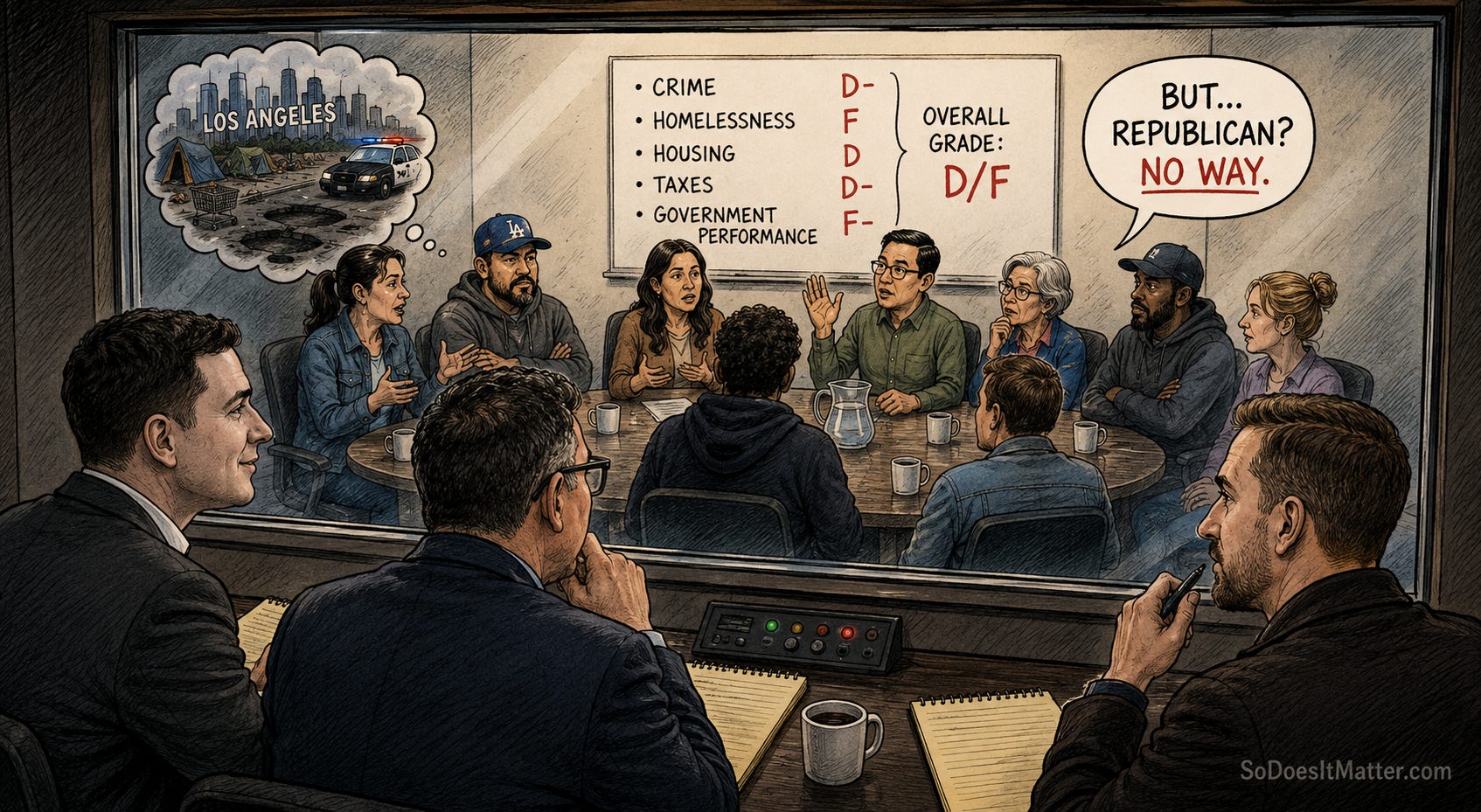
Imagine giving the politicians running your city a D or an F — and then having almost no interest in voting for the other party. That was the contradiction I couldn’t get out of my head after reading a fascinating piece in City Journal by Jesse Arm and Christopher F. Rufo, both with the Manhattan Institute.
They conducted two focus groups with 19 Los Angeles voters, all registered Democrats or No Party Preference. Fifteen voted for Kamala Harris in 2024. Just two voted for Donald Trump.
A brief aside: the Manhattan Institute has been doing excellent work on California policy and politics, much of it through City Journal. Rufo in particular has become an important and provocative voice on what’s happening here. California benefits from the scrutiny.
Arm and Rufo asked these voters about crime, homelessness, housing, taxes, government performance and politics. When asked to grade Los Angeles officials, the participants weren’t generous. C’s and D’s were common, with a few outright failing grades. Yet they weren’t exactly rushing toward Republicans.
Arm and Rufo offered their own thoughts about why, including some conclusions I think are right. But they also let readers see a lot of what the participants actually said, along with demographic and political information about them. So I decided to dig through it myself.
Obviously, 19 people aren’t a poll. These are also Democrats and independents in deep-blue Los Angeles, where Republican arguments don’t get much oxygen. Do the same thing in a purple suburb, the Inland Empire or parts of the Central Valley and you might get a very different conversation. That’s also part of the value here: we get to hear how dissatisfied non-Republicans in one of California’s bluest places explain what’s gone wrong.
I found five things that ought to get the attention of every Republican leader and political operative in California.
1. Republican Ideas Can Travel Without The Republican Label
Consider Kevin. He’s somewhat left-leaning and voted for Harris. He complained about high taxes, terrible roads and mentally ill people living on the streets. He compared Los Angeles unfavorably with Orange County’s tougher approach to homelessness and supported compulsory treatment for some mentally ill or addicted people.
He’s hardly alone. Another left-leaning Harris voter identified crime as his biggest concern and called for lower taxes, while a very left-leaning voter blamed years-long permitting for California’s astronomical housing costs. These aren’t closet Republicans. Kevin, in fact, later says he’d like a socialist along the lines of New York Mayor Zohran Mamdani.
I’ve spent a lot of years around Republican politics in California, and there’s something here worth noticing. None of these ideas belongs exclusively to Republicans, of course. But the Republican label may be considerably less popular than some of the positions Republicans campaign on, especially in red “deserts” like Los Angeles. Arm and Rufo saw this disconnect, too. Voters can embrace those positions without moving any closer to identifying with the party.
2. Government Can Fail Without Progressivism Taking The Blame
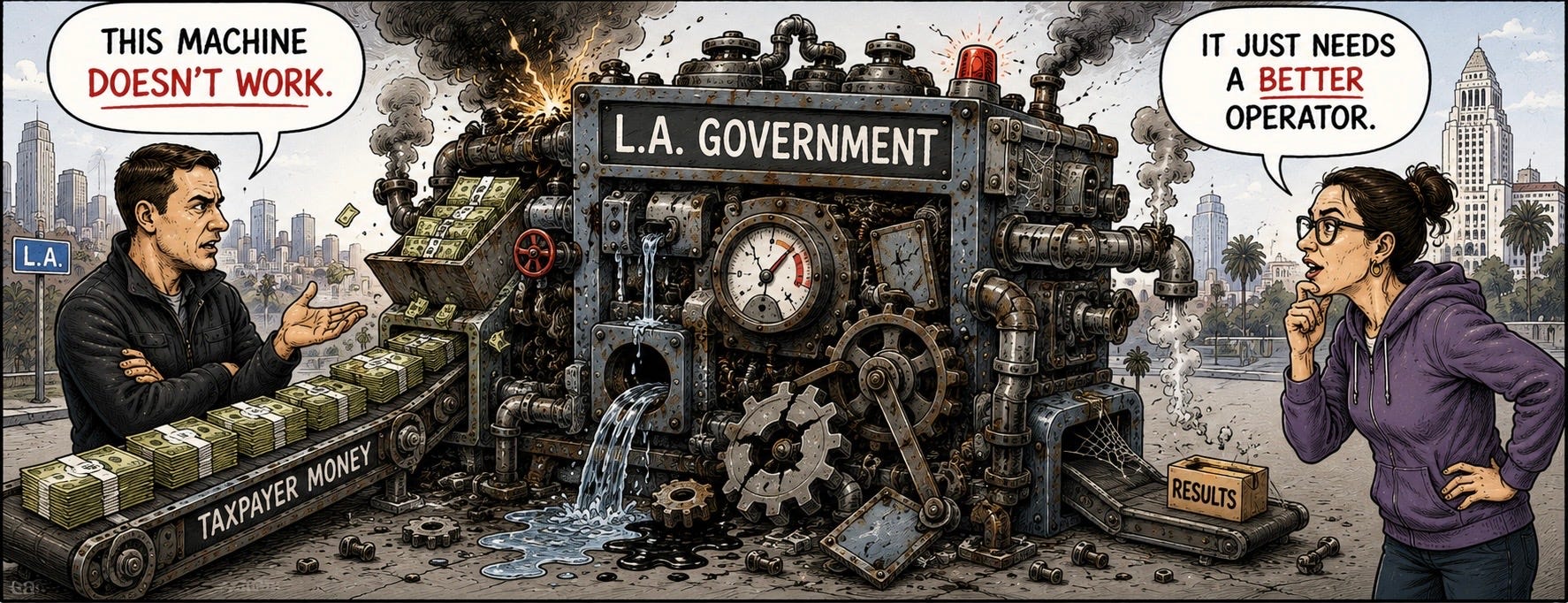
I’ve heard versions of this from California conservatives for years: eventually Democratic governance will get so bad that voters will reject the politics behind it. These focus groups offer a good reason not to count on that.
Ryan is a moderate Harris voter. Someone from a homeless encampment burned his car. Yet Ryan initially resisted the idea that Los Angeles was particularly unsafe. When pressed on whether people routinely have their cars burned in other cities, he conceded the point. His answer included reopening mental hospitals. And when asked whom he would support for mayor, he chose Karen Bass, saying he could live with the status quo as long as things didn’t get worse.
Another moderate Harris voter, Jehan, described people openly smoking crack on public transit and parts of Hollywood Boulevard looking like a horror show. She wondered where all the government money was going. But her takeaway wasn’t that government was doing too much. It was that government wasn’t using its resources properly.
Arm and Rufo make this point themselves, and I think they’re right. People can look straight at the failures of progressive government without deciding progressivism is the problem. A conservative sees a billion dollars wasted and thinks: Government can’t do this. A progressive can see the same billion dollars wasted and think: Government isn’t doing this right. Same billion dollars. Two very different reactions.
3. The Republican Problem May Be Less Policy Than Trust
Tristan is a moderate who voted for Harris. He’s unhappy with government spending and doesn’t want to reward California Democrats for the status quo. On paper, that’s exactly the kind of voter Republicans have been waiting for.
Except Tristan says he doesn’t see a future with Republicans.
Arm and Rufo describe Republican messengers as feeling “tribally foreign” to many of these voters. I think that gets pretty close to it. The problem isn’t simply disagreement over particular policies. They don’t trust what they think comes with the Republican package.
And that’s harder to deal with in a campaign than disagreement over an issue. Maybe you can convince somebody his taxes are too high. Getting him to vote for a political party he’s distrusted for years is another matter. In effect: I want to fire the people running the place, but I don’t trust you enough to hire you instead. Showing him another chart about California’s problems isn’t going to change that.
4. Republicans Need To Give Voters Permission To Defect
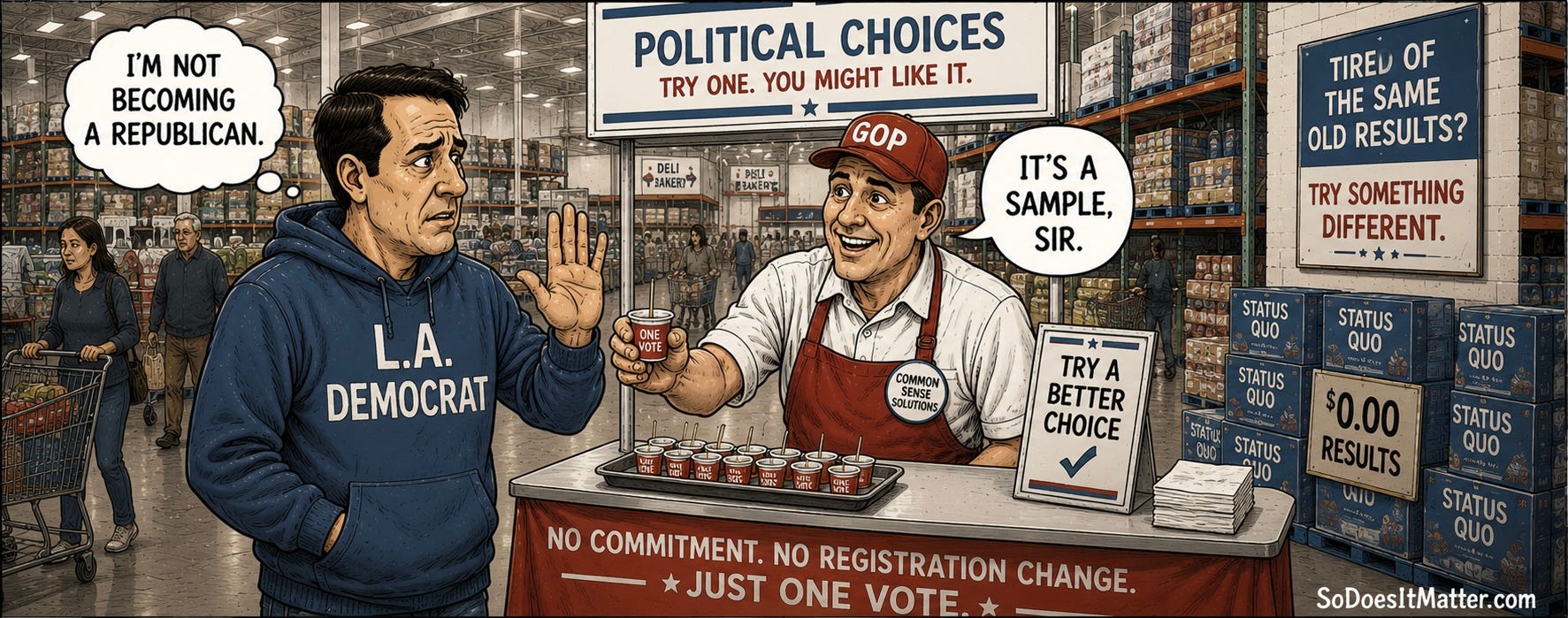
So what do you do with a voter like that? Asked why they kept voting Democratic despite everything they’d just complained about, one participant said she might vote more independently if credible alternatives existed but worried about bringing national Republican politics into California. Tristan called his voting a form of “damage control.”
I’ve spent a good part of my career trying to persuade voters in campaigns — statewide races around the country and congressional, legislative and local contests here in California. One of the great temptations is to try to move a voter all the way over to your side. I’m not sure that’s the right goal here.
A Los Angeles Democrat doesn’t have to become a Republican to vote for one Republican in one election. He doesn’t have to become a Trump supporter or change his views on everything else. You’re asking him for one vote.
Republicans need to give these voters permission to defect — or, more precisely, make that defection feel less consequential. You don’t have to become one of us. You just have to decide that the people running your city have failed and give somebody else a shot. Instead of persuading a lifelong Democrat that he’s been wrong about politics for 20 years, make it easier for him to make one different decision on one ballot.
Maybe conversion comes later. Get him comfortable voting for you first.
5. Things Getting Worse Won’t Necessarily Make California Redder
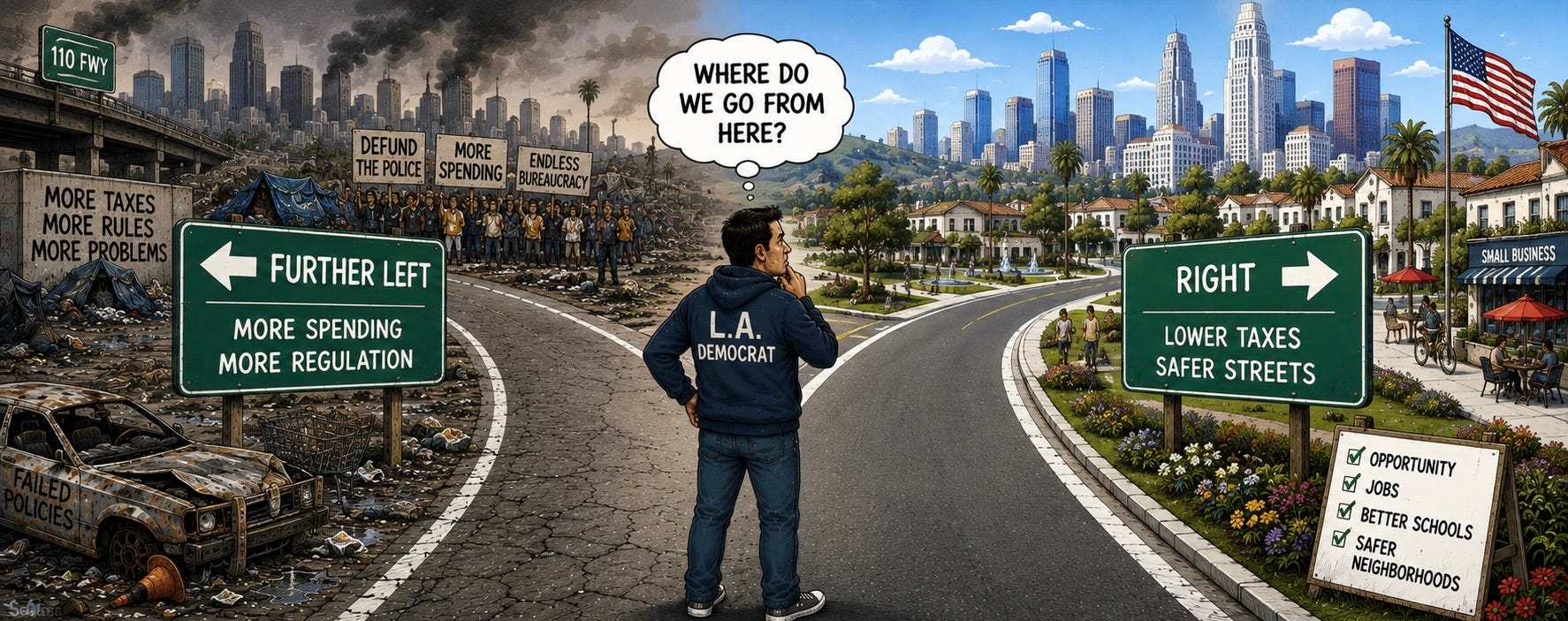
When participants were asked what Los Angeles would look like in ten years, many were pessimistic. Some expected more of the same. Others saw worsening homelessness, dirty streets, inequality or general decline.
You might assume that pushes people to the right. It didn’t necessarily do that here. Several participants were interested in politicians further to the left. One specifically wanted a socialist like Mamdani. Others were attracted to progressive Los Angeles Councilmember Nithya Raman as an alternative to Bass.
That’s the problem with the old Republican theory that eventually Californians will simply get fed up. Sure, they may get fed up. But that doesn’t tell you what they’ll do next.
Some voters may decide progressive government went too far. Others may blame incompetent politicians, corruption or special interests. And some will come away thinking the real problem was that California wasn’t progressive enough in the first place.
Maybe we just didn’t try progressivism hard enough.
Republicans shouldn’t assume worsening conditions will eventually rescue them. Voters can be furious with the people in charge and move in exactly the opposite direction Republicans expect. In the eyes of many of these 19 voters, Democrats have already failed. Republicans still have to convince them what should come next.
So, Does It Matter?
For years, California Republicans have assumed that at some point Democratic failure would start doing some of their political work for them. These 19 voters are a warning against counting on it.
People can be angry about crime, homelessness, taxes, housing costs and government incompetence and want something different. None of that means the something different will be a Republican.
Democratic governance has created plenty of dissatisfaction. Whether that becomes an opening for Republicans is another question. Republicans still have to become an acceptable place for dissatisfied voters to go. That starts with credible candidates, talking about the problems people actually experience and making it easier for Democrats and independents to cross over without feeling like they’re signing up for an entirely different political identity.
California Republicans don’t need these voters to become Republicans. They need them to become willing to fire Democrats.
Read the original source story:
City Journal: California Conversations, Part I: Los Angeles
Sounds like there’s more coming - maybe more focus groups!
Such an interesting article, thank you Jon