

Veterans Are The Star On Sacramento’s $11 Latest Billion Pork-Laden Christmas Tree
Sacramento is using veterans to sell voters another massive "affordable housing" borrowing package that is all about wealth redistribution.

You can listen to this post on our podcast feed, So, Does It Matter? SPOKEN. It’s available on your favorite podcasting app, or you can find it here. Our afternoon content is typically for our paid subscribers. Certain columns, like this one, are made available to all of our readers.
🕒 5 min read
Veterans On The Label
California politicians have apparently found their favorite new way to sell a massive borrowing package to voters: put veterans on the label.
Yesterday, Governor Gavin Newsom and legislative leaders rolled out what they are calling the Veterans and Affordable Housing Bond Act of 2026, an $11.25 billion package they want voters to approve this November.
The title sounds noble. Who doesn’t support veterans? That is precisely the point.
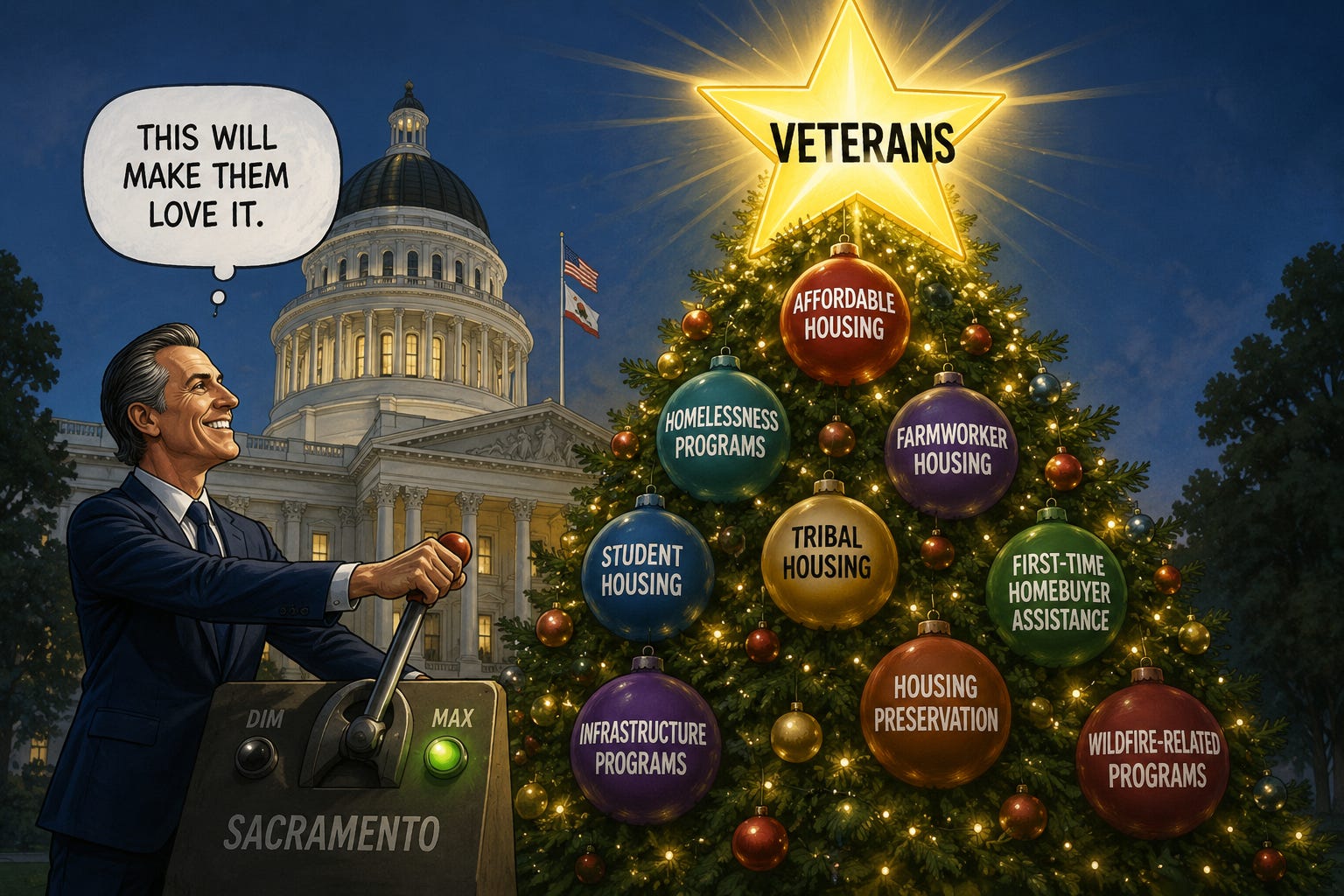
Because when you dig into the details, this is not primarily a veterans bond. It is a sprawling Christmas tree spending package, with veterans placed at the very top as the star.
The Numbers Tell The Story
According to the Governor’s own announcement, the package includes $10 billion in voter-approved general obligation bonds for affordable housing programs and another $1.25 billion in CalVet home loan financing for veterans and military families.
Here is the interesting part. The CalVet financing consists of self-supporting revenue bonds, repaid through veterans’ mortgage payments, that do not rely on taxpayer funding.
A Capitol finance expert tells me these CalVet revenue bonds do not require voter approval. The $10 billion taxpayer-backed housing bond does.
Jon Coupal, president of the Howard Jarvis Taxpayers Association, told me this kind of packaging is familiar.
“Unfortunately, this kind of maneuver is pretty typical,” Coupal said. “Put forward a sympathetic cause in the forefront to get voters onboard for even more spending. In this case, veterans are being used to help sell a much larger measure that is overwhelmingly focused on affordable housing programs.”
So if the veterans financing can stand on its own, why bundle it together with a massive affordable housing bond and put “Veterans” at the front of the title?
The answer seems obvious. “Veterans and Affordable Housing Bond Act” sounds a lot better than “Affordable Housing Bond Act.”
A Sacramento Christmas Tree
For most of its life, Senate Bill 417 was exactly that — the Affordable Housing Bond Act of 2026.
Only now, as lawmakers prepare to put the measure before voters, has the veterans branding suddenly moved front and center. That is not an accident. It is marketing.
And the rest of the package looks exactly like what Californians have come to expect from the Capitol.
This is not a narrowly tailored measure focused on one problem. It is a Christmas tree. Affordable housing advocates get billions for subsidized housing construction. Homelessness programs get funding. Farmworker housing gets funding. Tribal housing gets funding. Student housing gets funding. First-time homebuyer assistance gets funding. Housing preservation programs get funding. Infrastructure programs get funding. Wildfire-related programs get funding.
Nearly every organized housing-spending constituency gets an ornament on the tree.
Then lawmakers place veterans at the top, where voters will see them first.
Sacramento Created The Squeeze
No doubt the public feels strongly that veterans have earned every benefit they receive.
That is precisely why veterans are such valuable political packaging. The issue is not whether voters respect veterans. Of course they do. The issue is whether Sacramento is using that respect to help sell something much larger than a veterans program.
What Sacramento is really selling is another round of taxpayer-backed borrowing to finance the same government-centered approach that has dominated housing policy for years. That is where the deeper problem lies.
Housing affordability is not simply a function of how much money government spends. Affordability is a function of costs and income.
California’s political class has spent decades attacking families from both directions. On one side, state and local governments have piled on regulations, mandates, fees, permitting delays, environmental litigation, labor requirements, utility mandates, insurance burdens, and countless other costs that make housing more expensive to build and buy.
On the other side, Californians face some of the highest taxes in the nation, soaring utility bills, high gas taxes, rising insurance costs, and a regulatory environment that drives up the price of nearly everything families need.
The result is not mysterious. Families have less money in their pockets while housing costs keep climbing.
Two Bonds, Same Mistake
And this is not the only bad housing bond headed to voters. A separate $25 billion housing bond has already qualified for the November ballot. That measure is another Sacramento workaround — using government-backed debt to help select buyers compete in a market Sacramento helped make unaffordable in the first place.
It does not fix scarcity. It does not cut fees. It does not reduce mandates. It does not make building easier. It simply injects more subsidized buying power into a market where too few homes already exist.
So voters may soon face not one, but two massive housing bond schemes. One is a $25 billion homebuying subsidy measure. The other is this $11.25 billion Christmas tree package, dressed up with veterans at the top.
Different mechanics, same mentality: government creates the housing mess, refuses to fix the underlying causes, then asks voters to approve billions more in debt-financed intervention.
So, Does It Matter?
Supporters will argue that the bond will create housing, preserve housing, support homeownership, and address homelessness. Maybe some of that will happen. But Californians should not ignore what is happening politically.
This measure was not packaged around the biggest expenditure. It was not packaged around the largest spending category. It was not even packaged around the part that actually requires voter approval.
It was packaged around the most sympathetic constituency available: veterans.
The ornaments were chosen for the interest groups. The star was chosen for the voters.
And before Californians agree to borrow another $10 billion, they should ask themselves a simple question:
If this measure is really about affordable housing, why do Sacramento Democrats need veterans to sell it?
Voters should reject these housing bond measures and insist that the legislature actually fix the problem, not paper over it with more government spending or government-facilitated indebtedness.
Additional Recommended Reading
$25 Billion “Housing Bond” Measure Qualifies For November Ballot - It Should Be Firmly Rejected By Voters

You can listen to this post on our podcast feed, So, Does It Matter? SPOKEN. It’s available on your favorite podcasting app, or you can find it here. Our afternoon content is typically for our paid subscribers. Certain columns, like this one, are made available to all of our readers.