

Vacation Voting: How Special Interests Bankroll California Legislators On Lavish Junkets
Lawmaker “study tours” and luxury gifts create conflicts of interest in Sacramento

Some quick notes: Most of my columns run about 800 words. This one runs longer — because this issue deserves more than a surface-level treatment. Did you know you can listen to this content on one of our two podcasting channels: So, Does It Matter, Spoken? (Where all of our written commentaries are available in auditory form.) Finally, you do NOT want to miss my rant (and it is a rant) on this topic in the special video commentary at the bottom of this column. Trust me, must see!
⏱ 6 min read
Privileged and Posh “Policy Briefings” Around The World
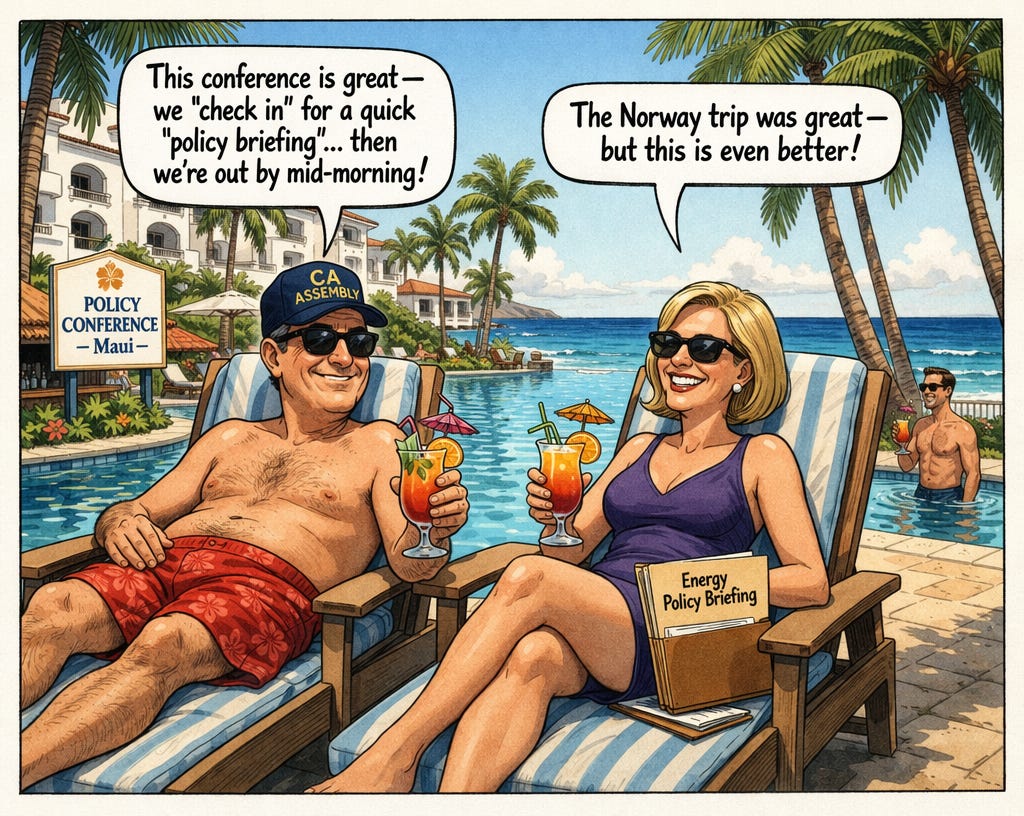
Picture the lifestyle: lawmakers flying to Maui, touring Europe, staying at luxury resorts, dining at exclusive restaurants, and rubbing shoulders with corporate executives — all while calling it “policy education.” These trips carry the thinnest veneer of official purpose, but no reasonable person believes they are anything other than lavish perks financed by the very interests these legislators are supposed to regulate. The money is routed through nonprofits to comply with the letter of the law, but the reality is obvious: these are effectively cash-equivalent gifts delivered as luxury travel. This is influence-buying — structured to comply with the law. Call it whatever you want — everyone knows exactly what this is. The legal technicalities may pass muster in Sacramento, but the moral failure is staggering. It defies common sense for an elected representative to participate in this system and then return home, claiming to serve the public interest.
Late last week, CalMatters featured an article titled “Pebble Beach golf, Maui resorts, European tours: How special interests woo California lawmakers.” Reading it was hard to do without shaking your head — and it reinforced how expansive and normalized this practice has become, prompting a closer look at the scale of these junkets and who is paying for them.
California lawmakers routinely take “educational” junkets paid for by the industries they oversee. In 2025, special interests paid roughly $1.2 million for lawmaker travel and $330,000 in gifts. Nearly 120 organizations funded trips to resorts in Maui, Pebble Beach, Europe, and beyond. Leading the pack is the California Foundation on the Environment & the Economy (CFEE) — a nonprofit that brings together major corporate and labor interests, including energy, utility, and technology stakeholders. CFEE alone paid $324,000 to send roughly 50 legislators on “study tours” of climate and energy sites all around the world. Earlier disclosures confirm this is not new: legislators logged $518K in gifts and travel in 2016 and $810K in 2018. I have been covering California politics for more than three decades, and these junkets have long been part of Sacramento’s culture. But things have changed. The scale and the luxury have grown — and the audacity has followed right along. This isn’t just business as usual. What once might have flown under the radar is now happening out in the open — bigger, more expensive, and much harder to justify to the public. In recent years, most state lawmakers have taken at least one of these junkets, all of which are advertised as policy briefings.
How the Junkets Really Work
These trips are sold as learning opportunities, but in practice, they are lavish perk tours. Legislators rub elbows with the lobbyists they regulate — for example, industry executives have joined lawmakers on international “study tours.” According to reports, these trips include five-star perks such as spa treatments, suite-level sports tickets, corporate golf outings, and gourmet banquets. Ordinary Californians have no comparable access; private insiders dominate the guest lists. These plush, exotic trips don’t just blur the ethical line — they blow right through it.
State law technically caps gifts at $630, but explicitly allows unlimited travel paid by nonprofits. In practice, almost every junket is run through charities with minimal disclosure. Under the old rules, nonprofits had to list a trip’s donors only if one trip cost over $5,000 and that spending was a third of their budget — a threshold most groups never reach. So the real money often stays hidden, while corporations and unions quietly fund these trips through intermediaries. The result is clear: Special interests and their lobbyists buy private access to lawmakers under the guise of education.
Money, Motives, and the Loophole
Behind every trip is a motive. Special interests bank on friendly lawmakers returning home more sympathetic to their needs. As one watchdog put it, “free trips would not be happening if the people giving them did not need or want something in return.” Ordinary voters do not get the same access or influence.
Special interest groups pay for foreign trips and luxe treatments because “public officials are in a much better and more agreeable mood if they are in a luxury setting than if they are in the middle of the Mojave in July,” Jack Pitney, a politics professor at Claremont McKenna College, told CalMatters. “If you are trying to learn about public issues, why are you doing it in Maui instead of Altadena?” he said.
These junkets may be marketed as bipartisan forums, but with heavy industry present, they serve donors’ agendas — in effect, they are private policy “seminars” paid for by the beneficiaries.
Who is behind these seminars? CFEE’s board is explicit: it brings regulators and businesses together. Another key sponsor is the Independent Voter Project, which spent over $100K sending legislators to conferences (Maui, California-Mexico trade) and listed donors, including PG&E, public-sector unions, and oil interests. Yet many groups hide their donors. Ethics experts say nonprofits often “muddle the water” by skirting disclosure requirements. To be clear, participants include Democrats and Republicans. Party labels disappear when big checks are involved.
Home Field Disadvantage
Consider the optics. Californians are dealing with housing crises, wildfires, and budget shortfalls, yet many of their representatives are vacationing on corporate expense. Small businesses and community groups do not get charter flights or Michelin dinners to discuss policy. A constituent would scoff if told, “Go tackle homelessness in Maui.” Yet that is essentially the message when lawmakers return from five-star “education” trips. Take Assemblymember Blanca Pacheco (D–Downey): she reported over $45,000 in sponsored travel in one year, including junkets to Spain and Hawaii. Her office says the trips inform her work, but each gift raises serious appearance questions.
In the end, this comes down to basic judgment. Any lawmaker can refuse these perks, but most do not. Imagine someone sworn to public service accepting such freebies — it violates basic fairness. Even insiders feel the sting: one lawmaker complained, “I cannot ask my constituents to go without school lunches if I am here eating caviar paid for by lobbyists.” California Assemblymember Tasha Boerner (D–Solana Beach), who has authored legislation to increase transparency around these trips, sums it up: “If you have nothing to hide, there is no problem disclosing more.” That sentiment is hard to argue with — and it reflects growing frustration with this system.
So, Does It Matter?
This goes directly to whether the public can trust their elected officials at all. These junkets are technically legal, but their ethical bankruptcy is obvious.
The simplest fix would be for lawmakers to just say no. No flights to Maui. No European “study tours.” No luxury perks paid for by the interests they regulate. Nothing requires them to accept these benefits — and declining them would immediately eliminate the conflict.
But absent that, real reform is necessary.
First, require full, real-time disclosure of every dollar funding these trips — not just the nonprofit shell, but the original source of the money. Californians should be able to see exactly which corporation, union, or special interest is paying for each flight, hotel stay, and meal.
Second, end the loophole that allows unlimited travel to bypass the state’s gift limits. If a trip has value, it should count as a gift — period. Lawmakers should not be able to accept tens of thousands of dollars in travel while the law caps gifts at a few hundred dollars.
Third, strengthen enforcement. Failure to fully and accurately report these benefits should carry meaningful penalties — not wrist slaps, but consequences that deter abuse.
None of this requires a revolution — just the political will to apply the same standards of transparency and accountability Californians expect in every other area of public life.
Until that happens, voters are left to ask a simple question: If it looks like influence-buying, why should anyone believe it isn’t? Democracy suffers when policy is shaped in luxury resorts instead of public view. And unless these junkets are brought into the light — or ended altogether — the cynicism they create will be well deserved.
Oh yes, you may want to ask your legislators if they go on these junkets…
VIDEO COMMENTARY BELOW
For our Paid Subscribers — I have a LOT more to say on this topic — he may even raise his voice. This rant is just below the pay wall!
What? Not a paid subscriber yet? Jump in? Get a free trial!
What? You want a preview of my rant?
Here’s about a minute's worth. But you want to watch it all… If you already have access, slip the preview, since it’s just a part of the longer commentary…
PREVIEW: (Wow, that image makes me look… mean!)
