

[UNLOCKED] Jon’s Weekend Political Reading Recommendations! Articles, Charts, A Video And More…
I am perusing the web all week, and I write about some of the things I find. But I there is so much great stuff that I do not write about, but I collect for this Saturday column. Enjoy.

This Saturday feature, which is a labor of love for me, is packed with amazing content. It’s very popular. It is a thank you to our hundreds of paid subscribers. But I’m opening up this issue so that our free subscribers can see what this is all about.
THANK YOU for being a part of this project putting a spotlight on California politics!
Reading Recommendations!
CALIFORNIA LOOKING FOR “FOREIGN AID” (FROM OTHER STATES!)
California’s demands for “foreign” aid — by which the author means money siphoned from other states — are the subject of a provocative new column from Pacific Research Institute. Written by Kerry Jackson, the piece argues that costly initiatives such as the high-speed rail and the expansive “Solar for All” program reflect bad bets by California, and that the state should stop expecting the rest of the country to foot the bill. Instead, Jackson contends, Californians should shoulder the outcomes of their own policy choices — without depending on other states’ taxpayers. Read this piece on The Economic Standard website.
OLIGARCH TOM STEYER’S FRAUDULENT POPULISM
In his latest column for American Greatness, my friend Ed Ring argues that Tom Steyer’s populist posturing masks a record of “climate-driven” policies that—according to Ring—help made California unaffordable. While Steyer presents himself as a champion for working families, Ring contends the billionaire’s history of backing aggressive environmental mandates and land-use restrictions has inflated housing, energy, and water costs, punished natural gas power, and restricted development. With a wealth amassed in finance, Steyer’s “climate crusade,” Ring warns, enables crony capitalism disguised as social concern. As the state faces cost-of-living pressures, Ring sharply questions whether Steyer’s promises offer real relief — or simply more of the same.
MISUNDERSTANDING ORIGINALISM
Legal scholar John Yoo argues that originalism — interpreting the Constitution strictly by its original, ratified meaning — remains the bedrock of true constitutional jurisprudence. According to Yoo, while originalism now enjoys mainstream acceptance in the judiciary, many conservatives are unsettled by its moral neutrality. They yearn for a “constitutional morality” that courts can use to shape social policy and rebuild civic order. Yoo counters: that is a misunderstanding of originalism’s role. Courts exist to interpret and enforce the law, not to craft morality or drive political agendas. For issues of public morality and social renewal — from cultural cohesion to family and civic life — the proper arena is the political branches, not the judiciary. In doing so, he reaffirms the constitutional design for limited government and separation of powers under the original meaning of the law. Read the entire piece on The American Mind website here.
ELECTION DAY 2026 WILL BE AN INDEPENDENTS’ DAY
Election Day 2026 may not belong to Republicans or Democrats — it may belong to independents. In this provocative analysis, veteran political observer Charlie Cook argues that growing voter dissatisfaction with both parties is setting the stage for a political realignment unlike anything seen in decades. As trust in traditional institutions erodes and frustration deepens over economic anxiety, border chaos, crime, and endless partisan warfare, more Americans are breaking away from party labels altogether. Cook explores what this surge in independent voters could mean for congressional races, the balance of power, and how both parties are being forced to rethink their strategies. If he’s right, the next midterm election could reshape the political map in ways few are prepared for.
THE MYTH OF THE TRUMP ONLY VOTER (Warning, fairly “wonky”)
For years, analysts have warned about the so-called “Trump-only voter” — the idea that millions of Americans show up only when Donald Trump is on the ballot and disappear in every other election. In this sharp data-driven piece, Patrick Ruffini takes that assumption apart. Using turnout patterns from recent midterms and off-year elections, he shows that Trump voters behave far more like traditional voters than the media narrative suggests. But Ruffini doesn’t stop there. He also digs into shifting coalition politics, realignment among working-class voters, the changing role of education and ethnicity in voting behavior, and what all of it means for both parties heading into 2026. The takeaway is uncomfortable for political strategists on both sides: the electorate is evolving in ways old models no longer explain — and the consequences will shape the next generation of American elections.

Quick Hits…
54 Gifts For People Who Have Everything (Know someone who needs a scythe?)
Need A New York Townhouse Complete with It’s Own 83 Foot Climbing Rock Wall?
Two Great Charts!

H/T to Bruce Mehlman for these.
One Great Video!
In this no-holds-barred conversation, Assistant United States Attorney General Harmeet Dhillon joins the State of Gold Podcast and host Jon Slavet to talk about her powerful new role reshaping the Civil Rights Division of the Department of Justice. She discusses her ongoing investigation into UC Berkeley’s response to violent protests, explains why DEI policies may be on their way out, and shares how she’s pushing back against the old status quo.
Dhillon also offers a candid diagnosis of California’s legal system, why she calls it the “utopian petri dish of bad ideas,” and what she would do—if King for a day—to fix the state. Her views are bold, controversial, and grounded in decades of legal experience. Whether you agree or disagree, you’ll walk away thinking differently about the future of civil rights and California politics.
Editor’s Note: Slavet is now a candidate for Governor. Inclusion of this video is not an endorsement of his candidacy.
ON THIS DAY - EDISON INVENTS THE PHONOGRAPH!
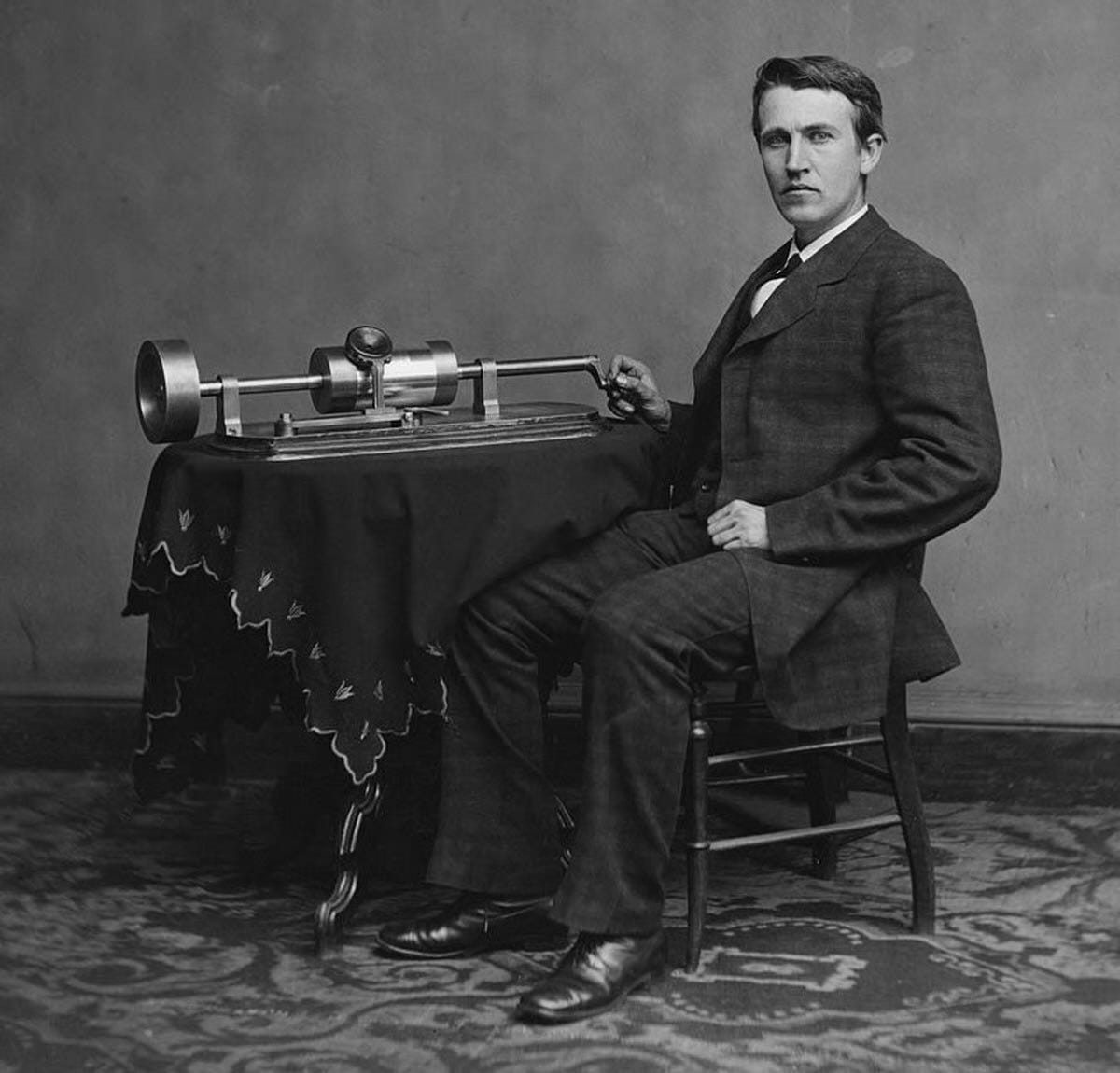
On this day in 1877, Thomas Alva Edison stunned the world by inventing the phonograph, the first device capable of recording and playing back sound. Working in his laboratory in Menlo Park, New Jersey, Edison was experimenting with ways to capture telephone messages when he realized that sound vibrations could be etched onto a rotating surface and later reproduced. Using a hand-cranked cylinder wrapped in tinfoil, he recorded the nursery rhyme “Mary Had a Little Lamb,” then played it back—astonishing everyone who heard it.
The phonograph was more than a scientific novelty; it marked the birth of sound recording and transformed entertainment, communication, and education. It paved the way for recorded music, radio broadcasting, and the modern audio industry. Edison’s invention forever changed how people experienced sound, allowing voices and music to be preserved and shared across time and distance.
Have a great weekend! If you are a free subscriber getting a chance to read this — now is the time to upgrade, so you get a similar email like this most Saturdays!
Jon