

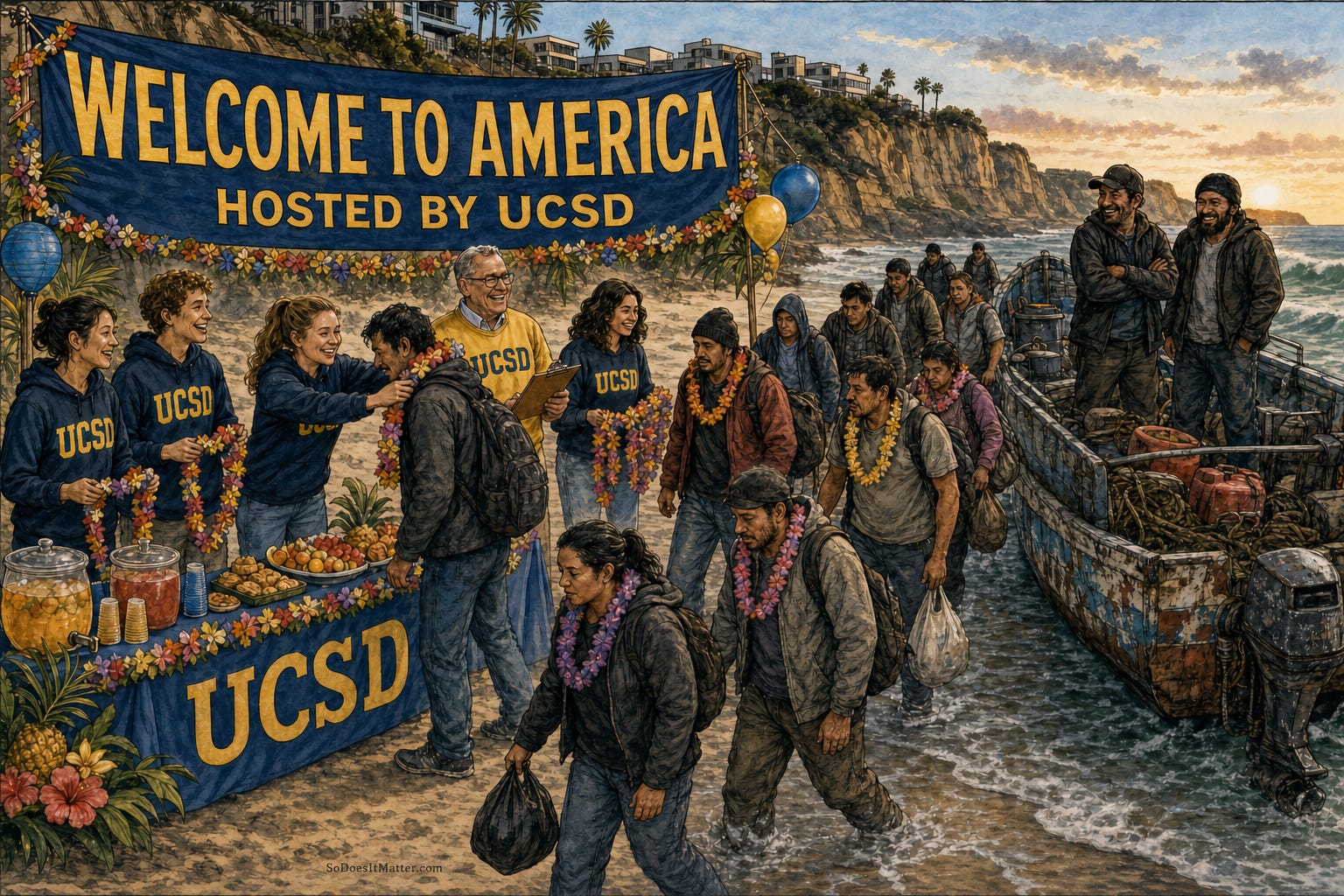
UC San Diego Surrenders At The Border
UCSD abandoned a coastal security partnership it said was legal, even as smugglers keep probing the Southern California coastline.

Typically, our afternoon content is behind a paywall — or there is something extra for our paid subscribers. If you are not one, please consider upgrading. You are missing a significant portion of what we produce each week, and your support makes it possible. If you want to get it all and support my efforts, please consider a paid subscription! Today there is exclusive content for paid subscribers below the paywall at the end of this column.
You can listen to this content on our Podcast — So, Does It Matter, Spoken! - on your favorite podcasting app. Or you can just go listen here.
🕒 5-minute read
UCSD Makes Its Retreat Indefinite
The Trump administration has driven illegal crossings at the southern land border to historic lows. This being California, the University of California, San Diego has chosen this moment to make its earlier retreat from coastal enforcement indefinite.
Under pressure from student activists, UC San Diego Police will no longer participate in Operation Stonegarden, a federal program supporting cooperation between Customs and Border Protection and local law enforcement. UCSD officers used it to patrol La Jolla, Black’s Beach and Torrey Pines for smuggling activity and illegal coastal landings.
What were these officers actually doing? They weren’t raiding dormitories or demanding to see students’ immigration papers. They were watching beaches used by criminal organizations to bring people and contraband ashore in small boats.
Success at the land border doesn’t put smugglers out of business. It pushes them toward alternatives, including Southern California’s long, accessible coastline.
A responsible university would recognize that danger. UC San Diego chose to back away.
What UCSD Was Actually Doing
UCSD Police had reportedly participated in Stonegarden since around 2012. Federal money paid officers to patrol nearby beaches roughly 20 nights a year and helped the department purchase night-vision binoculars.
Stonegarden did not turn campus officers into federal immigration agents. California law restricts local participation in immigration enforcement, while University of California policy bars campus police from questioning or detaining someone solely because officers suspect that person is here illegally.
UCSD therefore had a narrow supporting role. Its officers looked for human smuggling, drug trafficking and other crimes, investigated suspicious activity under their ordinary police authority and referred immigration matters to the federal agents responsible for them.
Apparently, even that was too much.
After CalMatters revealed the arrangement in February, student activist Aryan Dixit contacted Police Chief Lamine Secka and helped organize a rally. According to Dixit, Secka met with him the day before the event and promised that UCSD Police would leave Stonegarden and not seek another grant.
UCSD now says its officers have not conducted Stonegarden patrols since 2024, although the department remained connected to a grant agreement that extended beyond that year. That is hardly a defense. It suggests the university’s quiet retreat began before activists pressured officials to make it indefinite.
Students are free to protest. That freedom does not give them a veto over public safety or relieve administrators of their obligation to exercise independent judgment.
University officials should have explained the program, defended its legitimate purpose and disclosed as much information as possible. Instead, internal emails and the San Diego County Sheriff’s Office had to confirm what UCSD would not say publicly.
Smugglers Change Routes
Maritime smuggling isn’t some theoretical danger invoked to justify another federal grant. It is a deadly business operating along this very coastline.
In the spring of last year, a panga carrying 19 migrants capsized near Del Mar. Four people died, including children who were 10 and 14 years old. The Justice Department says the captains admitted working with a Mexico-based organization. Each passenger was paying approximately $13,500.
Vehicles were allegedly waiting to hide the passengers and carry them inland.
Last November, another suspected migrant vessel capsized off Imperial Beach, killing four people. Then, in mid-July, the Coast Guard intercepted a vessel entering Mission Bay with 21 people allegedly attempting to enter illegally. Sixteen had previously been ordered removed and were charged with attempting to reenter.
A little more than a week later, authorities intercepted another suspected smuggling boat six miles off Point Loma.
UCSD’s undisclosed reports make its precise enforcement record impossible to measure. They don’t make coastal patrols irrelevant. Smugglers aren’t fools. Their networks watch enforcement patterns, test routes and notice when agencies withdraw. Public confirmation that a local department won’t resume coastal patrols is useful information. To those planning the next landing, one fewer participating agency and less local coordination look like a welcome opportunity.
Border Patrol recorded roughly 237,500 apprehensions between southwest-border ports of entry in fiscal 2025, the lowest annual number since 1970. Crossings fell much further after Trump returned and restored detention and meaningful consequences.
The border crisis has receded. The people who made money from it haven’t gone away.
California Wants It Both Ways
California and UC have spent years restricting cooperation between local police and federal immigration authorities. UCSD was already confined to watching for smugglers, dangerous vessels and illegal landings, then referring immigration matters to federal agents. Now it is abandoning even that modest role.
Activists argued that Stonegarden damaged community trust, threatened undocumented and international students and enabled excessive surveillance. Yet UCSD officers were already forbidden from stopping people merely to question their immigration status.
If activists wanted better disclosure, they could have demanded it. Stonegarden reports were entered into a federal system and generally escaped local public-records requests. That called for greater oversight—not the abandonment of patrols along beaches smugglers demonstrably use.
“Community trust” can’t require police to ignore suspicious boats approaching secluded beaches at night. A panga might contain migrants being exploited by smugglers, previously deported offenders, narcotics, or all three.
Looking into that is ordinary police work.
This is the game California wants to play. Local agencies step aside, federal authorities have to fill the gap, and then California politicians complain that federal officers are too visible and too aggressive.
They can’t have it both ways.
So, Does It Matter?
No one claims that a single local police department controls the Southern California coastline. The point is what happens when department after department is pressured into backing away.
UCSD’s decision keeps its officers—and their knowledge of those beaches—out of an effort aimed at a coastline smugglers exploit. It also tells activists something worth remembering: Apply enough pressure and public institutions may retreat from legally authorized security programs.
California and UC can’t obstruct direct cooperation, eliminate indirect cooperation and then act scandalized when the Trump administration does the work on its own. Refusing to help doesn’t repeal federal law. It simply ensures that federal officers must enforce it with less local participation.
Border control won’t last if illegal entry still leads to years of residence with little meaningful risk of removal. Detention, prosecution, and removal provide the consequences that make deterrence credible.
California’s governing left objects to both local cooperation and federal officers acting alone. Some activists even oppose detention, let alone ejection —precisely what prevents illegal entry from becoming a dependable route into the country. They want immigration laws left on the books but progressively harder to enforce.
California may refuse to help enforce those laws. What it cannot honestly do is refuse that help—and then complain when the federal government comes in to do the job without California.
Three More Great And On-Point Political Cartoons
One of our most popular features is our political cartoons, like the one you see above this column. Below the paywall are three more great ones. There is just a lot of extra content each week here for our paid subscribers — please support this project and get more — by signing up today!
