

Two CNN Panels, One Big Question: What Will Decide the Midterms?
I joined Elex Michaelson and Democratic strategist Dave Jacobson to discuss Zohran Mamdani, election integrity, Arizona, Iran—and the issues that could shape November. We did two panels...

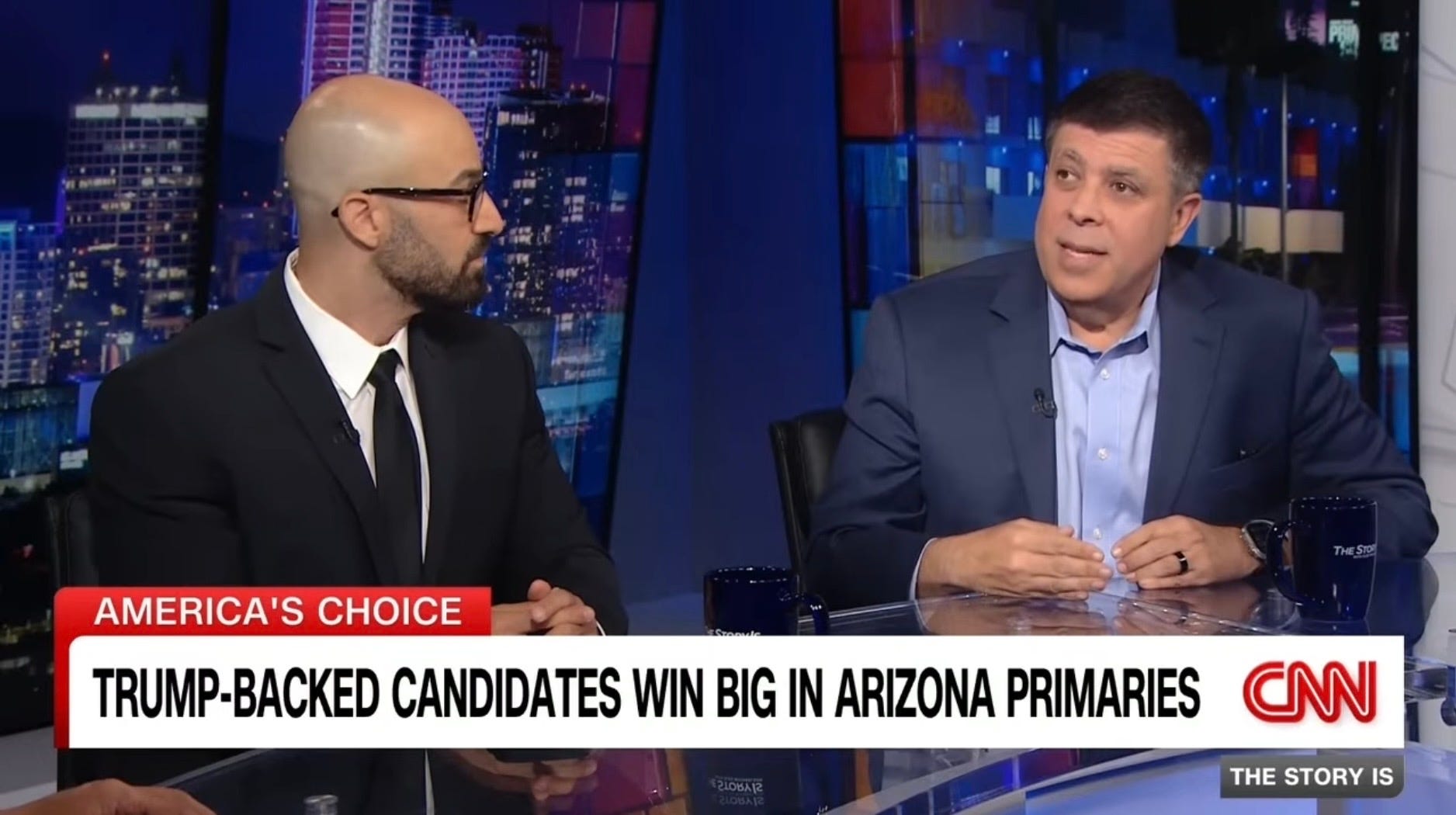
I made two appearances last night on CNN’s “The Issue Is…” with host Elex Michaelson and my co-panelist, Democratic consultant Dave Jacobson.
Across the two conversations, we covered an unusually wide political landscape: Zohran Mamdani’s transition from campaigning to governing, New Jersey’s voter-registration error, the battle for Arizona, control of Congress and the political consequences of the war with Iran.
Different issues, certainly. But they all lead back to the same question:
What happens when political promises collide with the realities of governing?
Mamdani, Netanyahu and election integrity
Our first conversation began with Zohran Mamdani walking back a major campaign pledge involving trying to potentially arrest Israeli Prime Minister Benjamin Netanyah were he to come to New York City.
Whatever one thinks of Mamdani or Netanyahu, the episode illustrates a recurring problem in politics: Candidates make promises that sound compelling on the campaign trail but prove impossible—or inadvisable—to carry out once they are responsible for governing.
Mamdani has received an extraordinary amount of national attention for a mayor. His carefully produced response video, complete with flags, an official setting and somber music, appeared designed to communicate that he had made the transition from candidate to officeholder.
But the trappings of office do not make the underlying contradiction disappear.
We then turned to New Jersey, where Governor Mikie Sherrill disclosed that a software error had improperly registered approximately 6,600 people to vote. According to the discussion, roughly 400 of those people subsequently voted.
I praised the governor for identifying the problem and addressing it transparently. That is how public officials should respond when the system fails.
The incident also raises a commonsense question: Why shouldn’t election officials use every reliable source of information available to keep voter rolls accurate?
The tolerance for ineligible voting should be zero. At the same time, confidence in elections depends on transparency, credible evidence and officials who can communicate without turning every administrative error into a partisan weapon.
Watch the first CNN panel below:
Arizona, the battle for Congress and the Iran war
In the second panel, we looked ahead to the midterms, beginning with Andy Biggs’ victory in Arizona and his coming contest against Democratic Governor Katie Hobbs.
Democrats will portray Biggs as an ideological extremist. But having spent time with both Biggs and Kari Lake, I believe voters will see a significant difference in temperament. Biggs is far more restrained in his personal style—and unlike Lake, he has repeatedly appeared on Arizona ballots and won.
Arizona also has hundreds of thousands more registered Republicans than Democrats. Independent voters will be critical, but neither party can ignore that underlying advantage.
The conversation then expanded to control of Congress and the central strategic question facing Trump’s political operation: What will happen to the more than $300 million reportedly held across its various committees?
Will that money be used to protect Republican congressional majorities? Will it be preserved for a preferred successor? Or is it destined for some other purpose?
Money alone will not solve the GOP’s problem. President Trump also has to focus his message on the issues that will move persuadable voters. A prime-time address centered on the SAVE Act is unlikely to do that.
And then there is Iran.
Trump may have expected a short, decisive operation. Instead, he appears to be caught in a conflict that is difficult to exit. If the war continues and gasoline prices remain elevated, the political consequences for Republicans could be severe.
The president still needs to make a clear case to the American people: Why did we enter this war? What does victory look like? What will it require? And how does it end?
You cannot win an argument you are not making.
Watch the second CNN panel below:
Always love feedback! Just hit reply or the button below.