


🕒 7-minute read
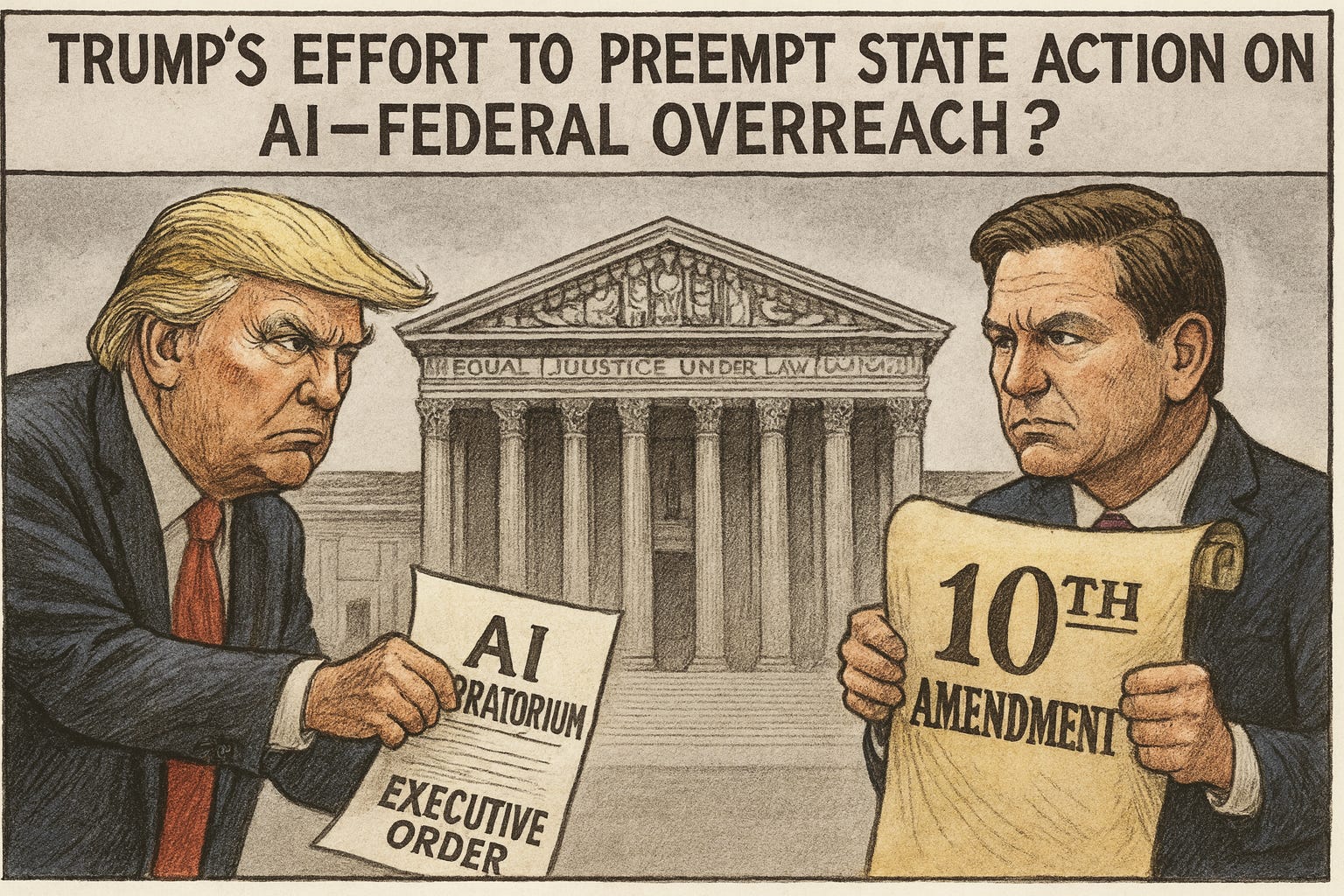
This column had a paywall when it was released nearly a week ago. It is not unlocked so everyone can read it! Also, since this was originally published the President, in fact, signed his constitutionally questionable Executive Order to try and shut down states from developing and implementing AI policies.
A Technology Debate That Is Really a Constitutional Debate
Donald Trump’s announcement that he intends to issue an executive order to block states from regulating artificial intelligence instantly sparked a national debate over innovation, competitiveness, and the future of one of the fastest-developing technologies in the economy. Supporters argue that a single national framework is needed to avoid a confusing patchwork of rules. Critics counter that such a move would crush state authority and consolidate sweeping domestic power in the executive branch.
Most of the public discussion has centered on policy. But beneath that policy dispute lies a more fundamental issue: federalism. The real question is not merely how artificial intelligence should be regulated, but which level of government is empowered to make those decisions in the first place.
Federalism is the principle that divides power between the federal government and the states. The national government is granted specific powers, and everything else remains with the states or the people. This structure was designed as a safeguard against the concentration of political power.
The Tenth Amendment makes that design unmistakably clear:
“The powers not delegated to the United States by the Constitution, nor prohibited by it to the States, are reserved to the States respectively, or to the people.”
Artificial intelligence is nowhere mentioned in the Constitution. That does not resolve the debate, but it does frame the central question: by what constitutional authority does a president declare that states are forbidden from acting in this policy space?
Why DeSantis’s Response Matters
Few elected officials responded more forcefully to Trump’s announcement than Florida Governor Ron DeSantis, whose reaction was immediate and unequivocal.
“This is not how our constitutional system works,” DeSantis said. “States are not satellites of the federal government. We are sovereign entities with our own responsibilities to our citizens, and no president can erase that with the stroke of a pen.”
DeSantis was not debating whether artificial intelligence will require regulation. He was defending the foundational principle that states retain inherent authority unless the Constitution clearly says otherwise. He went further, warning that allowing executive preemption would establish a dangerous precedent: “If Washington can nullify state law on AI today by executive order, it can do the same to any other area of state policy tomorrow. That is not federalism. That is consolidation of power.”
Congress may legislate within constitutional bounds. Presidents do not possess a free-standing power to erase state authority simply because a technology is economically significant or politically urgent. That distinction is essential to preserving the constitutional balance.
The California Paradox
From California’s vantage point, this debate becomes even more uncomfortable. There is virtually no major policy coming out of Sacramento today that inspires confidence. Trusting the governor and legislative supermajorities to craft restrained, technically sound regulation for artificial intelligence does not come naturally.
That concern is not abstract. California lawmakers are already advancing proposals that would impose disclosure mandates on AI developers, expand employer liability for algorithmic decision-making, and regulate automated hiring systems under the state’s civil rights code. Whether those rules prove wise or misguided remains to be seen—but under our constitutional system, those choices belong to Californians and their elected representatives, not the Oval Office.
Yet federalism does not depend on whether a state legislature uses its authority well. The framers did not design the system so that states retained power only when outsiders approved of the policies they produced. Power was meant to remain decentralized as a permanent structural protection against centralized rule.
States were intended to operate as laboratories. Some will regulate aggressively. Others will proceed cautiously. Over time, the results become visible, and policy evolves through experience and correction. That process is imperfect, but it is far safer than vesting sweeping domestic authority in a single executive office.
The Guardrail Problem
The central issue raised by Trump’s proposed executive order is not simply whether national uniformity is desirable. It is whether the presidency now claims the authority to unilaterally erase entire categories of state power that have historically been regarded as core components of state sovereignty.
If a president can preempt states on artificial intelligence today, what prevents the same theory from being applied tomorrow to education policy, land use, energy production, or healthcare? Once executive orders function as national vetoes over state law, the constitutional boundary between federal and state power ceases to operate as a meaningful limit.
At that point, federalism exists only so long as it is tolerated by whoever occupies the White House. That is not a constitutional safeguard. It is permission-based governance.
How Today’s Supreme Court Is Likely to View This
If a sweeping AI preemption executive order is issued, it is almost sure to reach the Supreme Court quickly. The Court’s current view of executive power is more nuanced than simple expansion or contraction. That complexity was on display as recently as yesterday morning during oral arguments in Trump v. Slaughter, where several justices appeared open to strengthening presidential control over federal agencies’ internal operations.
Beneath this dispute also lies a broader constitutional history that has shaped federal power for nearly 90 years. Since the New Deal era, Washington has steadily expanded its reach into areas once understood as core state authority by relying on an increasingly elastic reading of “interstate commerce.” That jurisprudence did not begin with artificial intelligence, but AI now presents one of the clearest modern tests of how far that logic may extend.
But that institutional sympathy for executive authority has clear limits. In recent years, the Court has drawn a firm constitutional boundary when executive action crosses into areas of vast economic and political consequence. Under the “major questions doctrine,” the justices have insisted that transformative policy decisions require unmistakably explicit congressional authorization. A unilateral presidential effort to override state authority across the AI regulatory landscape would almost certainly fall into that category. The Court may tolerate stronger executive management within the federal government, while remaining deeply skeptical of executive actions that reorder the federal-state balance.
So, Does It Matter?
Artificial intelligence will transform medicine, transportation, national defense, education, and creative industries. Regulation will be necessary. What is in dispute is who gets to decide—and by what constitutional authority.
If the answer becomes “the president, acting alone,” then the AI debate becomes something far more consequential than a technology fight. It becomes a quiet but profound shift in the balance of constitutional power that governs nearly every aspect of domestic life.
Federalism was never designed for efficiency. It was designed to prevent the accumulation of authority in a single set of hands. Once that protective friction is removed, what remains is not innovation policy. It is a centralized rule by executive decree.
And that is a tradeoff the country should consider very carefully—regardless of who signs the order.
If you value independent analysis that calls balls and strikes on California and national politics without marching to a party script, this is where that work continues. Your paid subscription unlocks nearly 40% more of our content, supports daily reporting and long-form analysis like this, and helps keep
Please share So, Does It Matter? With others you think care about our state!
Trump’s position on this is hopeless unless he can find another “emergency” power granted by Congress. Federal statutes pre-empt most state laws, but Executive Orders have no power over states in the absence of an authorizing Federal law.