

Tonight’s Debate May Be The Last Best Chance For Someone To Break Out - Let's Break Down What Each Candidate Needs To Do...
With ballots arriving next week, California’s would-be governors are running out of time to prove this race is more than a crowded exercise in political sameness.

You can listen to this post on our podcast feed, So, Does It Matter? SPOKEN. It’s available on your favorite podcasting app, or you can find it here. Our afternoon content is typically for our paid subscribers. Certain columns, like this one, are made available to all of our readers.
Normally, I tuck “extra cartoons” under the paywall for my paid subscribers. This time, I am including them so that free subscribers can see what they are missing. Just one more plus for upgrading (there are a lot of upsides).
⏱️ 6.5 min read (This one’s a little longer!)
The “Debate Of The Week” Is Upon Us…
Tonight brings us the next installment of what is starting to feel like a weekly debate series in the race to become California’s next governor. This one is scheduled for 5:30 p.m. at Pomona College’s Bridges Auditorium in Claremont. It is being hosted in partnership with CBS California, APAPA, and Pomona College, and it should be available across CBS’s California stations and streaming platforms.
The confirmed candidates are former Obama Health and Human Services Secretary Xavier Becerra, Riverside County Sheriff Chad Bianco, former Fox News host Steve Hilton, San Jose Mayor Matt Mahan, former Congresswoman Katie Porter, billionaire former hedge fund poobah Tom Steyer, Superintendent of Public Instruction Tony Thurmond, and former Los Angeles Mayor and former Assembly Speaker Antonio Villaraigosa. That is a lot of candidates. And it raises the obvious question: Will tonight’s debate actually matter?
Last week’s debate did not. No one melted down. No one broke through. No one delivered the kind of moment that changes the trajectory of a campaign. Tonight could be different. But two things stand in the way: the format and whether anyone is actually paying attention.
The Format May Is The First Problem
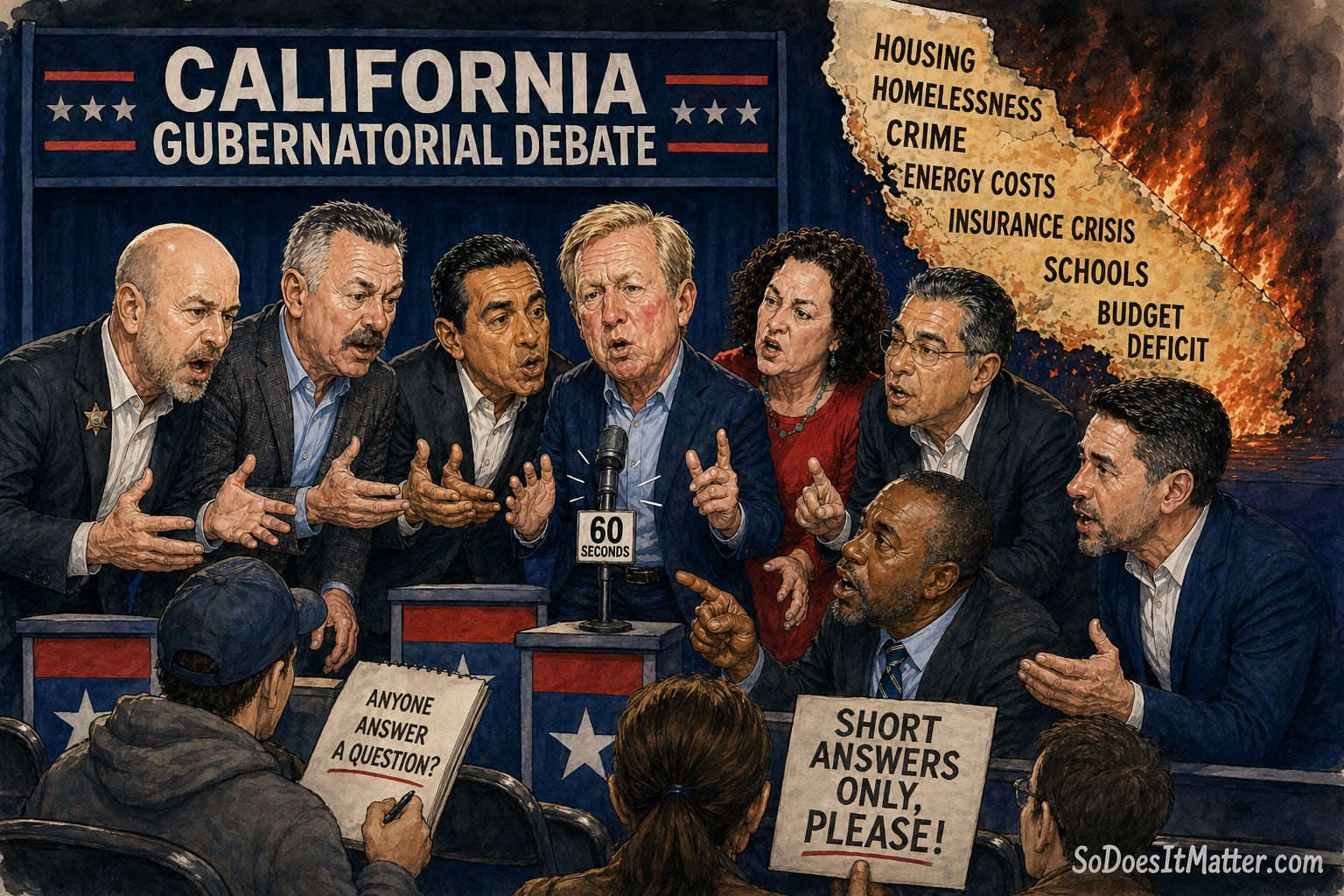
Eight candidates on one stage is a lot. That is not really a debate so much as a political speed-dating exercise with better lighting. CBS says tonight’s forum will include opening statements, a moderated discussion, and closing remarks, with a focus on public safety, housing, immigration, and the economy. Those are the right subjects, but with eight candidates, multiple moderators, and the usual debate mechanics, the time available for any one candidate to actually make a sustained case becomes painfully limited.
That is the problem. California’s challenges do not lend themselves to 60-second slogan answers. Housing is broken. Homelessness is everywhere. Crime and disorder remain major public concerns. Energy costs are brutal. Insurance markets are collapsing in parts of the state. Schools are underperforming. The budget is a mess. A serious debate would force the candidates to explain what they would actually do with the powers of the governor’s office.
But crowded debates tend to reward performance over substance. They reward the interruption, the canned line, the artificial contrast, and the candidate who knows how to create a social media clip. They punish patience, detail, and seriousness. That is bad for voters, but it is reality. If a candidate wants to break through tonight, he or she cannot merely be informed. They have to be memorable.
The Bigger Problem Is That Voters May Not Be Watching
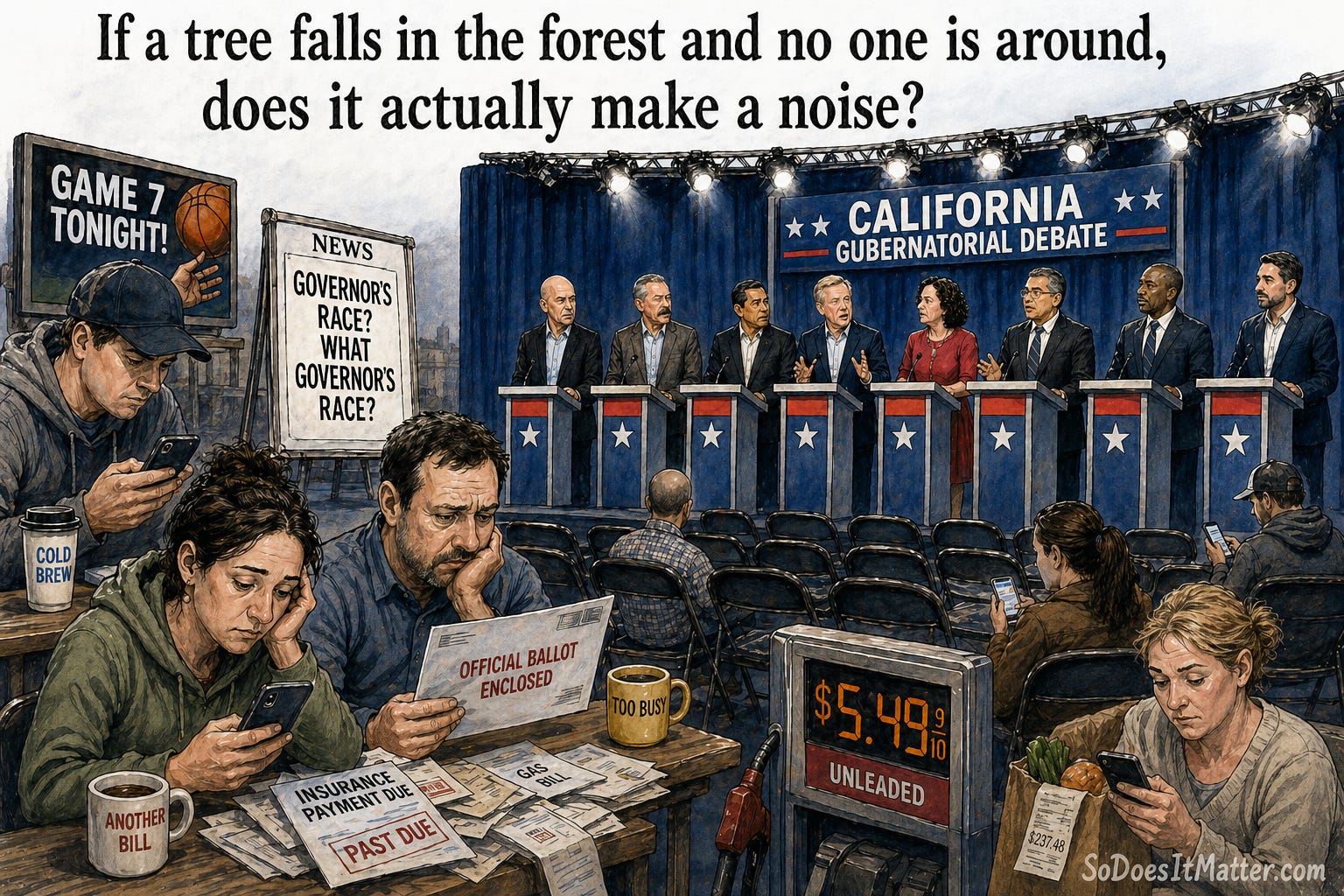
The more alarming problem is not the stage. It is the audience. Are Californians paying attention? They should be. Ballots start going out next week. Millions of Californians will soon have live ballots sitting on their kitchen counters. They can fill them out, mail them back, and move on with their lives long before most people have focused on the race.
That is a serious problem in a wide-open governor’s race. For months, this campaign has had a strange quality to it. It is important, but not urgent. It is consequential, but not dominant. Everyone in politics knows the race matters. The next governor will inherit a state with massive structural problems. But outside the political class, it still feels like much of the electorate has not locked in.
That creates risk. In a top-two primary, a fragmented field can produce strange outcomes. The winner does not need a majority. A candidate just needs enough voters, in the right lane, while everyone else splits the rest. That is why these debates matter. They are not just about who “wins” a night. They are about whether any candidate can become real to voters who are only now tuning in.
What Each Candidate Needs To Do Tonight
Start with the Republicans.
STEVE HILTON
Steve Hilton is the Republican frontrunner, and for him, the debate has to accomplish two things. First, he needs to remind voters that he is proud to be endorsed by President Trump. Yes, the president is generally unpopular in California, but he remains very popular among likely Republican voters who will be turning out in this June election. For Hilton, the endorsement is a key factor in the primary, even if it would become a challenging factor in the drive toward November if he makes the top two.
Second, Hilton needs to do what he is already capable of doing: demonstrate that he can govern on day one. He has policy chops, so this should be easy for him, but he still needs to show it. And more than anyone in the last debate, Hilton seemed willing to jab other candidates and press the debate format as much as the format allowed. He needs to keep doing that.
CHAD BIANCO
Sheriff Chad Bianco needs to continue impressing upon people his public safety background. That is a big issue for him and one of the clearest reasons voters might give him a serious look. But this is also a debate in which he probably needs to demonstrate some policy chops. Not a lot. Just enough so that voters do not feel like he is simply a one-line populist.
That matters because Bianco’s secret weapon may be independent voters. There are independents who could be very interested in his law enforcement background. But those voters are not necessarily populists. They will want to know that Bianco has enough going on to step in and start running the state on day one.
Then come the six Democrats.
XAVIER BECERRA
Xavier Becerra is now a top-tier candidate based on recent polling, and he needs to consolidate the experienced-candidate lane. That means he will have to restate his résumé if the moderators do not do it for him. But the résumé alone is not enough. Becerra needs to get specific about what he would actually do.
His problem is that he tends to be vague and bureaucratic. He needs sharp, memorable answers. He may also need to explain whether he is the continuation of Gavin Newsom or would make real changes from what Newsom is doing. I am not sure the format will let him get away with that, but it is the question sitting underneath his candidacy.
TOM STEYER
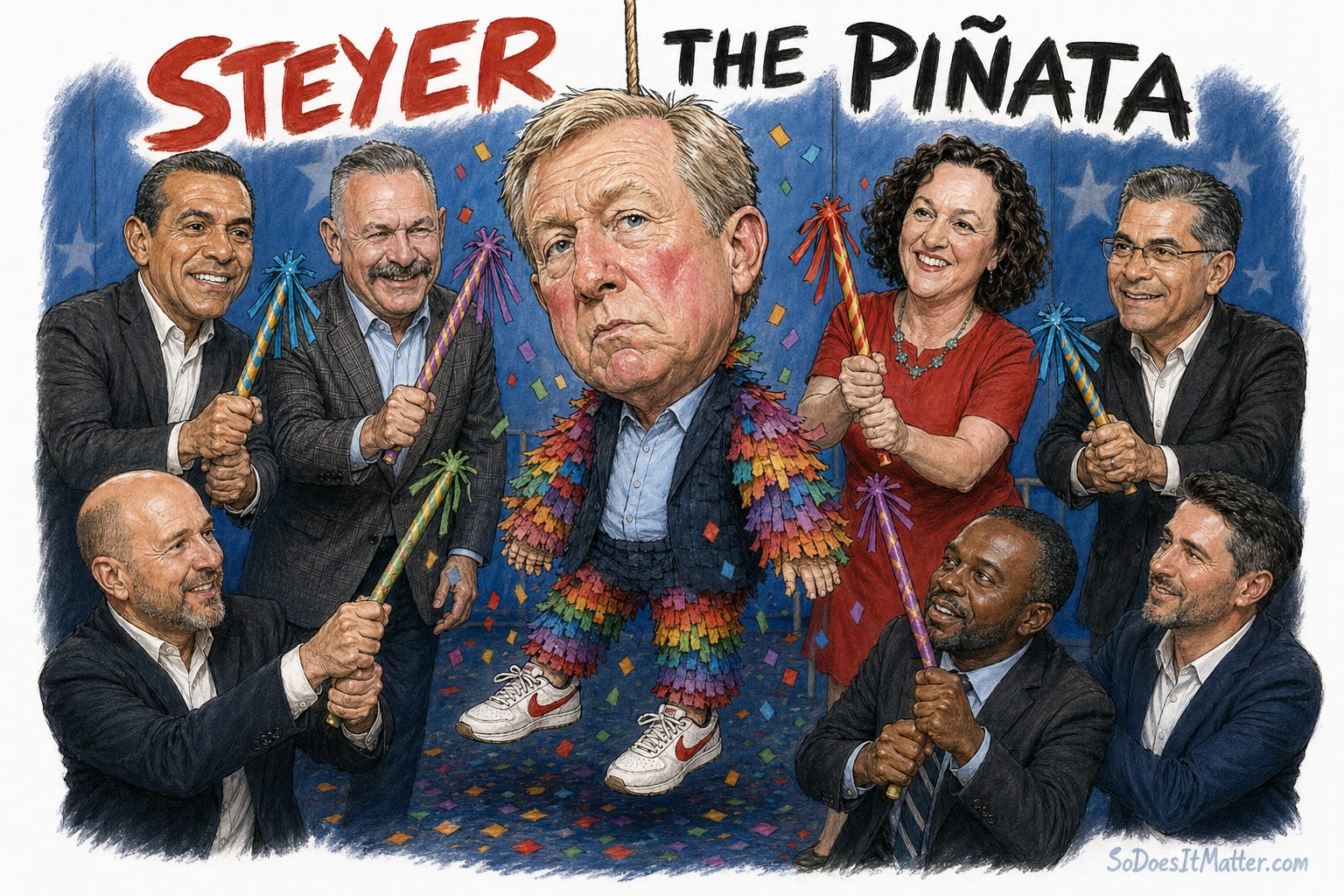
Tom Steyer needs to survive being the human piñata. He is rich, self-funded, and ideologically progressive, which makes him a big target. His task is to remind people that he cannot be bought and that he is not waiting for anyone's permission.
But Steyer also needs to demonstrate an ability to govern if he wants to drive up his polling numbers. That means figuring out how to stop being so hyperbolic in these debates and instead come across as clear-eyed about what he would actually do. Maybe he needs to talk about things he would do on day one that do not sound outrageous. Not “I am going to fund a ballot measure.” Not “I am going to do these extreme things.” He needs to show how he would be hands-on without coming across as a chaotic change agent.
KATIE PORTER
Katie Porter needs a breakout moment. She has basically hit the top of what she can get from her existing base, so if she is going to grow, she needs to do something more.
First, she has to demonstrate her policy chops. But the most important thing she needs to do is give Tom Steyer the whiteboard treatment. Even if she has to upset the moderators to do it, she needs to laser-focus on him and go after him. She needs to take on the billionaire and hit him hard in a way that causes people to say, “Whoa, now there is a fighter who understands what she is doing.” If she does not, she risks getting bogged down by her own negatives.
MATT MAHAN
Matt Mahan comes across as the practical, sane, results-oriented Democrat. In a word, a moderate. His lane is competence, local government, accountability, and the basic argument that he actually runs a city. But the problem is that there is a ceiling on that. With eight people on stage, Mahan cannot simply be the reasonable guy. There is not enough bandwidth for that. He is going to have to come out punching pretty hard. Temperamentally, he is going to have to try to be someone he is not, and he is really going to have to get aggressive.
That is a risk. But it is a risk he needs to take, because right now he is selling oatmeal, and nobody is buying oatmeal. Maybe that means getting aggressive against Trump, which he has not really done. Maybe it means getting aggressive against Steyer, which he has done a little bit. But he needs a breakout moment to show that he can get out of the single digits. That is not going to happen if he performs the way he did in the last debate.
ANTONIO VILLARAIGOSA AND TONY THURMOND
Finally, we have the also-rans: Antonio Villaraigosa and Tony Thurmond. Both have been polling so poorly that it is hard to see how a single debate could resuscitate their campaigns. But that is the reality they are facing. They are the candidates who probably need to do something unpredictable, and frankly outrageous, if they are going to get noticed.
That is the lousy part about being down in the doldrums. You do not get the luxury of playing it safe. You have to throw a Hail Mary. Thurmond is temperamentally equipped to go crazy tonight, I suppose, though I am not sure it will matter. Villaraigosa does not really have much craziness in him, so that will be a big challenge for him.
So, Does It Matter?
In the end, all of these candidates could do what they need to do tonight and still produce a status quo outcome. That is the strange reality of this race. Ever since former Vice President Kamala Harris and U.S. Senator Alex Padilla (and Attorney General Bonta, to a lesser extent) decided not to run, the campaign has been stuck with a field of B-level candidates. Some are accomplished. Some are interesting. Some have real constituencies. But none has broken through in a truly dominant way.
Eventually, this will sort itself out. Someone will win. Two candidates will advance. California will get a new governor. But for now, the race still feels oddly underdeveloped for something this consequential. Maybe tonight at Pomona College, in front of the CBS cameras, someone finally creates a real moment. Or maybe it is another ho-hum evening, and we just keep plodding along.