

Threats Against AI Executives Remind Us How History Turns Inventors Into Villains
Threats against AI executives reveal a familiar historical pattern: fear of new technology quickly finds human villains.

Our morning content is free for all subscribers and guests! Usually our afternoon content is behind a paywall… If you are not yet a paid subscriber, consider upgrading — you are missing a significant portion of what we produce each week, and your support makes it possible. If you want to get it all and support my efforts, please consider a paid subscription! There is exclusive content below this column for paid subscribers…
Most of our content is available on our podcast feed. So, Does It Matter? SPOKEN. Which is available on your favorite podcast app. You can listen to it right here as well.
🕒 6 min read
The Story That Sent Me Down A Rabbit Hole
Every morning I read through dozens of newspapers, websites and policy publications looking for stories that deserve a closer look. One of those daily stops is The Wall Street Journal.
One headline immediately caught my attention:
“The AI Backlash Has Tech Executives Fearing for Their Lives.”
At first glance, it sounded like another story about angry people on the internet.
It wasn’t.
The Journal detailed a disturbing series of threats against executives and employees at companies like OpenAI and Anthropic. It reported on an alleged attempted firebombing at OpenAI CEO Sam Altman’s home, death threats against AI leaders, and companies quietly increasing executive security as artificial intelligence becomes more deeply woven into everyday life.
The story itself was compelling. But what really captured my attention wasn’t the violence.
It was the history.
I found myself wondering whether we’d seen this before. Not artificial intelligence specifically, but public anger becoming focused on the people behind disruptive technologies. After spending the next hour digging into history, I came away convinced that we have.
Fear Finds A Human Face
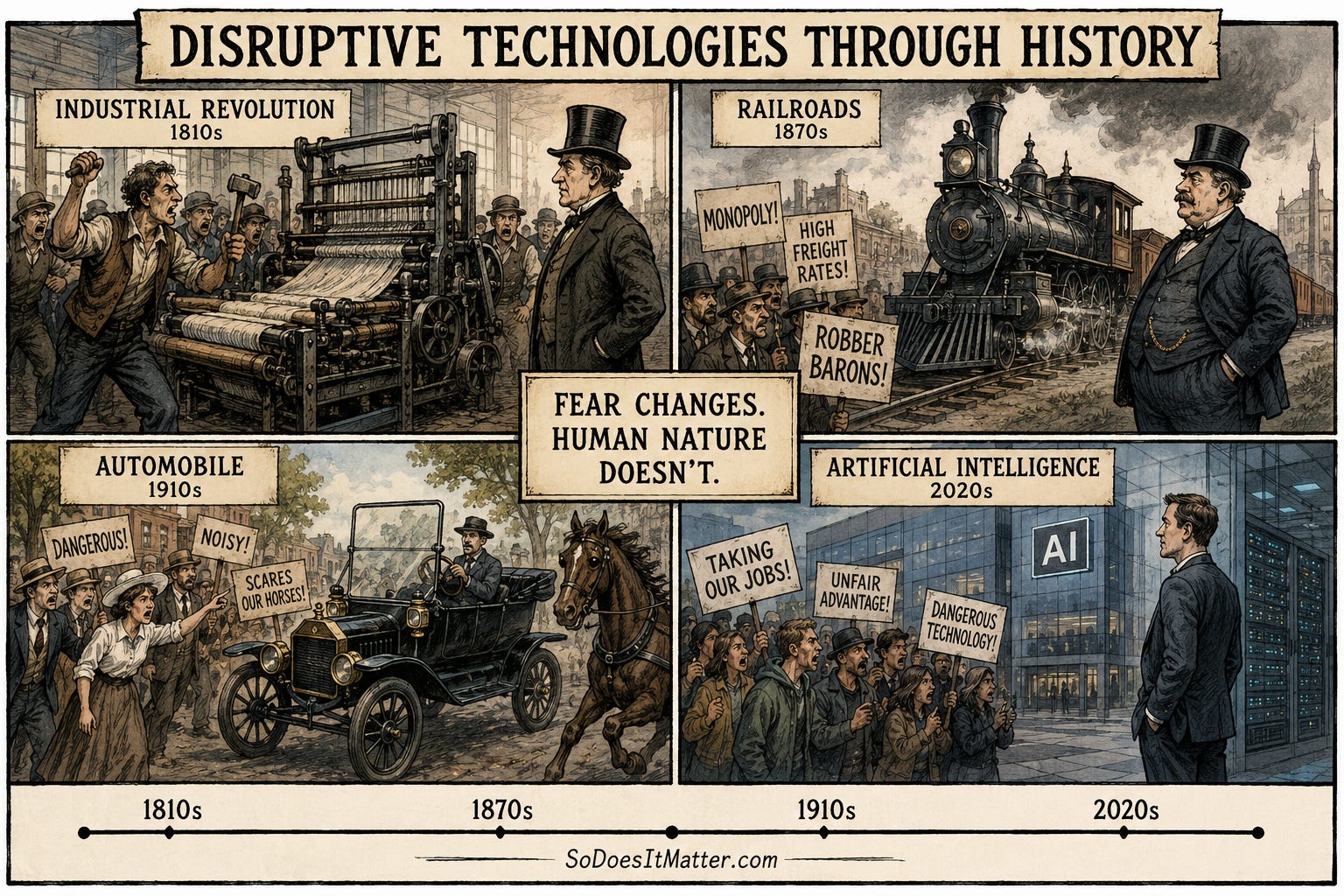
One of history’s recurring patterns is that public fear of disruptive technology rarely remains focused on the technology itself. Before long, it finds human faces to blame.
Perhaps the clearest example came during the Industrial Revolution.
Today, the Luddites are often remembered simply as people who smashed machines. But the story was more complicated than that. Skilled textile workers believed new machinery threatened their livelihoods while making wealthy mill owners even richer. Their anger quickly shifted from the looms themselves to the factory owners installing them. Mills were attacked. Owners received threats. The British government ultimately deployed thousands of troops to restore order, and some participants were executed.
The technology started the conflict.
People became the target.
When Innovation Gets A Face
The pattern didn’t end there.
As railroads transformed America in the nineteenth century, industrialists and railroad magnates became lightning rods for public resentment. The so-called “robber barons” became symbols of rapid economic change, widening inequality and corporate power, whether they deserved all of that blame or not.
The automobile followed a similar trajectory. Americans initially feared cars as dangerous machines that killed pedestrians, frightened horses and upended daily life. Before long, Henry Ford himself became a polarizing symbol of the transformation reshaping the country.
We could keep going. From the railroads of the nineteenth century, to nuclear power in the twentieth, to Amazon’s reinvention of retail and Uber’s disruption of transportation in the twenty-first, history keeps repeating itself. First comes the disruptive technology. Then comes public anxiety. Finally, that anxiety finds human faces to blame.
The names change. The inventions change.
Human nature doesn’t.
Why AI Feels Different
Artificial intelligence, however, may be producing an even more personal reaction than many earlier innovations.
Previous technological revolutions primarily threatened manual labor. AI has convinced millions of lawyers, programmers, accountants, designers, consultants, writers and countless other white-collar professionals that their own careers could someday be at risk.
Ironically, many of the industry’s own leaders have helped reinforce those fears.
For the past two years, AI executives have openly discussed how dramatically the technology could reshape the workforce. Others have warned that AI poses an existential risk to humanity. Americans have opened their newspapers to predictions that millions of jobs could disappear, entire professions could be transformed and humanity itself could eventually lose control of the technology it created.
Those warnings were intended to demonstrate AI’s extraordinary power.
But many workers heard something entirely different.
They heard that some of the wealthiest people in the world were telling them their jobs might disappear.
Whether that interpretation is fair or not is almost beside the point. History suggests that once enough people begin to fear a disruptive technology, the public rarely remains angry at the invention itself.
It starts looking for the people responsible.
So, Does It Matter?
None of this excuses violence. It never has.
But it does help explain why The Wall Street Journal’s story didn’t surprise me as much as it probably should have. For the past two years, Americans have been inundated with warnings that artificial intelligence could replace millions of jobs, transform society and perhaps even pose an existential threat to humanity. Heck, I have written some pretty dramatic cautionary words of my own, about the potential negative impacts of AI on the fundamental societal institutions needed to maintain our American way of life.
After reading headlines like those day after day, who wouldn’t feel at least some anxiety?
Most people channel that anxiety into curiosity, debate or calls for regulation. A tiny, dangerous minority goes looking for someone to blame.
And that’s the uncomfortable lesson history keeps teaching us. Public fear rarely remains directed at a disruptive technology for very long. Eventually, it finds the executives, inventors and entrepreneurs believed to have unleashed it.
Artificial intelligence doesn’t have a home address.
The people building it do.
There’s More… Below the Paywall
Read the entire WSJ article that inspired this column…
Keep reading with a 7-day free trial
Subscribe to So, Does It Matter? On CA Politics! to keep reading this post and get 7 days of free access to the full post archives.