

The Upcoming SCOTUS Case That Could Put Asset Forfeiture On Trial
It will not dismantle the system, but even an incremental check on legalized government excess would be welcome.

Typically, our afternoon content is behind a paywall — or there is something extra for our paid subscribers. If you are not one, please consider upgrading. You are missing a significant portion of what we produce each week, and your support makes it possible.
You can listen to this and all of our content on our podcasting channel, So Does It Matter? SPOKEN! You can find it on your favorite podcasting app, or right here.
🕒 5-minute read
A Legal Nerd Alert
Unless you know me pretty well—and perhaps even if you do—you may not know that I am a nerd for constitutional law. I am especially fascinated by the inner workings of the federal courts and, of course, the Supreme Court.
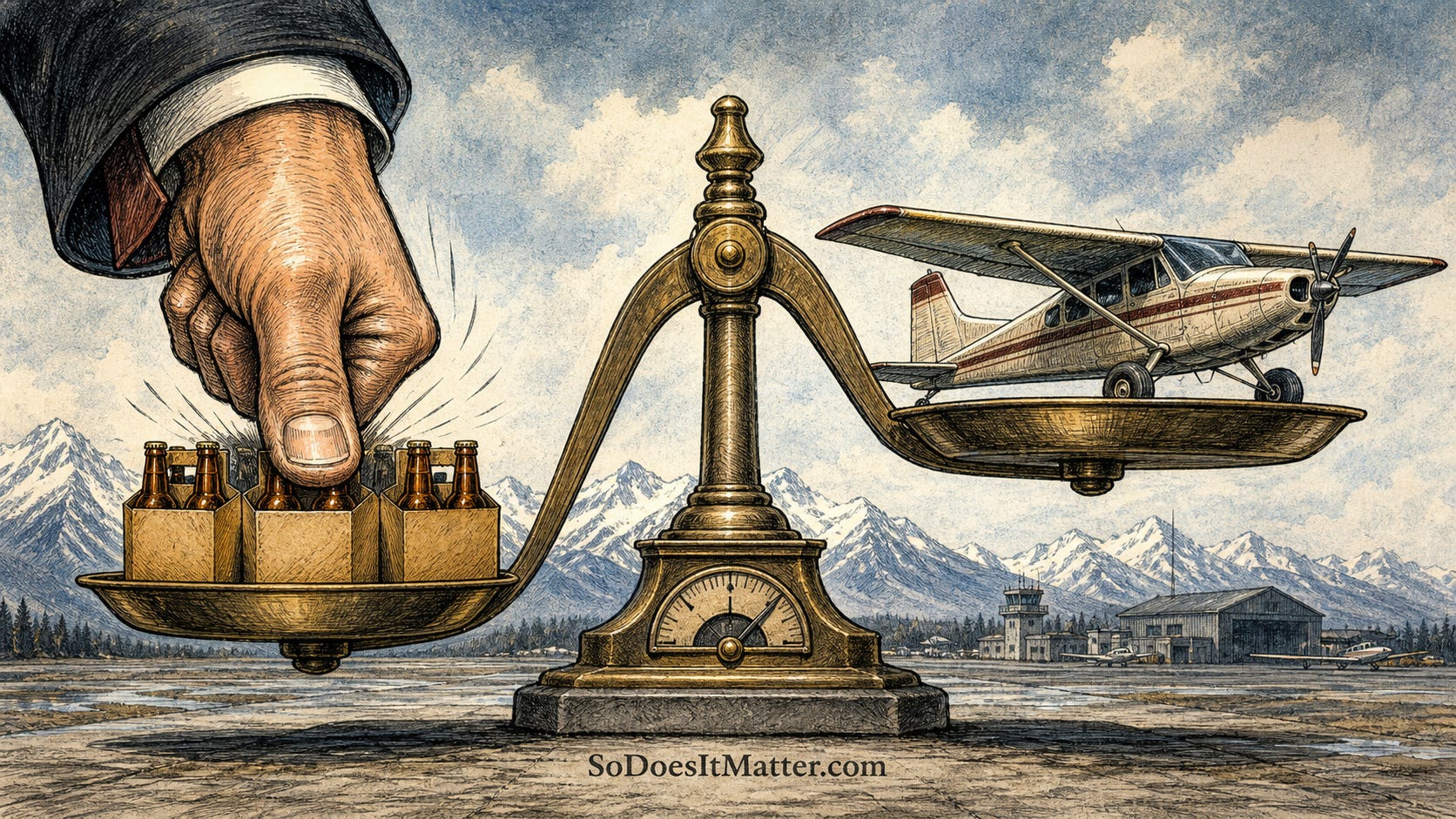
That is why I subscribe to Advisory Opinions, the podcast from The Dispatch where Sarah Isgur and David French engage in upper-division legal nerdery at least twice a week. Their latest episode sent me down a rabbit hole involving an obscure Supreme Court case, a six-pack of beer and a $95,000 airplane.
It is a strange little case. It could also change how easily the government can take someone’s property.
The $95,000 Misdemeanor
The case is Jouppi v. Alaska. In 2012, Kenneth Jouppi was hired to fly a passenger from Fairbanks to Beaver, a remote Alaskan village where the importation, sale, and possession of alcohol are prohibited.
Jouppi flew a 1969 Cessna 206, a small, single-engine bush plane built to carry only a handful of people. It is the kind of plane where you sit within arm’s reach of the pilot and, if you are not accustomed to bush flying, spend at least part of the trip wondering whether you have made a terrible mistake.
Before the plane could leave Fairbanks, troopers found three cases of beer aboard—approximately 72 beers in all. Most were packed with the passenger’s groceries. But at least one six-pack was sitting in a shopping bag where prosecutors said Jouppi could not have missed it.
The plane never left the ground. But Alaska law defines transporting alcohol to include attempting to transport it, and a jury convicted Jouppi of a misdemeanor under instructions allowing knowledge to be established through deliberate ignorance. He received three days in jail, three years of probation and a $3,000 fine, with $1,500 suspended.
Then Alaska came for his $95,000 airplane.
To be clear, this was not the classic case of an innocent mother whose car was secretly used for a drug deal. There was plenty of beer aboard, Jouppi owned the air-taxi company, and Alaska has good reasons to protect isolated communities with limited police resources from bootlegging. State law mandates the forfeiture of aircraft used to transport alcohol into dry villages.
Even so, taking a $95,000 airplane over a misdemeanor is a lot of government punishment.
When Property Pays The Police
I do not have to believe Jouppi was innocent to be uncomfortable with what happened to him. I have long been skeptical of asset forfeiture, particularly when the government agency taking the property stands to benefit from keeping it.
Civil forfeiture is where things get especially strange. In a judicial civil-forfeiture proceeding, the government brings its case against the property itself, which is how we end up with absurd names such as United States v. $92,000 in Cash. Other seizures can be completed administratively unless the owner files a timely challenge.
There is a process on paper. In practice, the owner may have to meet strict deadlines, decipher an unfamiliar system, and hire a lawyer who costs more than the seized property. Plenty of people simply walk away.
Jouppi did receive a criminal trial, so his case does not directly address those due-process problems. His argument involves a different constitutional protection: the Eighth Amendment’s prohibition against excessive fines. Still, the financial incentive running through the larger forfeiture system is hard to ignore.
The Justice Department’s forfeiture fund received $2.422 billion in fiscal 2024 and paid approximately $369 million through “equitable sharing” to participating law-enforcement agencies. Those payments rose to $540 million in 2025. The separate Treasury Forfeiture Fund reported another $2.263 billion in fiscal 2024 revenue.
That is more than $4.6 billion flowing into two federal funds in one year, before counting forfeitures handled exclusively under state and local law.
These are not all police slush funds. Some of the money is returned to victims or innocent third parties, and some pays the cost of running the system. But hundreds of millions still flow back to law-enforcement agencies.
As Isgur put it, “It’s the budgeting problem.”
Police budgets should be set through taxation and legislative appropriations—not determined in part by how much property an agency manages to confiscate.
What Jouppi Could Change
Now we arrive at the constitutional-law part.
The Supreme Court has held that a punitive forfeiture violates the Eighth Amendment when it is “grossly disproportional” to the underlying offense. The question in Jouppi is how a court is supposed to decide how serious that offense was.
The Alaska Supreme Court considered facts specific to Jouppi, including the quantity of beer, his role as pilot and operator, and the jury’s finding that he was deliberately ignorant. When assessing the gravity of the offense, however, the court also zoomed out. It considered the broad consequences of alcohol abuse in rural Alaska: violence, addiction, public-health costs and death. Viewed from that altitude, even one six-pack could be connected to grave social harm.
Jouppi wants the justices to zoom in. Was he running a bootlegging business, or was this an isolated incident? Did he earn additional money by allowing passengers to carry alcohol? How much did he knowingly transport? What harm did this particular attempt cause?
If the government gets to describe every offense at the highest possible level of abstraction, almost any forfeiture can be defended. A low-level drug offender becomes responsible for the opioid epidemic. A traveler who violates a currency-reporting rule becomes the equivalent of an international money launderer.
If the Court adopts Jouppi’s proposed rule, lower courts would have to look more closely at the individual, the conduct, and the punishment before allowing the government to take a valuable car, home, business, or airplane. Because the Eighth Amendment also applies to punitive civil forfeitures, the effects might extend beyond criminal cases like his.
So, Does It Matter?
The Supreme Court granted review in Jouppi on July 20. The case will not abolish civil forfeiture, end equitable sharing, or require a criminal conviction every time the government takes property.
Claimants would still have to show that a forfeiture is not simply harsh but grossly disproportional. Many would still find that contesting a seizure costs more than surrendering what was taken.
That is not a reason to dismiss the case.
Government should be able to confiscate criminal proceeds and the tools of a genuine criminal enterprise. But it should not be able to inflate a person’s wrongdoing into the worst imaginable version of the offense merely because that makes a valuable forfeiture easier to defend.
French described forfeiture as an “extra layer of punishment” that can become either “our extra way to punish you” or “our way to make money.”
When the government imposing the punishment also profits from it, even an incomplete constitutional restraint is worth welcoming.
Keep an eye out for oral argument in Jouppi during the Court’s 2026–27 term—and, of course, a decision likely arriving by late June.
Below the Paywall
A couple of political cartoons on this topic that didn’t make it up top, and some interesting videos…
