

The Surveillance State Is Being Built One Camera At A Time
The technology can help solve crimes. That does not mean government should be able to track where innocent Americans go.

Typically, our afternoon content is behind a paywall — or there is something extra for our paid subscribers. If you are not one, please consider upgrading. You are missing a significant portion of what we produce each week, and your support makes it possible. If you want to get it all and support my efforts, please consider a paid subscription!
Our written content is converted, for your auditory pleasure, to our podcasting challenge, So, Does It Matter? SPOKEN. It’s available on all of your favorite podcast apps, and you can listen to this post here.
⏱️ 5 minute read
When Useful Technology Goes Too Far
Flock Safety has been in the news after mounting criticism of its automated license-plate-reader network and how those systems can be searched and shared. In response, the company recently announced tighter privacy rules, including a new seven-day default recommendation for data retention and stronger auditing of police searches.
Flock’s systems are used by law-enforcement agencies, businesses, schools, neighborhoods and homeowners associations. Its cameras photograph passing vehicles, read license plates, record the time and location, and make that information searchable.
Flock says the technology helps recover stolen cars, find missing people and solve serious crimes. There is plenty of evidence that law enforcement finds the technology useful. I believe them. That is what makes this a hard issue.
These systems can work and still give government too much power. The real question is how much surveillance we are willing to accept in exchange for more security.
Seeing You Is Not Tracking You
There has always been a difference between being seen in public and being tracked.
A police officer sitting at an intersection can see my car drive past. A security camera may record me entering a parking lot. A toll system may record that I crossed a bridge. None of that, by itself, particularly bothers me.
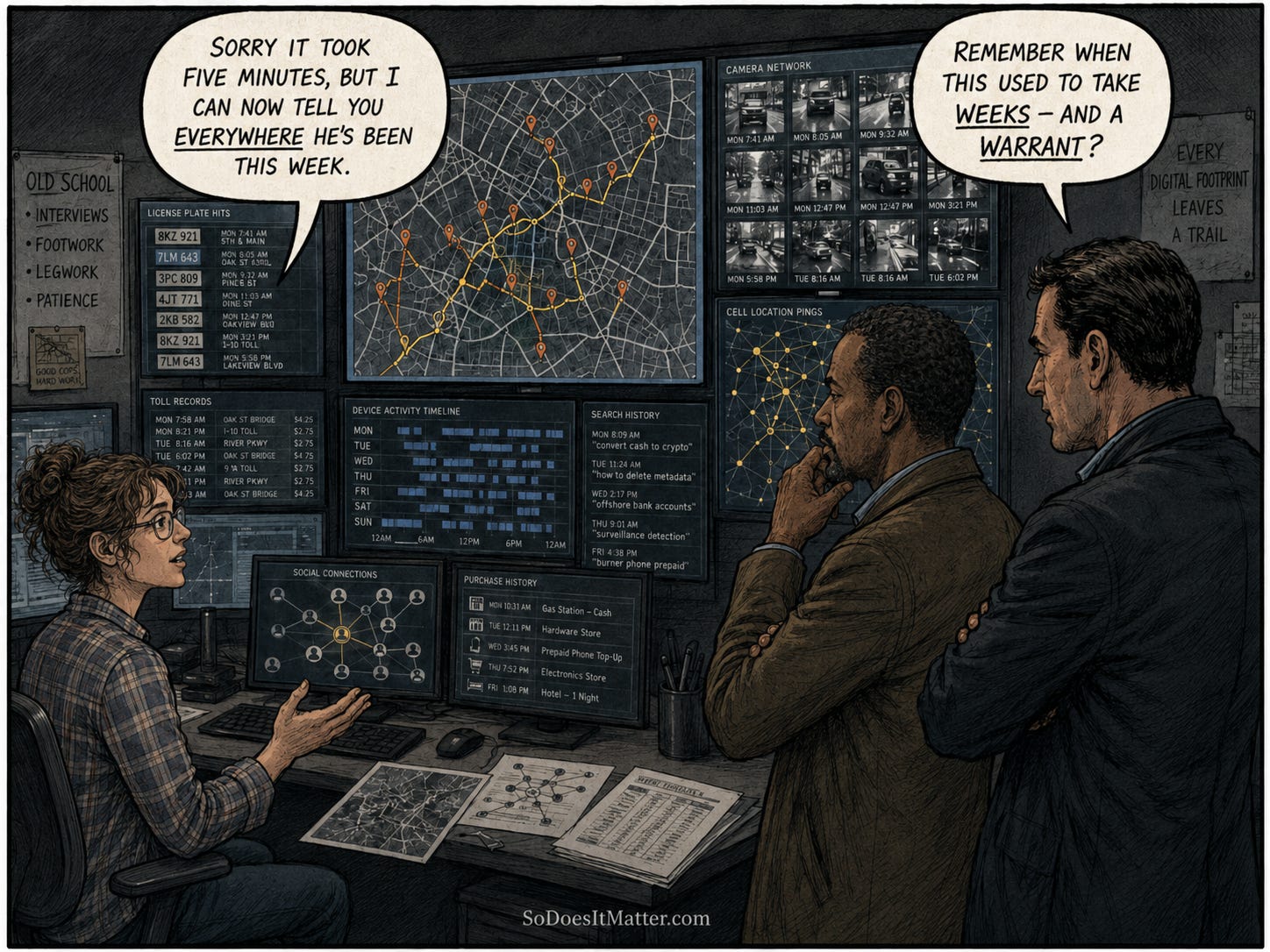
What bothers me is connecting thousands of those observations so that someone sitting at a computer can reconstruct where I have been.
Twenty years ago, following someone around town required officers, surveillance vehicles, manpower and time. Those practical limits restrained government in ways we rarely thought about. Today, a dense network of cameras and searchable databases can do in seconds what once required an entire surveillance team.
Cato Institute scholars have raised exactly this concern in litigation over automated license-plate readers. In Norfolk, Virginia, Cato notes that nearly 200 ALPRs allow officers to chart a person’s movements across the city with just a few keystrokes.
Being seen in public is part of life. Having government able to look backward and map out where you have been is something else entirely.
The Fourth Amendment Still Matters
The Fourth Amendment exists because government searches are supposed to begin with suspicion, not curiosity. It requires probable cause and particularity before government can intrude deeply into someone’s private life.
The Fourth Amendment to the United States Constitution
“The right of the people to be secure in their persons, houses, papers, and effects, against unreasonable searches and seizures, shall not be violated, and no Warrants shall issue, but upon probable cause, supported by Oath or affirmation, and particularly describing the place to be searched, and the persons or things to be seized.”
The Supreme Court last term stepped into this same privacy-versus-security debate in Chatrie v. United States, involving a geofence warrant used to obtain cellphone-location information from Google. The Court held that obtaining that information constituted a Fourth Amendment search, even though the records were held by a private technology company.
Chatrie involved cellphone data, not license-plate readers, and the Court did not outlaw every geofence warrant. But the principle matters. Technology cannot become a back door around constitutional protections simply because private companies now hold enormous amounts of information about where we go.
Government should not be able to collect information about everyone first and search it later for someone worth investigating.
That reverses the proper order. In America, government is supposed to develop individualized suspicion first and then seek authority to search.
Flock Is Only One Piece
Flock is simply a timely example of a much larger surveillance ecosystem.
License-plate readers, traffic cameras, facial recognition, police drones, toll records, doorbell cameras, cellphone-location information, connected automobiles and commercial data brokers can increasingly be combined.
I am writing this column sitting in a Tesla, a rolling computer capable of generating enormous amounts of data about where it goes. That does not mean Tesla is doing anything improper or that companies should be barred from collecting information needed to provide products customers choose to use.
Still, there is a line that matters. Google knowing where I am is primarily a privacy issue. Government knowing where I am is a liberty issue.
Government should not be allowed to do indirectly what the Constitution would restrain it from doing directly. If it needs a warrant to compel sensitive location data, it should not be able to get around that requirement by buying the information from a data broker.
Some critics of Flock on the political left worry that license-plate information could assist federal immigration enforcement. That is not my concern. I believe federal immigration laws should be enforced.
What concerns me is the machinery itself: a system capable of tracking millions of people suspected of nothing. Governments and political priorities change. A surveillance system built for something you support today can be used for something you strongly oppose tomorrow.
So, Does It Matter?
Congress and every state legislature should establish a strong presumption of privacy for sensitive personal data, especially information revealing where a person goes. Except in genuine emergencies, government seeking that information should have to obtain a particularized search warrant based on probable cause. That rule should apply whether the information is held by a technology company, data broker or other private party.
Private companies should also resist sharing sensitive location data with government absent lawful judicial process. Americans should not be deemed to have waived meaningful privacy rights simply because they clicked “I agree” on a lengthy terms-of-service agreement.
There is no free lunch here. Stronger privacy protections will make some law-enforcement investigations harder. Of course they will. In some cases, police will have a harder time getting useful evidence quickly. If you want to maximize security even if it costs you some liberty and privacy, you may disagree with me. Fair enough. But I would rather make law enforcement work harder than make it easy for government to know where innocent Americans have been.
That is why we have a Fourth Amendment. Rights restrain government power, and sometimes that means government cannot take the easiest path available to it. The most troubling surveillance system is not necessarily one that is abused. It may be one that works exactly as designed and slowly becomes normal.
In a free country, government should have to establish a reason to track you. You should not have to establish a reason not to be tracked.
For Paid Subscribers… More On The Fourth Amendment…
If the Fourth Amendment seems like an obvious part of the Constitution, here is something worth remembering: it wasn’t in the Constitution when the founders wrote it. Neither was the rest of the Bill of Rights.
For paid subscribers, I’ve added a short companion piece below on how we got from the Declaration of Independence, to the Constitution, to the Bill of Rights — and why Americans ultimately insisted on spelling out exactly where government power had to stop.
It is a short history, but it helps explain why the Fourth Amendment is not some antique protection from another era. It was written in response to a very old temptation by government — one that modern technology may be making easier than ever.
