

The San Quentin Inmate Who Fears ICE — and the Attempted Murder He Did Not Mention
A Los Angeles Times letter argues an inmate is safer in San Quentin than facing deportation. What the piece does not tell readers is why he is in prison in the first place.

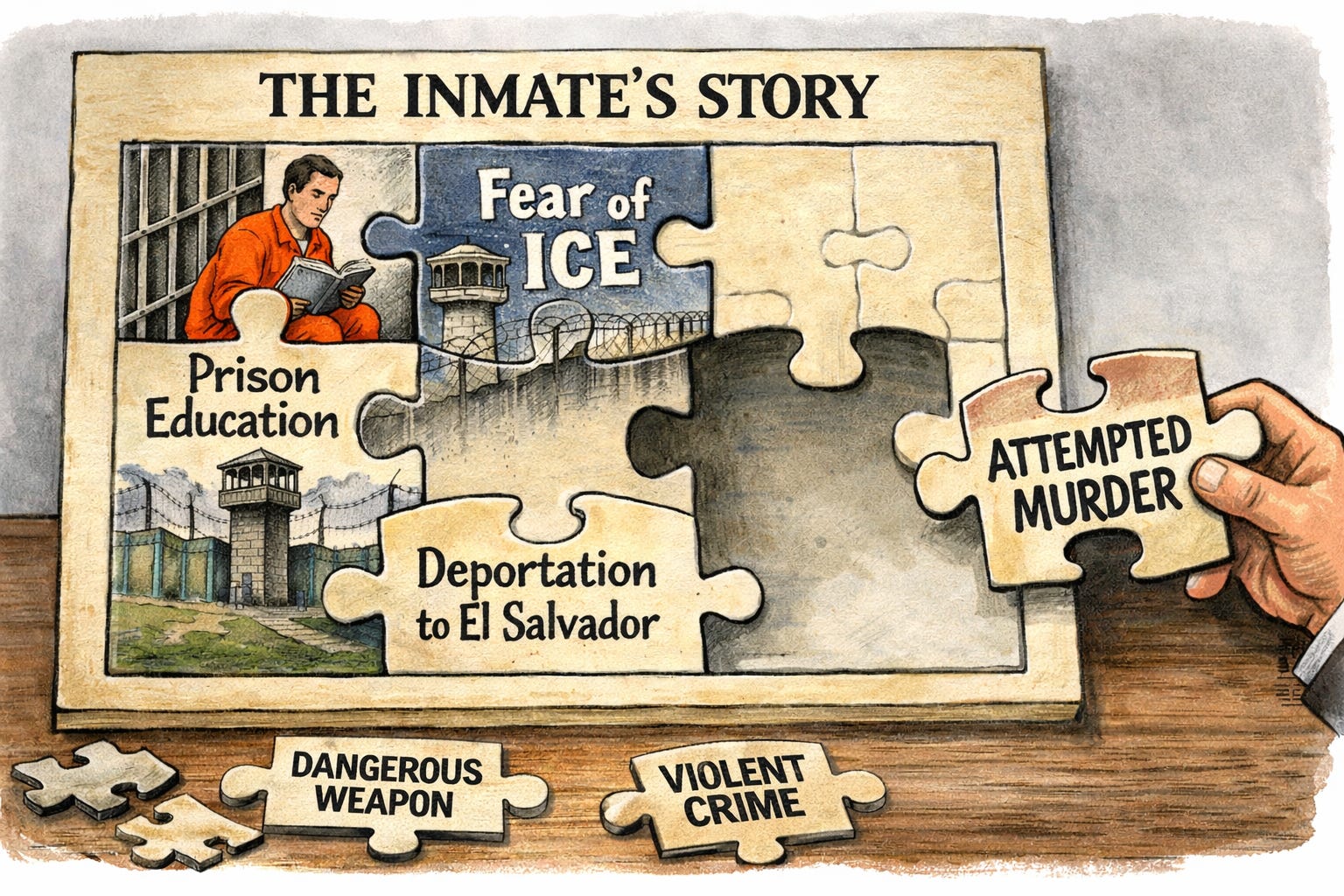
The Narrative Presented to LA Times Readers
The Los Angeles Times recently published a letter from San Quentin inmate Edwin E. Chavez arguing that he is more afraid of being turned over to Immigration and Customs Enforcement than he is of remaining behind bars in California. The piece is written to generate sympathy. Chavez describes himself as having been a scared teenager who learned to read in prison and embraced the ideals of America. He presents his story as one of reflection and transformation during decades behind bars.
For example, Chavez writes that while incarcerated, he “devoured books” and came to identify with what he calls “The Land of the Free.” He presents himself as someone who discovered education and purpose through years of confinement. The portrait he paints is that of a man who has remade himself through study and self-reflection.
Chavez also warns that if he were paroled, he would immediately be transferred to immigration authorities. “If I were freed, I would go straight into the arms of Immigration and Customs Enforcement,” he writes. He argues that deportation could mean imprisonment in El Salvador’s massive anti-gang facility known as CECOT. He describes the prospect of being sent there as a “virtual death sentence.”
At another point in the letter, Chavez explains that he has effectively stopped seeking parole. Remaining incarcerated in California, he argues, may be safer than facing deportation. “In today’s America,” he concludes, “real freedom is not an option for me.” The message is clear: staying in San Quentin feels less frightening to him than being handed over to immigration authorities.
The letter asks readers to see Chavez primarily as an immigrant fearing deportation. But there is a glaring omission in the narrative presented to Los Angeles Times readers. Chavez never explains why he is in San Quentin in the first place. That missing context is essential to evaluating the argument he is making.
The Critical Detail the Letter Leaves Out
Chavez briefly mentions that he was sentenced to life with the possibility of parole. What he does not do is explain the underlying crime. Leaving out that detail makes it easier to frame the story as an immigration debate rather than a case involving serious violence. A brief review of publicly available court records fills in the missing context.
Court records show Chavez was convicted of attempted murder in the mid 1990s and sentenced to life in prison. Attempted murder is one of the most serious violent felonies under California law. The case involved the use of a weapon and serious violence against the victim. That fact is nowhere mentioned in the letter the Los Angeles Times chose to publish.
It is also important to remember that one of the elements of the crime of Attempted Murder, which has to be proven to a jury, is that the accused intended to actually murder the victim, even if they did not actually do so.
The conviction also counted as a strike offense under California’s three strikes law. In other words, this was not a minor brush with the law. It was a violent felony serious enough to justify a life sentence. Yet none of that appears anywhere in this Letter To The Editor.
Instead, readers are invited to view Chavez primarily as an immigrant worried about deportation. The more relevant question for the public is different. Should someone who commits attempted murder in the United States be allowed to remain here after serving his sentence? From a law-and-order perspective, the answer is straightforward.
So, Does It Matter?
Chavez was nineteen when he committed the crime. That is not a child. It is an adult capable of understanding the consequences of violent criminal behavior. He made a choice to engage in conduct that nearly took another person’s life. Let’s remember that one of the elements of the crime of Attempted Murder that has to be proven in California is that the perpetrator intended to kill their victim.
A jury and a judge concluded that the crime warranted a life sentence. Now, decades later, Chavez writes a carefully constructed letter describing his fears of immigration enforcement. What he does not mention is the violence that put him in prison in the first place.
That raises an obvious question about the editorial judgment behind the piece. Would it have been too much for the editor to email the inmate back and ask him to include the crime that landed him in San Quentin? For context?
I actually learned of this letter because I frequent the Golden State Report, a Substack started by lefty former LA Times Editorial Board Members Marial Garza and Paul Thornton - among others - that I find makes for interesting reading — by the way you should not get caught up in the idea that you should only read things with which you agree - challenge yourself, have an open mind. As I recall, there was a mass exodus by the Times Editorial staff after the publisher Dr. Patrick Soon-Shiong nixed a planned endorsement by the paper of Kamala Harris for President. As a fellow ideologue, I admire them for sticking to their guns.
Paid Subscribers - I have a video commentary below… (Always worth it!)

NO, you can’t click on the image above to watch this. You have to click on the VIDEO below! Jump in! The water’s warm!
