

The Runoff In The Governor’s Race Gets Its First Major Survey. Here Is What The Numbers Mean.
Berkeley’s new IGS survey gives us the first meaningful look at November’s governor’s race — and the numbers reward a careful read.

[REMINDER, WE ARE ON A VACATION SCHEDULE THIS WEEK AND NEXT]
Our morning content is free for all subscribers and guests! Usually our afternoon content is behind a paywall, but not when I am previewing a California Post column… If you are not yet a paid subscriber, consider upgrading — you are missing a significant portion of what we produce each week, and your support makes it possible. If you want to get it all and support my efforts, please consider a paid subscription!
You can also listen to this post — along with my California Post column — on our podcast feed, So, Does It Matter? SPOKEN. It is available on your favorite podcast app. And you can listen to it here.
⏱️ 4 min read
The Survey And What It Found
With Xavier Becerra and Steve Hilton now established as the top two finishers in California’s gubernatorial primary, the Berkeley Institute of Governmental Studies released its first general election assessment of the race yesterday. Becerra — California’s former Attorney General and former U.S. Health and Human Services Secretary under President Biden — is the Democrat. Hilton — British-born political commentator, entrepreneur, former Fox News host, and Trump-backed Republican — is the Republican.
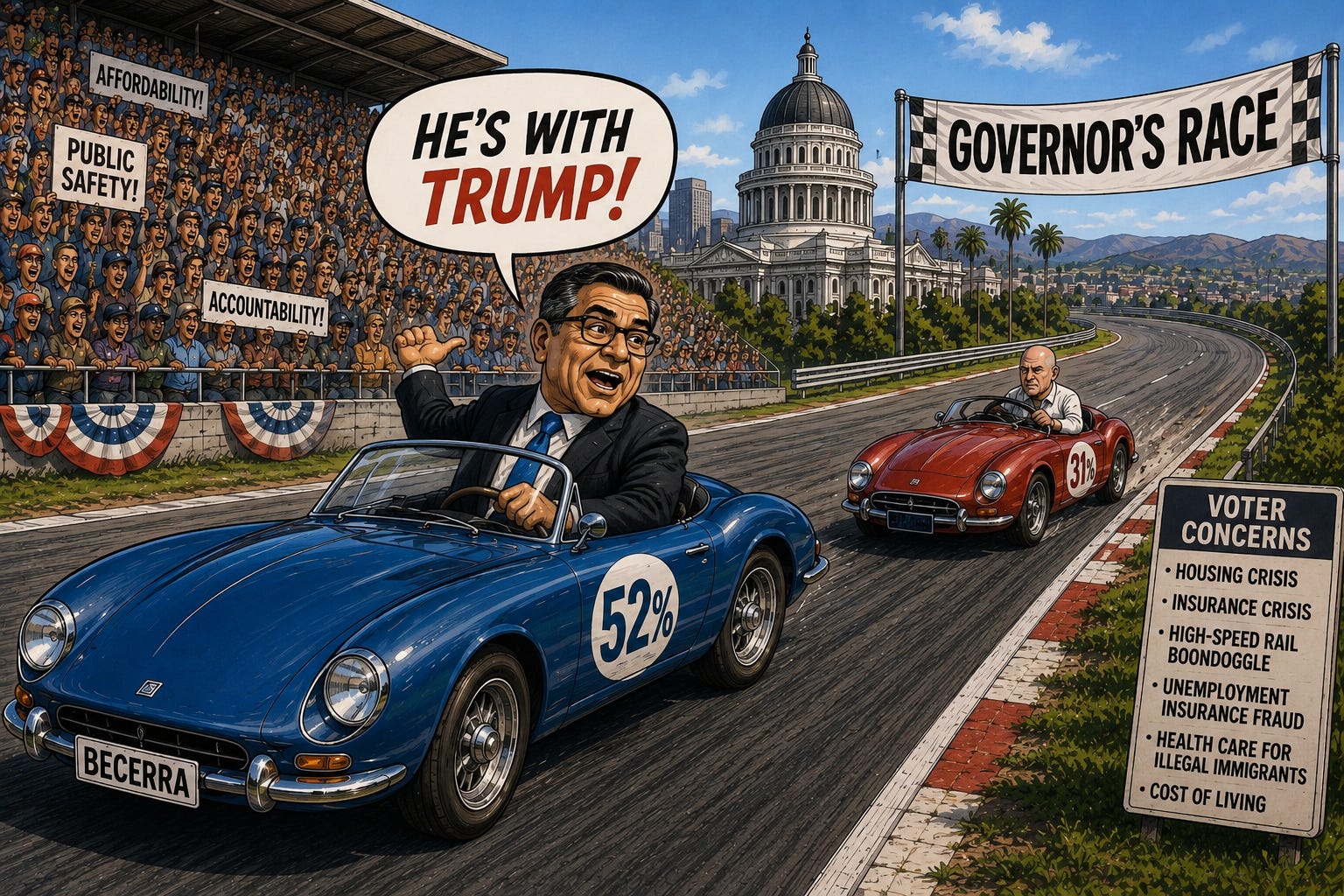
The survey, conducted online May 19–24 among more than 8,500 registered California voters, puts Becerra at 52 percent and Hilton at 31 percent, with 17 percent undecided. The poll is among the most credible in state politics, run by veteran pollster Mark DiCamillo and funded in part by the Los Angeles Times.
The topline confirms what most California political observers already expected: the general election begins with a Democrat holding a commanding lead in a state that has not elected a Republican governor in more than two decades — and the last one was an internationally known action-movie star. But the poll does not merely show that Becerra is ahead. It shows why Democrats remain structurally dominant in California — and why Becerra should not be mistaken for a political powerhouse.
A Lead Built On Math — And An Anchor That Makes It Worse
The 21-point margin sounds decisive, but California’s partisan structure makes it difficult to interpret at face value. A generic Democrat in a two-way statewide race in California normally begins with a very large structural advantage. Becerra at 52 percent, with 17 percent still uncommitted, is performing below what the state’s partisan baseline might otherwise suggest.
DiCamillo notes this in his own write-up: Democratic registrants outnumber Republicans by 20 percentage points, giving Democratic candidates what he calls “a huge advantage in general elections.” The lead is real. It is not a measure of Becerra’s individual strength as a candidate.
Compounding that problem for Hilton is the fact that he started there. Trump’s job approval among California registered voters stands at 29 percent approve, 69 percent disapprove — with 62 percent disapproving strongly. The Berkeley survey finds these numbers essentially unchanged across years of measurement.
Trump’s endorsement was clearly helpful fuel in the Republican primary, with 37 percent of likely GOP voters saying it made them more likely to back Hilton. In a general election decided by the entire electorate, that same endorsement serves as an anchor. The credential that helped accelerate Hilton’s path to the top two is now one of the largest obstacles to everything that comes next.
The Voters Who Matter Most
No Republican has a realistic path to statewide victory in California without performing strongly among No Party Preference voters. NPP voters account for roughly three in ten registered voters in California. Right now, Becerra leads among them 43 to 28, with 29 percent still undecided.
That undecided pool is the most genuinely open terrain in this survey — the one number a Hilton strategist can point to with any encouragement.
The problem is what surrounds it. NPP voters disapprove of Trump’s performance as president by 68 to 22 percent — nearly three to one. The voters Hilton must win are the voters most alienated from the political identity that helped him secure his spot in November.
Creating sufficient separation from that brand while keeping his base intact is the central strategic challenge of the next five months. The math says those voters are theoretically available. Nothing in this poll suggests Hilton has yet found the argument to reach them.
The Narrative The Data Doesn’t Support
One more detail is worth examining before leaving the toplines. The IGS press release leans into a historic framing: co-director G. Cristina Mora contributed a lengthy passage about California’s “long-standing Latino plurality” and described a potential Becerra victory as a “model for multiracial democracy-building.”
The cross-tabs do not support that much narrative weight. Becerra wins Latino voters 52 to 28 — precisely his overall statewide number. The history may be meaningful. But the polling data do not show a distinct Latino surge for Becerra. At least in this survey, Latino voters appear to be behaving much like the electorate as a whole.
So, Does It Matter?
California has not elected a Republican governor since Arnold Schwarzenegger, and nothing in this survey alters that arithmetic. But a genuine race between two candidates with genuinely contrasting governing philosophies forces the majority party to defend a record rather than run against a placeholder.
The Newsom era has produced real and accumulating grievances — housing costs, public safety, the high-speed rail boondoggle, taxpayer-funded health care for people who entered the country illegally, unemployment-insurance fraud, the insurance crisis, and basic fiscal management. A credible Republican on the ballot forces a real debate over that record.
That is almost certainly the campaign Hilton will try to run: a race about competence, accountability, affordability, and the accumulated failures of California state government. Becerra’s incentives point in the opposite direction. The data suggest he has little reason to take unnecessary risks or help elevate Hilton into an equal combatant. Expect Becerra to run as the generic Democrat in a blue state, stay low-key where possible, and repeatedly recast the race as Trump-and-Hilton rather than Becerra-versus-Hilton.
The undecideds are real. Hilton’s path requires Becerra to stumble in a visible and serious way. That possibility is not zero. But this poll does not show a competitive race — yet. It shows where one could theoretically develop.
Premium Subscribers: The Story Gets More Interesting
The Berkeley IGS data contains far more than the headline numbers reported in most news coverage.
Below the paywall, I take a deeper dive into the cross-tabs and examine several findings that received little attention in the poll's release. Some reinforce the conventional wisdom. Others point to vulnerabilities and opportunities that neither campaign is likely eager to discuss.
Among the topics covered:
Why financially stressed voters are producing some of the closest numbers in the survey
How much of Becerra’s support appears tied to Gavin Newsom’s existing coalition
The favorability numbers that suggest Becerra’s lead may be softer than it looks
The regional breakdowns showing where Hilton is competitive — and where he is getting buried
What the data says about independent voters and the narrow Republican path in California
Premium subscribers can continue reading below. What? You’re not a paid sucriber yet? Jump in! Get exclusive content several times a week, and help support this project!
