

The Pope’s Warning About AI Deserves To Be Taken Seriously By Everyone
Artificial intelligence should serve human flourishing, not quietly replace the institutions that make a free society possible.

REMINDER, WE ARE ON A VACATION SCHEDULE THIS WEEK.
Our morning content is free for all subscribers and guests! Occasionally I write columns that are a little longer, a little deeper. More thought provoking. This is one of those. If you are not yet a paid subscriber, consider upgrading — you are missing a significant portion of what we produce each week, and your support makes it possible. If you want to get it all and support my efforts, please consider a paid subscription!
You can also listen to this post on our podcast feed, So, Does It Matter? SPOKEN. It is available on your favorite podcast app. And you can listen to it here.
⏱️ 5 minute read
The Pope Raises The Right Question
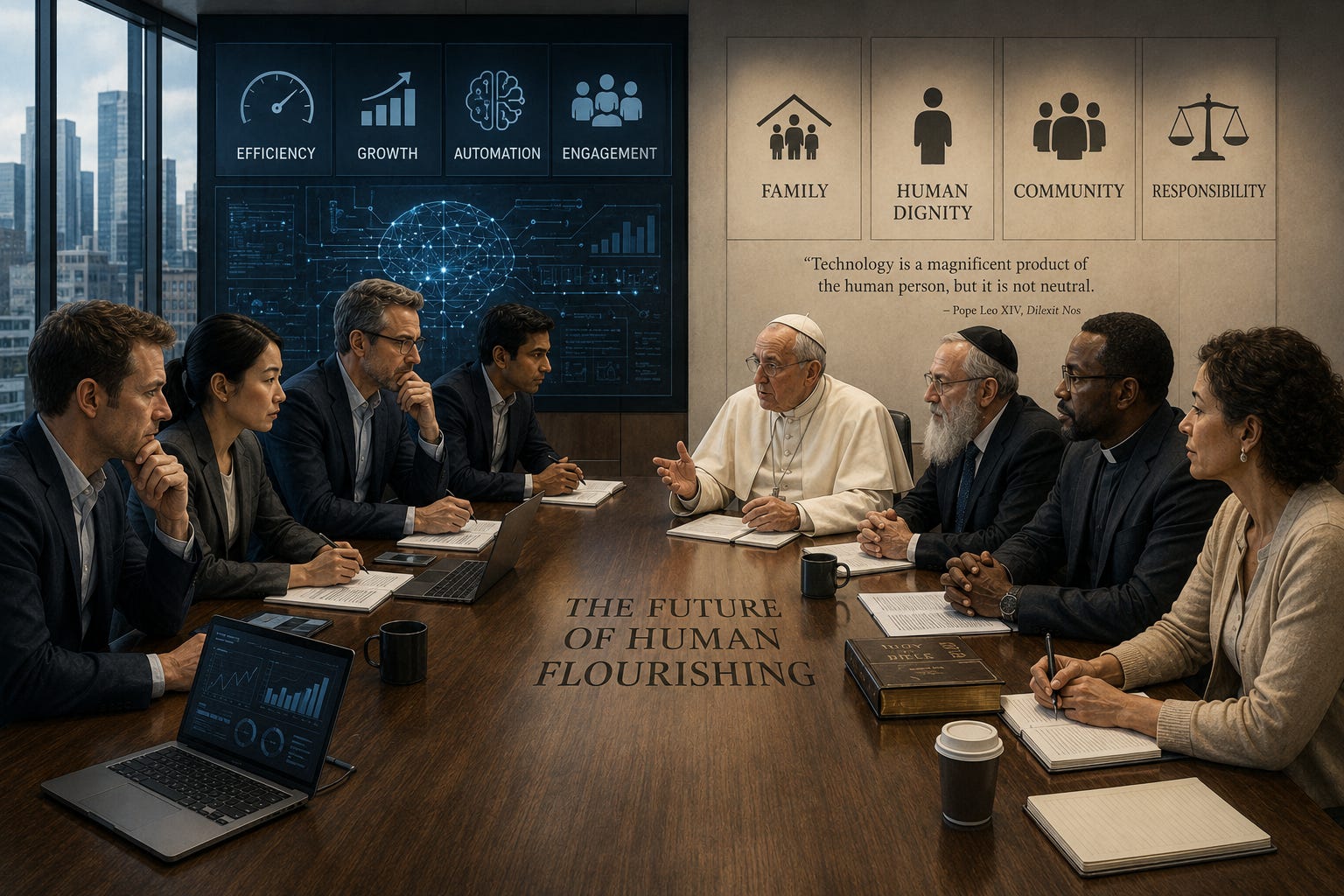
When Pope Leo XIV issued his encyclical on artificial intelligence, he did not call for AI to be abolished. He did not argue that technological progress is inherently bad. He did something more useful.
He asked whether this technology is being built with a serious understanding of the human person.
That question should matter far beyond Catholic circles. As a conservative Jew with strong libertarian instincts about government power, I am not eager to see bureaucrats regulate every new invention. Innovation matters. Free enterprise matters. Human creativity matters.
But the Pope is right to warn that technology is never merely technical. It carries assumptions about man, society, work, family, responsibility, and the common good.
Long before artificial intelligence existed, the Book of Genesis taught that human beings are created in the image of God. That idea places human dignity at the center of moral life. Human beings possess worth not because they are efficient, productive, or useful, but because they are human.
The danger may not be that AI becomes more human.
It may be that humans become less dependent on one another.
Liberty Needs Institutions
One of the great errors of modern politics is treating freedom as though it exists only between the individual and the state.
That is not how free societies work.
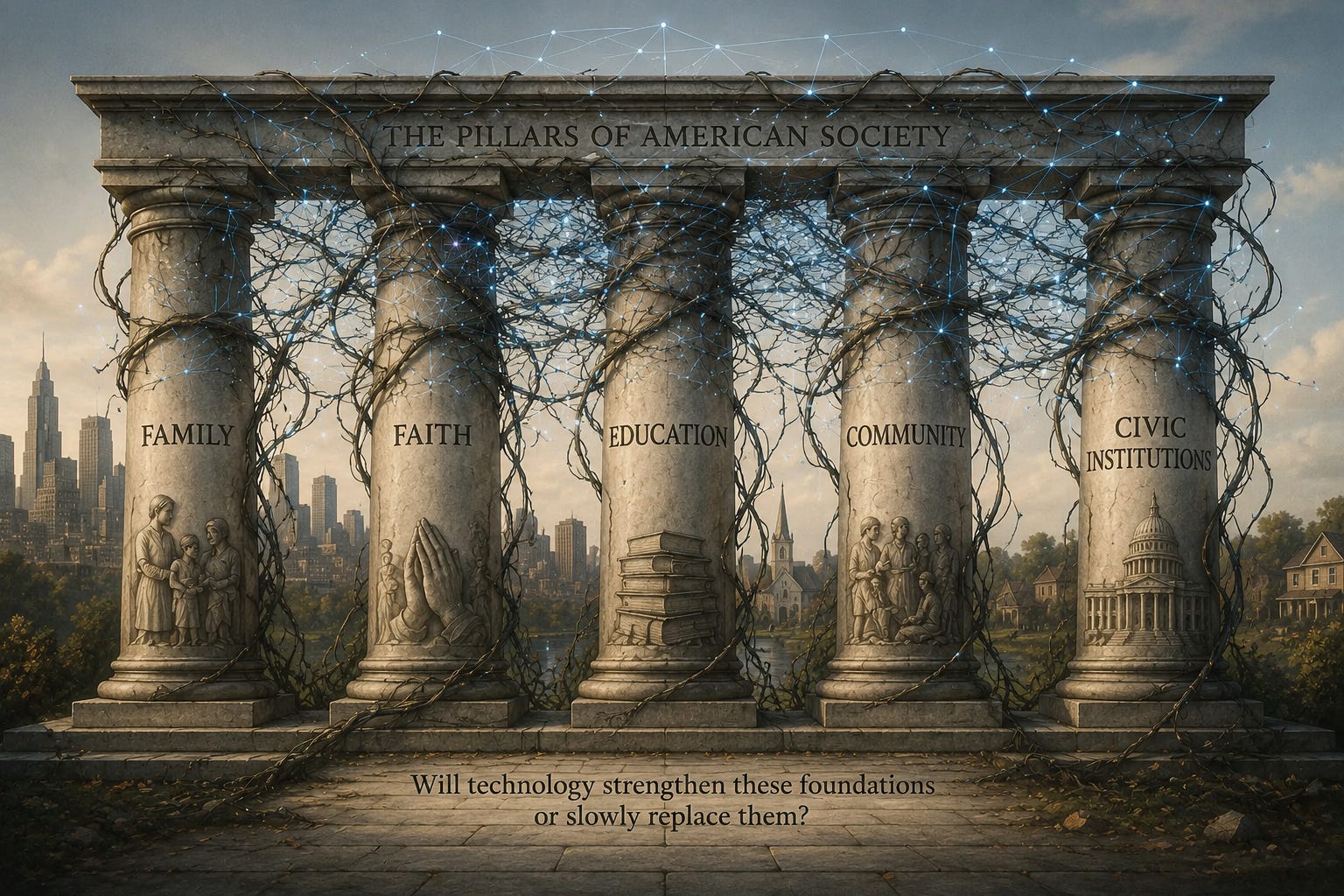
Families raise children. Churches, synagogues, mosques, and temples transmit moral tradition. Schools educate. Civic organizations build community. Neighborhoods create habits of trust. Voluntary associations teach people how to cooperate without waiting for government permission.
These institutions stand between the isolated individual and centralized power. They make liberty livable.
The incentives driving AI development prioritize efficiency, engagement, personalization, and scale. But the institutions that sustain civilization — families, faith communities, schools, neighborhoods, and civic organizations — operate according to very different values.
The concern is not necessarily malice.
The concern is indifference.
The Substitution Problem
AI will do many useful things. It can improve productivity, expand access to information, assist research, support medical advances, and help people do work faster and better.
But useful tools can still do damage.
What happens when AI companions replace friendships? What happens when people turn to chatbots instead of clergy, family, mentors, or counselors? What happens when children become more attached to personalized algorithms than to teachers, parents, and peers?
None of this requires a conspiracy. It will be sold as convenience.
But civilization is often weakened through gradual substitution. A human relationship is replaced by a digital interaction. A community function is replaced by a platform. A moral conversation is replaced by a personalized answer generated by a machine designed to satisfy the user immediately.
The result may be greater efficiency. It may also be greater isolation.
If AI hollows out the institutions that sustain human dignity, it will not matter that the technology is impressive. A society can become wealthier, faster, and more automated while becoming less humane.
The Problem Of Incentives
It is tempting to believe that the future of artificial intelligence depends primarily on the wisdom and good intentions of the people building it.
Perhaps it does.
But history suggests that incentives often matter more than intentions.
The companies leading the AI revolution are engaged in a global competition for market share, investment capital, talent, and ultimately profit. At the same time, the United States faces a strategic competition with China to develop increasingly powerful AI systems.
In that environment, caution can easily become a competitive disadvantage. The company that pauses to consider the long-term social consequences of a new capability may find itself overtaken by a rival willing to move faster.
The question is whether any individual company can afford to slow down if its competitors refuse to do the same.
The challenge is not merely developing artificial intelligence that is more powerful. The challenge is ensuring that a race for technological advantage does not outrun the moral wisdom needed to guide it.
A society that waits until after the consequences become obvious may discover that the most important decisions have already been made.
Innovation Requires Moral Limits
A free and virtuous society should not begin with bureaucratic control. It should begin with moral responsibility, institutional strength, and a culture capable of saying no.
The people building AI are not merely creating better software. They are shaping the future of work, education, communication, friendship, family life, religious life, and civil society itself.
That imposes obligations.
C.S. Lewis saw this danger coming more than eighty years ago. In The Abolition of Man, he argued that what we call mankind’s power over nature almost always turns out, on closer inspection, to be power exercised by some people over other people, with nature as the instrument. Technological progress does not eliminate questions of power. It simply changes who holds it.
A free society should give innovation room to breathe. But liberty is not the same thing as moral emptiness. Markets work best inside a moral culture that understands human dignity, personal responsibility, honesty, restraint, and the limits of power.
What We Are Already Seeing
But we should be honest about what we are already seeing. Artificial intelligence is developing rapidly, and there is little evidence that the industry, as a whole, has imposed meaningful restraints on itself. The competitive pressures are too strong, the financial incentives are too large, and the geopolitical stakes are too high.
Nor is the industry simply waiting passively for society to deliberate. The future of artificial intelligence has already become a political battleground, with rival AI interests spending extraordinary sums to shape the rules under which this technology will develop. The point is not that every company wants the same thing. Some support stronger safeguards. Others favor lighter regulation or federal rules that would preempt state action. But the scale of the political spending tells us something important: the people closest to this technology understand how much is at stake.
That does not mean government should rush in with clumsy mandates that freeze innovation, entrench incumbents, or hand bureaucrats sweeping control over technology.
But it does mean society cannot simply trust the process.
If AI leaders want to preserve public confidence, they need to demonstrate now that they are building these systems with serious regard for the human person, the family, religious liberty, civil society, free inquiry, and the moral formation required for self-government.
Absent that, public policymakers have an obligation to act.
Not because government knows best, but because a free society has a duty to protect the institutions and values upon which its freedom depends.
So, Does It Matter?
The Pope’s warning matters because it puts the AI debate where it belongs: not merely in economics, engineering, or politics, but in the deeper question of what kind of human beings we are trying to form.
A free people has the right to defend itself from threats to its survival — whether those threats come from government, corporations, foreign adversaries, or machines.
The Pope is not asking us to reject artificial intelligence.
He is asking us to remember what intelligence is for.
And that is a question every free society has an obligation to answer.