


Our morning content is free for all subscribers and guests! Not a subscriber yet? Become one today! You can subscribe for FREE to get most of my content delivered to your inbox. A PAID subscription is $7 a month or $70 a year, and it gets you access to ALL of my stuff (about 35% more). Why subscribe? Because now more than ever, you need someone calling balls and strikes, and who isn’t owned by ANYONE.
You can also listen to this post — along with my California Post column — on our podcast feed, So, Does It Matter? SPOKEN. It is available on your favorite podcast app. And here.
🕐 4-minute read
AI Disruption Is Real — But Newsom’s Response Is Disturbing, To Say The Least
Yesterday, Governor Gavin Newsom issued a new executive order on artificial intelligence and California’s workforce. On the surface, it reads like a standard government response to technological disruption: study the problem, consult the stakeholders, prepare workers, and monitor the labor market.
But this order is about more than workforce planning. Artificial intelligence is going to change the economy. Pretending otherwise is foolish. Some industries will evolve, some jobs will disappear, and new kinds of work we cannot fully imagine yet will emerge.
That is not new. The automobile disrupted the horse-and-buggy economy. Assembly lines changed manufacturing. Personal computers eliminated a large amount of clerical work. The internet upended retail, media, travel, communications, and advertising almost overnight.
Innovation has always been disruptive. It is also one of the main reasons America became the most prosperous nation on Earth.
America became the world’s innovation leader because entrepreneurs, inventors, and businesses were free to take risks and build the future — not because the government tried to centrally manage every technological transition before it happened.
That does not make AI the villain. The question is whether the government is addressing the real risks or using disruption as an excuse to expand control.
The Most Dangerous Line In The Order
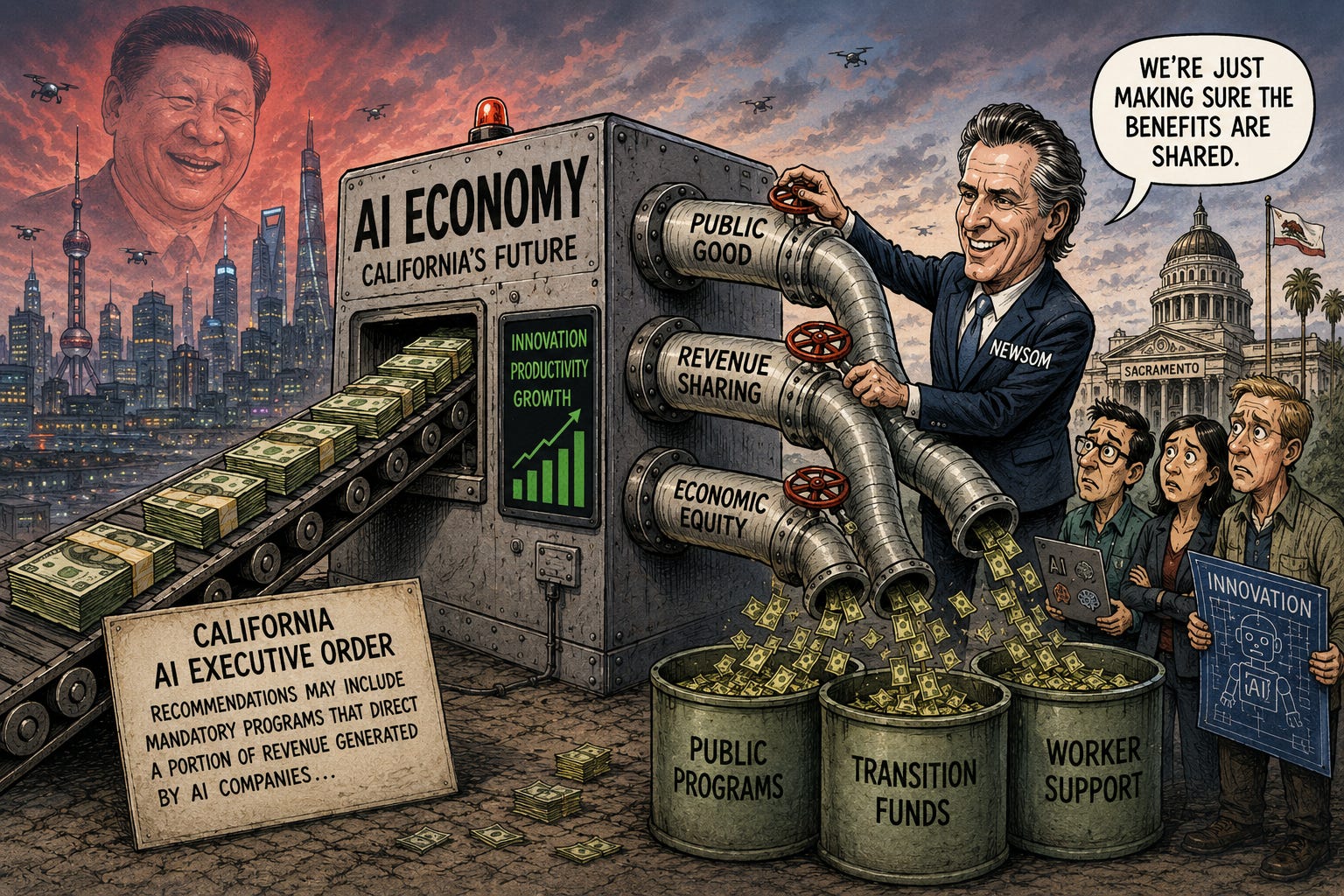
Buried deep inside the executive order is perhaps the most revealing sentence in the document. The order calls for recommendations that could include “mandatory programs that direct a portion of revenue generated by AI companies” toward government-defined public goals.
That is not merely workforce training. That is redistributionist thinking.
Elsewhere, the order discusses exploring “other tools for more broadly sharing the economic benefits” created by artificial intelligence. The wording may sound harmless, but the meaning is not. California increasingly appears to view AI-generated gains as something the government should help direct and distribute.
Once the government treats innovation-generated wealth as something society collectively deserves a claim upon, the relationship between free markets and the state changes. The discussion moves beyond temporary worker training and toward permanent economic management.
Newsom’s Embrace Of Collectivism, Statism
Two days before signing the order, Newsom was already testing this language publicly. According to Politico, he told a Center for American Progress audience that Democrats need to move beyond “tinkering” and consider ideas such as “universal basic capital” or “wage replacement” to respond to AI-driven job losses.
Universal basic capital is the cousin of universal basic income — instead of simply sending people checks, the government would try to give people a claim on capital, wealth, or returns from the new economy.
Supporters frame the concept as economic fairness. But the underlying premise represents a significant shift toward collectivism and statism: the belief that the gains generated by private innovation should be increasingly directed, shared, and managed by government policy rather than primarily retained by the individuals and companies that take the risks.
The executive order does not use those exact words. But it clearly points in the same direction with softer bureaucratic language about “sharing the economic benefits” of AI and redirecting AI-generated revenue toward government priorities.
California’s Answer Is Always More Government
What makes this executive order especially revealing is how perfectly it fits California’s broader governing style.
California already struggles with crushing housing costs, energy instability, insurance market turmoil, business flight, impossible permitting systems, and layers of regulation that make large-scale development painfully difficult. Yet Sacramento’s answer to nearly every new challenge remains remarkably consistent: more bureaucracy, more oversight, more stakeholder processes, and more political supervision.
Artificial intelligence now appears headed down the same road.
The executive order proposes dashboards to track AI’s labor-market impacts, expanded workforce monitoring, labor-management reviews, public-private “partnerships,” and new mechanisms to direct AI-generated wealth toward state-defined priorities.
California increasingly treats successful industries not as engines of prosperity to unleash, but as systems requiring political management.
Who Decides The “Public Good”?
One phrase appears repeatedly throughout the executive order: “public good.”
That sounds nice. Of course, technology should benefit society. But the obvious question is: who defines the public good?
Politicians? Bureaucrats? Activist groups? Regulatory agencies? Labor organizations? Future administrations with entirely different agendas?
Once the government gains authority to steer innovation toward politically defined outcomes, politics starts shaping business decisions. Incentives get distorted. Bureaucracies expand. Companies begin designing products and investment strategies around political expectations instead of market demand.
California’s executive order repeatedly assumes that the government should help shape labor arrangements, ownership models, incentive structures, and economic outcomes related to artificial intelligence. That is not traditional limited-government regulation. That is industrial policy.
So, Does It Matter?
As I have argued before, artificial intelligence does need guardrails. Systems designed to earn trust, shape decisions, and form relationship-like bonds with users — especially children and emotionally vulnerable people — raise serious questions about duty, loyalty, transparency, and accountability. But that is not what Newsom’s executive order is really about.
Instead, the order reflects California’s familiar instinct to respond to innovation not with restraint and limited government, but with bureaucracy, redistribution, political oversight, and economic management.
The issue is not whether California should help workers prepare for the future. The issue is whether Sacramento increasingly believes that the wealth generated by innovation belongs not mainly to innovators, entrepreneurs, and risk-takers, but to the political system that manages the consequences.
That is the ideological shift hidden inside this executive order.