

The More America Sees Of Gavin Newsom, The Worse He Looks
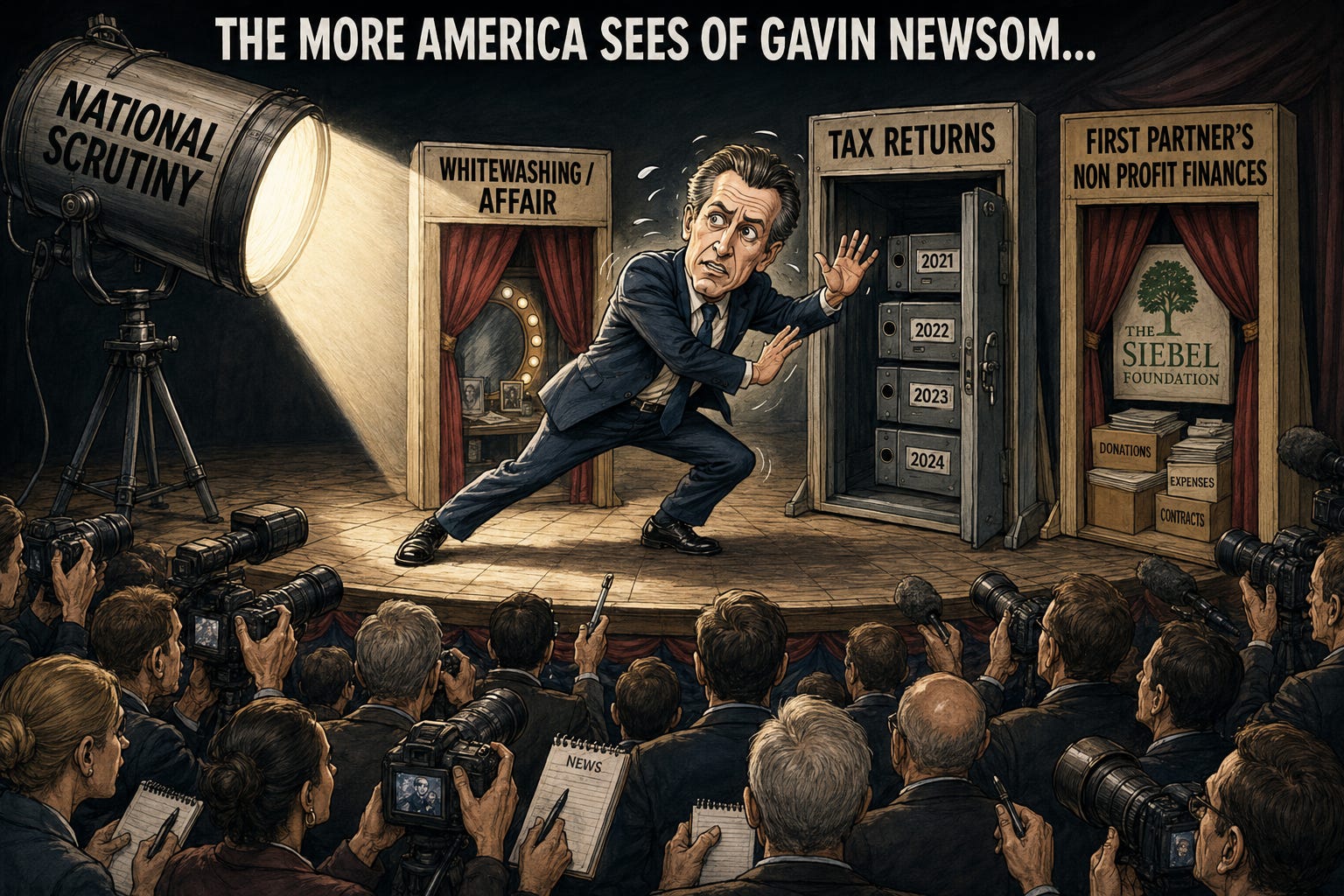
His fake tax-return release adds to the doubts about whether he is ready for the national stage.

Our morning content is free for all subscribers and guests! Usually our afternoon content is behind a paywall… If you are not yet a paid subscriber, consider upgrading — you are missing a significant portion of what we produce each week, and your support makes it possible. If you want to get it all and support my efforts, please consider a paid subscription! There is significant exclusive content below the paywall, after this morning’s column.
Most of our content is available on our podcast feed. So, Does It Matter? SPOKEN. Which is available on your favorite podcast app. You can listen to it right here as well.
🕒 7-minute read
A Self-Inflicted Problem
Gavin Newsom has spent the better part of two years positioning himself for a presidential campaign. His attacks on Donald Trump, national media appearances, podcast and carefully cultivated image as the Democrat willing to take the fight to Republicans have hardly been subtle. For a while, it worked. Newsom found himself at or near the top of early Democratic presidential polls, and many observers began treating his nomination as almost inevitable.
But the dynamic has changed. Trump’s political standing has softened, other Democratic voices have emerged, and Americans are spending less time watching Newsom attack Trump and more time evaluating Newsom himself.
Last week, Newsom’s supposedly candid memoir looked less like confession than reputation management. It whitewashed the salacious affair that helped destroy his best friend’s marriage. This week, he tried something remarkably similar with his tax returns, staging a fake “release” in which selected reporters could inspect the documents but were forbidden to photograph, copy or scan them. All of this is unfolding as federal investigations involving Newsom and his wife continue to attract attention.
Presidential campaigns rarely die from one scandal. They die when voters begin seeing a pattern.
If you are expecting this to be a column about what Newsom’s tax returns revealed, you will probably be disappointed. Nothing reported so far suggests a hidden financial scandal. The bigger story is how hard he worked to keep Californians from seeing documents he repeatedly promised to release.
The Promise
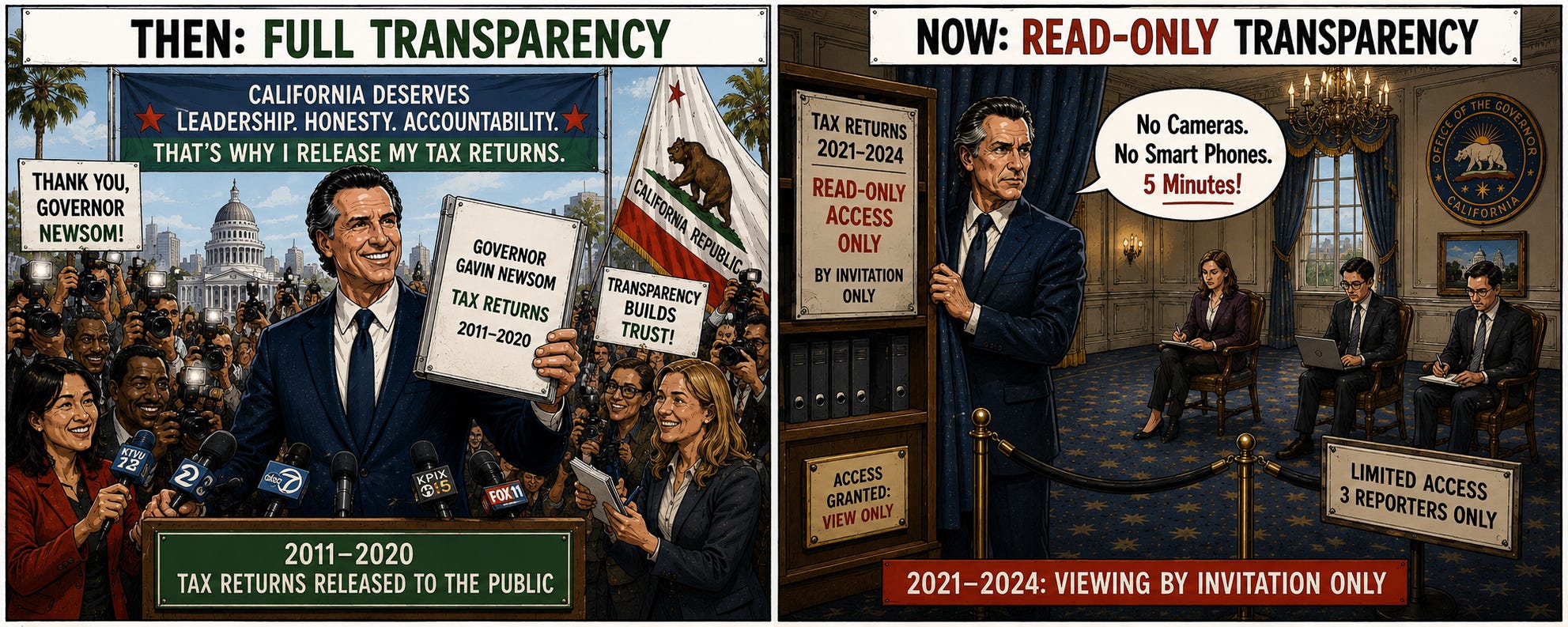
During his 2018 campaign, Newsom voluntarily released tax returns dating back to 2011. Once elected, he signed legislation requiring candidates for governor to disclose five years of federal tax returns before appearing on California’s primary ballot. At a time when Trump refused to release his own returns, Newsom presented himself as the politician who believed voters deserved more disclosure, not less.
He also promised to release his tax returns every year while serving as governor. Californians expect elected officials to disclose potential financial conflicts, and Newsom was holding himself to a higher standard.
Then they stopped.
Tax year 2021 came and went. Then 2022. Then 2023. Then 2024. Reporters continued asking. Nothing happened. Earlier this month, Newsom joked that he had “no reason” reporters had not already received the returns.
His office then suggested there had essentially been only one request, from a CalMatters reporter who supposedly left the publication before anything could be arranged. That explanation hurt more than it helped when the reporter himself, Alexei Koseff, pointed out that he remained at CalMatters for another ten months after making the request. Almost as revealing as the four-year delay has been the governor’s explanation for it.
Both Xavier Becerra and Steve Hilton have released their tax returns. Newsom eventually produced his. He just never really released them.
The Release That Wasn’t
Instead of posting PDFs online, the governor’s office invited a handpicked group of reporters into a Sacramento room to inspect more than 700 pages of tax documents. They could examine them and take notes. They could not photograph, copy, scan or remove them. Californians still cannot review the returns themselves.
For decades, “released” has had a plain-English meaning. The documents become public. Reporters and citizens examine them. Anyone can decide whether the coverage accurately reflects what is in them.
Newsom chose a different approach. He did not release his tax returns. He released access to his tax returns.
He has apparently invented a new category of government accountability: Read-Only Transparency. You may look. You may not keep. You may trust. But you may not verify.
Californians were told the governor had released his returns. They just were not allowed to possess them. His office controlled who entered the room, what they could leave with and how the information reached the public.
Maybe someone in the governor’s office thought this was a clever compromise: let reporters see the returns without ever placing them in the public’s hands. I do not. If Californians still cannot read the governor’s tax returns, what exactly was released?
The Real Story
The contents of the returns may be the least interesting part of the story.
They show the Newsoms earned between roughly $1.7 million and $2 million annually. They reveal charitable giving, substantial household staffing expenses, losses from Jennifer Siebel Newsom’s production company and thousands of dollars in donated Armani clothing. Those details generated headlines. None changes the larger story.
I have watched Gavin Newsom operate for more than three decades. One thing virtually everyone around the Capitol understands is that he likes to control every variable he can—the rollout, the visuals, the guest list, the timing and, ideally, the headline. This episode did not strike me as unusual. It struck me as familiar.
Whether it is a memoir or tax returns, the instinct is the same: control the narrative first, explain it later and hope the explanation is enough. In one case, readers received a conspicuously incomplete account of deeply personal events. In the other, Californians were told the governor had “released” his returns while being denied the opportunity to inspect them.
No single incident is politically fatal, but politics is cumulative. Every future opponent will make the same argument: the memoir goes into the file, the tax returns go into the file, and together they build a narrative about credibility that may be difficult to escape.
So, Does It Matter?
We may someday look back on Newsom’s presidential ambitions and conclude that his high-water mark came when he was regarded as the country’s most effective troll of Donald Trump. For a time, that role made him look almost inevitable.
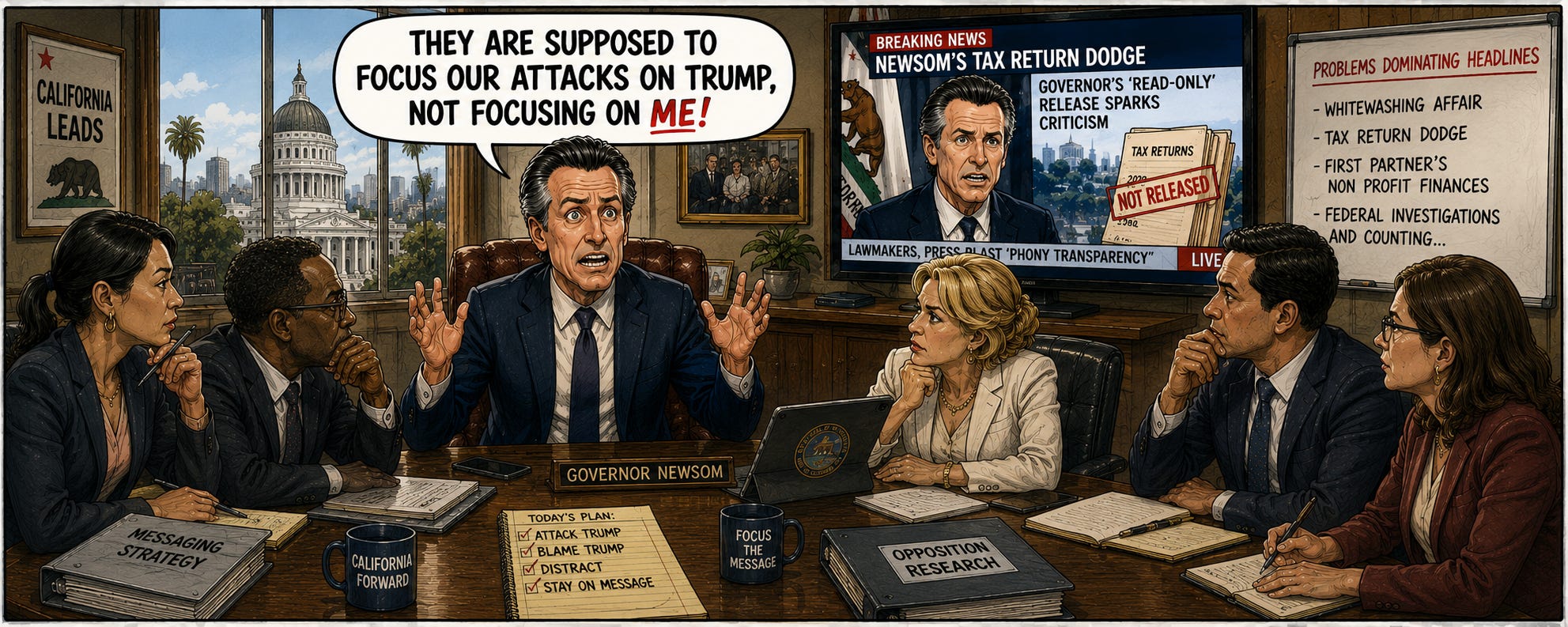
But Trump’s declining political standing and the rise of former Vice President Kamala Harris, New York Congresswoman Alexandria Ocasio-Cortez, Georgia Senator Jon Ossoff and others have deprived Newsom of that protective role. As the spotlight shifts from what he says about Trump to who he is, the picture has become considerably less flattering.
Last week it was a memoir that looked more like reputation management than honest reflection. This week it was Read-Only Transparency—a carefully choreographed viewing of tax returns that Newsom still refuses to place in the public’s hands. Different controversies, but the same governing instinct: control the narrative, minimize the uncomfortable facts and trust that the press will move along.
For much of his career, Newsom has benefited from a California press corps that has become smaller and less effective and that, with notable exceptions, too often allows him to hide, deflect and avoid accountability. He has grown accustomed to brushing aside difficult questions and waiting for the next news cycle.
That will not work on the national stage. A presidential campaign brings tougher reporters, rival campaigns and opposition researchers who will not accept a clever quip as an answer. Every inconsistency will be replayed, and every evasion catalogued.
Newsom will raise enormous sums of money and attract no shortage of attention. But the habits California’s political environment has allowed him to develop may not survive the more punishing scrutiny of a national campaign. Gavin Newsom built his national reputation by convincing Democrats that he was the party’s most effective messenger against Donald Trump. He may discover that the greatest obstacle to becoming president is himself.