

The IRS Wronged Trump. This $1.776 Billion "Anti-Weaponization" Fund Still Stinks.
Conservatives cannot fight weaponized government by defending a settlement that bypasses Congress, sidesteps the courts, and shields the President’s private interests.


Our morning content is free for all subscribers and guests! Not a subscriber yet? Become one today! You can subscribe for FREE to get most of my content delivered to your inbox. A PAID subscription is $7 a month or $70 a year, and it gets you access to ALL of my stuff (about 35% more). Why subscribe? Because now more than ever, you need someone calling balls and strikes, and who isn’t owned by ANYONE.
You can also listen to this post — along with my California Post column — on our podcast feed, So, Does It Matter? SPOKEN. It is available on your favorite podcast app. And you can listen to it here.
🕒 6 min read
Why I Am Speaking Up
I voted for Donald Trump over Hillary Clinton, and again over Joe Biden, and yet again over Kamala Harris, and I do not regret any of those votes. I think President Trump has done many important things right, including pushing back against the administrative state, the cultural left, and securing our borders.
But support is not silence.
Most disagreements do not require a column. This one does.
Real Abuse Does Not Justify This Remedy
The leak of Donald Trump’s private tax information was wrong.
Full stop.
No conservative should minimize that. The IRS should never be used as a political weapon. Private tax information should not be stolen or leaked for politics. The person responsible deserved more serious punishment than he received, and the public had every reason to be disgusted.
But a real abuse does not justify a constitutionally troubling remedy.
That is the problem with the Trump administration’s new $1.776 billion “Anti-Weaponization Fund.” It is being sold as justice for people victimized by government lawfare. But the structure looks like something conservatives used to oppose: an executive-branch compensation program created through settlement authority rather than through Congress.
The Justice Department says Trump, Donald Trump Jr., Eric Trump, and the Trump Organization are not receiving direct monetary damages from the fund. That is technically true. It is also wildly incomplete.
A normal settlement compensates the injured party. This settlement creates a nearly $1.8 billion fund for future claimants alleging government “weaponization” or lawfare, as determined by the fund itself. The fund is tied to Trump’s IRS-leak lawsuit, but its beneficiaries are not limited to the plaintiffs in that case.
If the President wants a $1.776 billion anti-weaponization program, he should ask Congress for one. He should not manufacture it through a settlement with the executive branch he now leads.
A Settlement That Bypasses Congress And The Courts
That is the part conservatives cannot ignore. Trump sued federal agencies. Then Trump became President. Then, under his administration, the Justice Department settled the case. The agreement was signed off on by Acting Attorney General Todd Blanche, who had previously represented Trump as his private attorney. The fund will be run by people appointed through the executive branch and subject to presidential control.
This is not normal adversarial litigation. This is the President’s lawsuit being settled by the President’s administration in a way that creates a nearly two-billion-dollar political compensation program.
The legal forms may be there. The ordinary safeguards are not.
There is also a legal process problem. A normal claimant has to go to court, sue on time, and prove standing, causation, damages, and legal entitlement, while the government can raise defenses such as the statute of limitations, immunity, and lack of proof. Judges decide. Appeals exist.
This fund appears to short-circuit that discipline. Claims that might be stale, time-barred, previously dismissed, or simply unwinnable in court could still become payable at the fund's discretion, which is made up entirely of taxpayer dollars.
That is not justice. That is a workaround around the courthouse.
The constitutional problem is even bigger. Congress controls spending. The Constitution says, “No Money shall be drawn from the Treasury, but in Consequence of Appropriations made by Law.” That is not a technicality. It is one of the basic safeguards of republican government.
The administration is relying on the Judgment Fund, a permanent federal appropriation used to pay judgments and settlements against the government. But it was not supposed to become a blank check for Presidents to create politically charged compensation programs.
Congress created the loaded gun. The executive branch is now firing it.
This may fall into a gray area where Congress delegated too much power and then acts shocked when a President uses it aggressively. But legality is not the same thing as legitimacy.
Conservatives Used To Understand This
The administration points to Keepseagle v. Vilsack, an Obama-era settlement involving Native American farmers and ranchers who alleged USDA discrimination. But that was a long-running class-action case with a defined plaintiff class and court approval. This is a broad political compensation program arising from the President's settlement of litigation involving his own administration.
Conservatives used to object to this kind of settlement-driven spending. In 2017, Trump’s first appointed Attorney General, Jeff Sessions, warned that settlement money should not bankroll “special interest groups or the political friends of whoever is in power.”
He was right then. The principle is still right now.
The Side Agreement And The Leftover Money
The side agreement may be the most troubling part.
Blanche also signed a separate addendum that goes far beyond compensating victims of an IRS leak. It says the United States “releases, waives, acquits, and forever discharges” the plaintiffs and is “forever barred and precluded” from pursuing claims, examinations, reviews, appeals, costs, fees, interest, and related matters. It also extends to family members, joint filers, trusts, related companies, affiliates, and subsidiaries, including tax returns filed before the effective date.
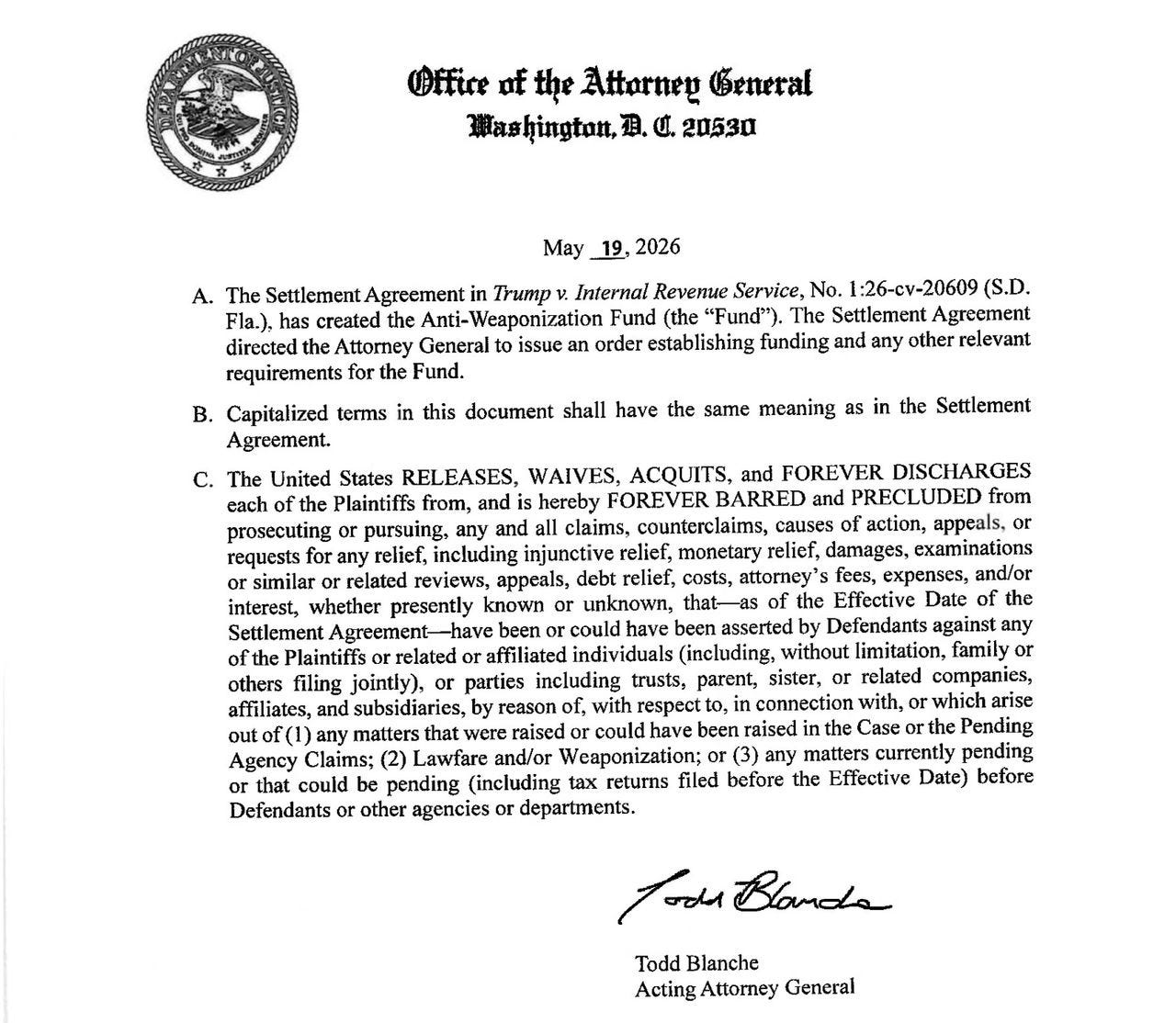
That distinction matters. This is not lifetime immunity from all future taxes. But it does look like a sweeping retroactive liability shield for pre-settlement tax and related matters involving Trump, his family, his businesses, and affiliated entities.
A direct check would have looked ugly. A federal promise to stand down on past tax claims could be worth far more.
Then there is the leftover-money clause.
The administration says unused money will revert to the federal government. But that is not the same as saying it goes back to the Treasury’s general fund. The agreement allows the remaining money to be transferred to Commerce, Interior, or another appropriate federal account designated by the President.
Maybe that discretion is never abused. It should not exist in the first place.
No President should be able to create a billion-dollar settlement fund, shield his own family and businesses from prior tax claims, and then retain discretion over where the leftovers go.
So, Does It Matter?
The IRS leak was wrong. Government weaponization is real. Conservatives are right to demand accountability when federal agencies abuse their power.
But this is not accountability.
I do not have Trump Derangement Syndrome, nor am I a constant critic. Hardly. I remain mostly supportive of his administration. But support for good policies does not mean surrendering judgment. No President, no party leader, no elected official, and no political movement gets to be the sole judge of what constitutes a good idea simply because they are on our side.
James Madison explained the reason for checks and balances in Federalist No. 51: “If men were angels, no government would be necessary.” That is the point. We are all flawed. Presidents are flawed. Parties are flawed. Movements are flawed. That is why conservatives should be the first to defend constitutional guardrails, even when our own side is holding power.
This $1.776 billion settlement-created compensation fund is a bad idea. It bypasses Congress, skirts normal legal safeguards, relies on a precedent conservatives once criticized, appears to shield the President’s private interests from pre-settlement tax claims, and leaves dangerous discretion over leftover public money.
The IRS leak was wrong. But conservatives should not answer one abuse of power by excusing another.
I have read that some Republicans want to seek changes to this scheme. But at its core, it is dreadful public policy, and should simply be withdrawn altogether.
Let me ask one final question to end this column, aimed at some of my friends who might think this is a good idea. Ask yourself this? If President Biden had sued the federal government and had his own Justice Department “settle” for a fund to pay off his political allies, would you think it egregious and wrong?
Wow. I really did not know/understand this entire matter. You are correct in this case. Thanks Jon!