

The Half Of The Healthcare Spending Debate That The Media Ignores
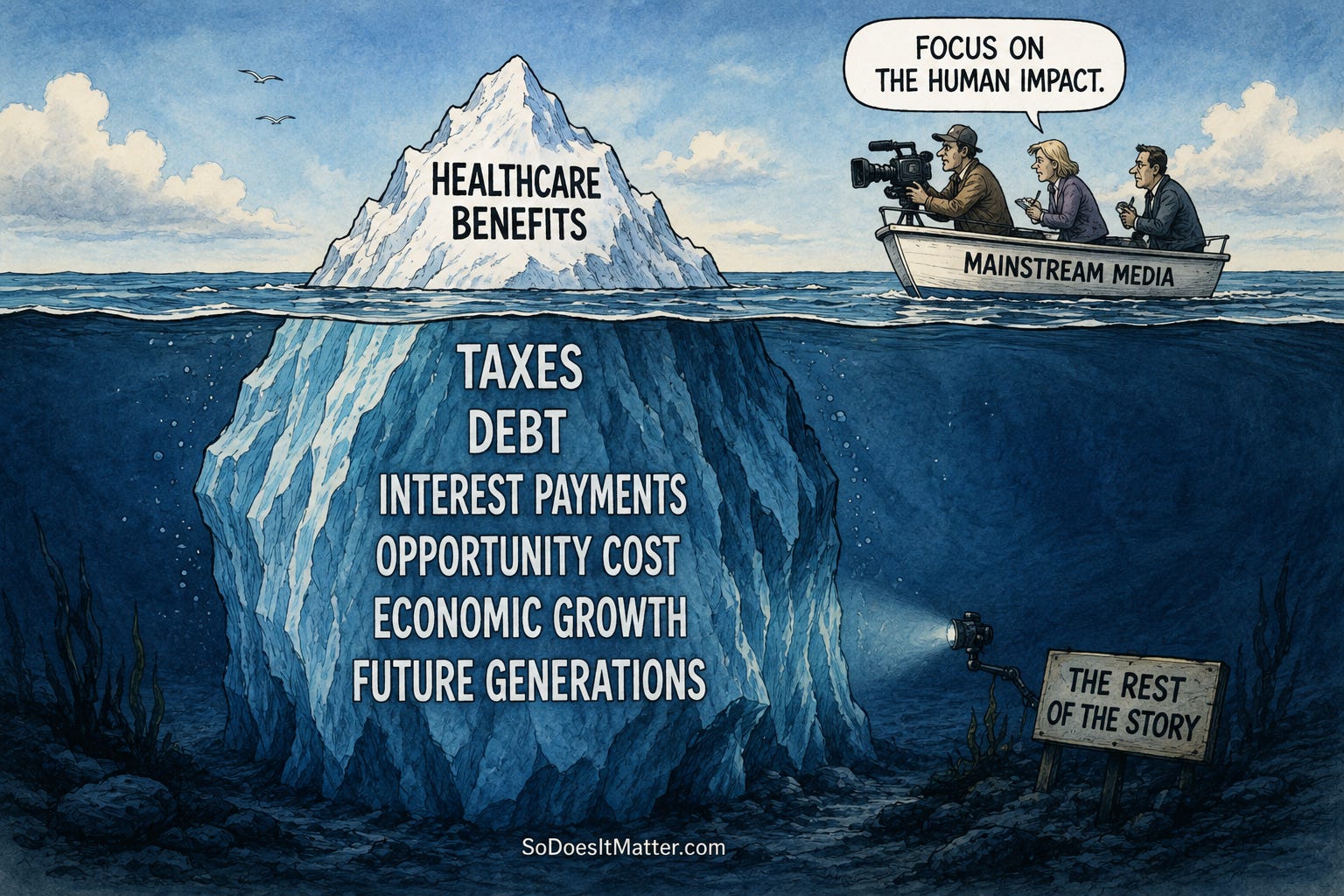
Government healthcare isn’t free. Yet stories about spending cuts rarely examine the taxes, debt and tradeoffs required to sustain it. Media bias is real, if not always intentional.

Our morning content is free for all subscribers and guests! Usually our afternoon content is behind a paywall… If you are not yet a paid subscriber, consider upgrading — you are missing a significant portion of what we produce each week, and your support makes it possible. If you want to get it all and support my efforts, please consider a paid subscription! There is significant exclusive content below the paywall, after this morning’s column.
Most of our content is available on our podcast feed. So, Does It Matter? SPOKEN. Which is available on your favorite podcast app. You can listen to it right here as well.
🕒 7-minute read
The Human Story
This week, CalMatters published another heart-wrenching story about Californians worried they could lose Medi-Cal coverage because of federal spending reductions. It focused on people wondering whether they’ll still be able to see a doctor, fill a prescription or receive the care they’ve come to rely on.
Those hardships are real. Nobody should dismiss them.
But as I finished reading, I couldn’t shake one question.
Who pays?
Not just today’s taxpayers, but tomorrow’s. They don’t have lobbyists. Reporters don’t interview them. They can’t object when politicians make promises that will eventually land on their shoulders. But they’ll pay the bill just the same.
I catch myself doing this too. My first reaction is to sympathize with the people who might lose healthcare. That’s natural. What’s much harder is thinking about the family paying another tax, the business owner who decides not to hire someone or the young worker who inherits another mountain of debt. Those people almost never make it into stories like this.
That’s why I read these articles with a healthy dose of skepticism. Not because the reporting is inaccurate, but because it leaves out half the equation.
News organizations are generally much better at telling the stories of people who receive government benefits than the stories of the people who finance them. I don’t think that’s necessarily intentional. It’s simply easier to put a face on someone losing healthcare than on someone paying another tax bill or carrying another generation’s debt. But readers deserve to see both sides.
If a story carefully explains the consequences of government spending less but never asks about the consequences of government spending more, it isn’t telling the whole story.
Every Choice Has A Cost
Nothing government provides is free—not healthcare, not roads, not schools, not police or fire protection. Every dollar has to come from somewhere.
There are only a handful of possibilities. Government raises taxes, cuts spending somewhere else, hopes economic growth fills the gap or borrows the money.
Politicians understandably prefer choices that appear painless. Unfortunately, those choices don’t exist.
Whether Sacramento raises taxes or invents another fee, somebody has less money at the end of the month. Families adjust their budgets. Businesses think twice about hiring or expanding. There is always a cost, even if it isn’t immediately obvious.
Borrowing doesn’t eliminate that cost. It postpones it. Debt isn’t a new source of revenue; it’s tomorrow’s tax bill arriving late.
That’s why tradeoffs matter. Every dollar spent on one priority is a dollar that can’t be spent somewhere else, returned to taxpayers or used to reduce the debt. That’s the question I wish more of these debates would ask: if government spends another billion dollars here, what gives somewhere else?
California’s Reality
California has been here before.
During years of soaring capital-gains revenue, Sacramento expanded programs and made long-term commitments as though those boom years would never end.
That has been a recurring mistake. Temporary money is fine for temporary priorities. It is a risky way to finance permanent obligations.
The federal government faces the same problem on a much larger scale. The national debt has climbed into the tens of trillions of dollars, and interest payments have become one of Washington’s biggest annual expenses. That’s money that builds nothing, protects no one and provides healthcare for no one. It simply pays yesterday’s bills.
The challenges don’t end there. Congress has spent years avoiding difficult decisions about Medicare and Social Security. Those bills eventually come due, and every year they are postponed, the available options become fewer and more painful. Meanwhile, interest on the debt consumes a growing share of federal resources.
California won’t escape that reality. Much of Sacramento’s spending assumes continued federal support. If Washington begins tightening its belt, California will feel it too.
Arithmetic doesn’t care which party is in power.
So, Does It Matter?
Conservatives are often accused of caring more about budgets than people. I think that gets the argument backwards. If government makes promises it can’t afford to keep, the people who depend on those promises are eventually the ones who get hurt.
I’ve never understood why compassion and fiscal responsibility are treated as opposites. They aren’t. A program built on borrowing forever isn’t compassionate if it eventually collapses under its own weight.
Every government program helps someone. Every government program also has someone paying for it, whether through taxes today or debt that becomes taxes tomorrow. Both groups deserve a place in the conversation.
The people featured in the CalMatters story deserve to be heard. So do the Californians—and the future Americans—who will ultimately pay for the programs they’re defending.
Every story about government healthcare should answer one more question:
Who pays?
There are important debates to be had about the proper role of government and the tradeoffs that come with every policy choice. Journalism serves the public best when it helps readers understand both sides of that equation. Too often, it tells only one side of the story.
Three More Political Cartoons
Below the paywall are three more sobering political cartoons on this topic, for our paid subscribers! If you’ve been enjoying our content, you get more of it and support my efforts! Sign up now for a paid subscription!
