


Our morning content is free for all subscribers and guests! Usually our afternoon content is behind a paywall… If you are not yet a paid subscriber, consider upgrading — you are missing a significant portion of what we produce each week, and your support makes it possible. If you want to get it all and support my efforts, please consider a paid subscription! Today there is exclusive content below this column for paid subscribers.
You can also listen to this post on our podcast feed, So, Does It Matter? SPOKEN. It is available on your favorite podcast app. And you can listen to it here.
⏰ 6 minute read
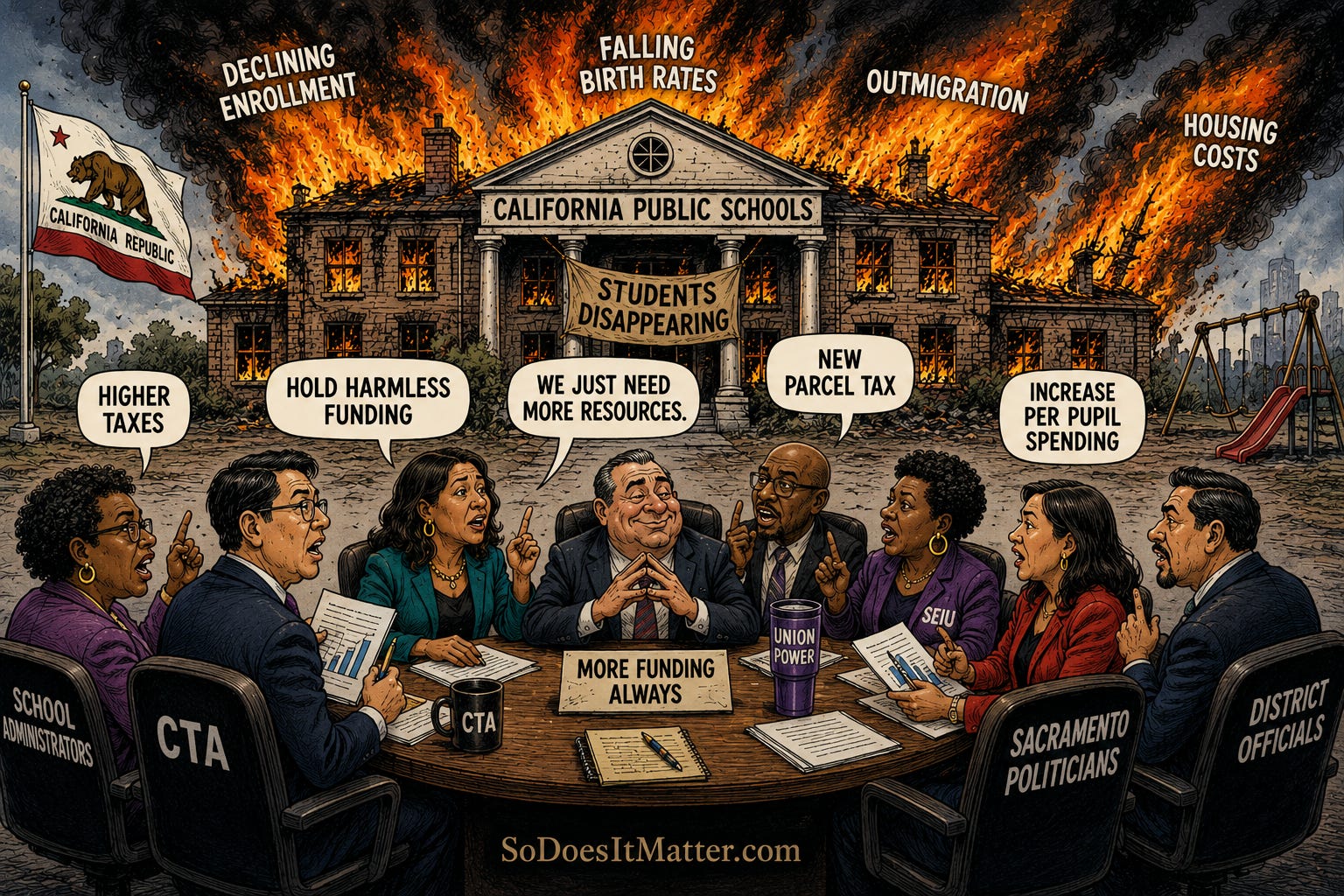
The Students Are Disappearing
For generations, California worried about overcrowded classrooms and whether enough schools could be built quickly enough to keep up with a growing population. Entire neighborhoods were planned around new campuses, and bond measures promised new schools, new classrooms, and new hiring. Today, however, the state faces the exact opposite problem: too few students rather than too many.
According to the California Department of Finance, California’s public school enrollment peaked at more than 6.3 million students in 2004. Today, despite the addition of universal transitional kindergarten, that number has fallen to roughly 5.8 million students. The state has lost more than 420,000 public school students over the past decade alone, and Sacramento’s own projections anticipate another half-million students disappearing over the next ten years. Since 2015, 630 schools across California have closed, including 57 in the 2024-25 academic year alone.
This is not a temporary COVID disruption. It is a demographic transformation. Birth rates have fallen. Families continue leaving California for more affordable states. Housing costs have made it increasingly difficult for young families to remain in many communities. Charter schools, private schools, and homeschooling have all grown in the post-pandemic era.
Some students chose alternatives. Others moved away. Many were never born at all.
Built For Growth
California’s education system was built during decades of almost uninterrupted growth. More students meant more schools, more teachers, more administrators, more support staff, and more facilities. For most of the last half-century, the central challenge facing school districts was figuring out how to keep up with demand.
Growth is politically easy because everybody wins. Managing decline is different.
Declining enrollment forces questions that elected officials and school boards would often prefer to avoid. Which schools should close? Which campuses should merge? Which programs should be consolidated? Which administrative positions are no longer necessary? How much excess capacity should taxpayers continue funding?
Government institutions are generally designed to grow, but they are rarely designed to shrink. Every school closure creates opponents. Every consolidation creates controversy. Every staffing reduction creates organized resistance.
Students do not vote. Employees do.
Los Angeles And San Francisco School Districts
Perhaps nowhere is this challenge more visible than in Los Angeles. The Los Angeles Unified School District reached peak enrollment of nearly 747,000 students in the early 2000s. Today, enrollment sits near 400,000 students, yet the district still employs more than 55,000 people. That is what happens when a district built for nearly three-quarters of a million students continues operating as though the enrollment boom never ended — and when union influence makes shrinking the payroll the last option anyone in charge wants to consider.
The obvious question is what exactly is supposed to shrink when the students disappear. The schools? The bureaucracy? The payroll? Or nothing at all?
San Francisco faces a different version of the same problem, but the underlying math is remarkably similar. The district has already lost more than 4,000 students since 2012 and projects another 4,600 students will disappear by 2032. Today, SFUSD operates 125 campuses with room for roughly 14,000 additional students who simply do not exist.
The financial consequences have become impossible to ignore. The district has wrestled with deficits exceeding $100 million, faced the prospect of state oversight, and repeatedly considered school closures and consolidations that would have been politically unthinkable a generation ago. At one point, district officials considered closing or merging as many as 13 schools in an effort to stabilize finances.
The irony is difficult to miss. San Francisco has spent years debating equity, access, and educational outcomes, but it may ultimately be demographics and housing affordability that reshape the city’s schools more than any education policy ever could. Communities understandably view neighborhood schools as permanent institutions. Demographics do not share that sentiment.
The Political Response
The politics of declining enrollment are remarkably predictable. The major public employee unions that dominate California education politics did not build their power during an era of contraction. They built it during an era of expansion, when more students meant more schools, more employees, larger memberships, larger budgets, and greater political influence.
Now the students are disappearing, but the system does not want to shrink.
There is another uncomfortable reality beneath these enrollment numbers: while student populations keep moving down, compensation costs keep moving up. Teachers and classified employees in many California districts now receive salaries, health benefits, pensions, step-and-column raises, and job protections that would be the envy of many private-sector workers. That was easier to sustain when enrollment was growing, revenues were expanding, and districts could assume tomorrow would be bigger than today.
But that world is disappearing.
Now enrollment is falling, revenue pressure is increasing, and the political class is still trying to preserve a growth-era cost structure in a shrinking system. The response, predictably, is not to reduce the size and cost of school districts to match the number of students they serve. The response is more taxes, more money per student, and less connection between funding and actual enrollment.
As enrollment declines continue, expect a familiar three-part playbook. First, expect calls for additional local taxes and bond measures designed to replace revenues that disappear along with students. Second, expect continued pressure on Sacramento to increase the amount of money attached to each remaining student so districts can maintain larger payrolls with smaller enrollments. Third, and perhaps most importantly, expect efforts to weaken the relationship between enrollment and funding itself.
In many ways, that process has already begun. California has moved toward funding protections and enrollment cushions designed to soften the financial impact of declining attendance. Supporters argue districts need time to adjust. Critics argue taxpayers should not indefinitely fund institutions sized for students who are no longer there.
No organization has a larger stake in that debate than the California Teachers Association, the most powerful public employee union in California politics. For decades, CTA and its local affiliates thrived in an environment where more students meant more teachers, more dues-paying members, larger budgets, and greater political influence. Declining enrollment threatens that model.
The same is true for local teachers unions and SEIU locals representing classified employees throughout the state. If funding follows students too closely, declining enrollment eventually forces downsizing. If funding becomes detached from students, the bureaucracy can survive even as the classrooms empty.
The students are disappearing. The payroll is not.
So, Does It Matter?
California schools may be the first major public institution forced to confront demographic decline, but they will not be the last. Similar questions are coming for public transit systems built for commuters who no longer ride them, local governments built around assumptions of endless growth, and pension systems designed around the expectation that next year would always be bigger than the last.
California’s political class became exceptionally good at governing expansion. The next generation of leaders may be judged on whether they can govern contraction with equal success.
The old California education debate was where to build the next school. The new California education debate is which schools close, which bureaucracies shrink, and whether taxpayers should continue funding institutions designed for a California that no longer exists.
That is the real fight. Not whether California values education. Of course it should. The fight is whether education dollars exist to educate students, or whether students increasingly exist to justify the dollars, jobs, contracts, and political power of the system built around them.
Below the paywall are three more outstanding political cartoons on this topic!
