

The Difference Between Liberalism, Progressivism, Socialism And Communism
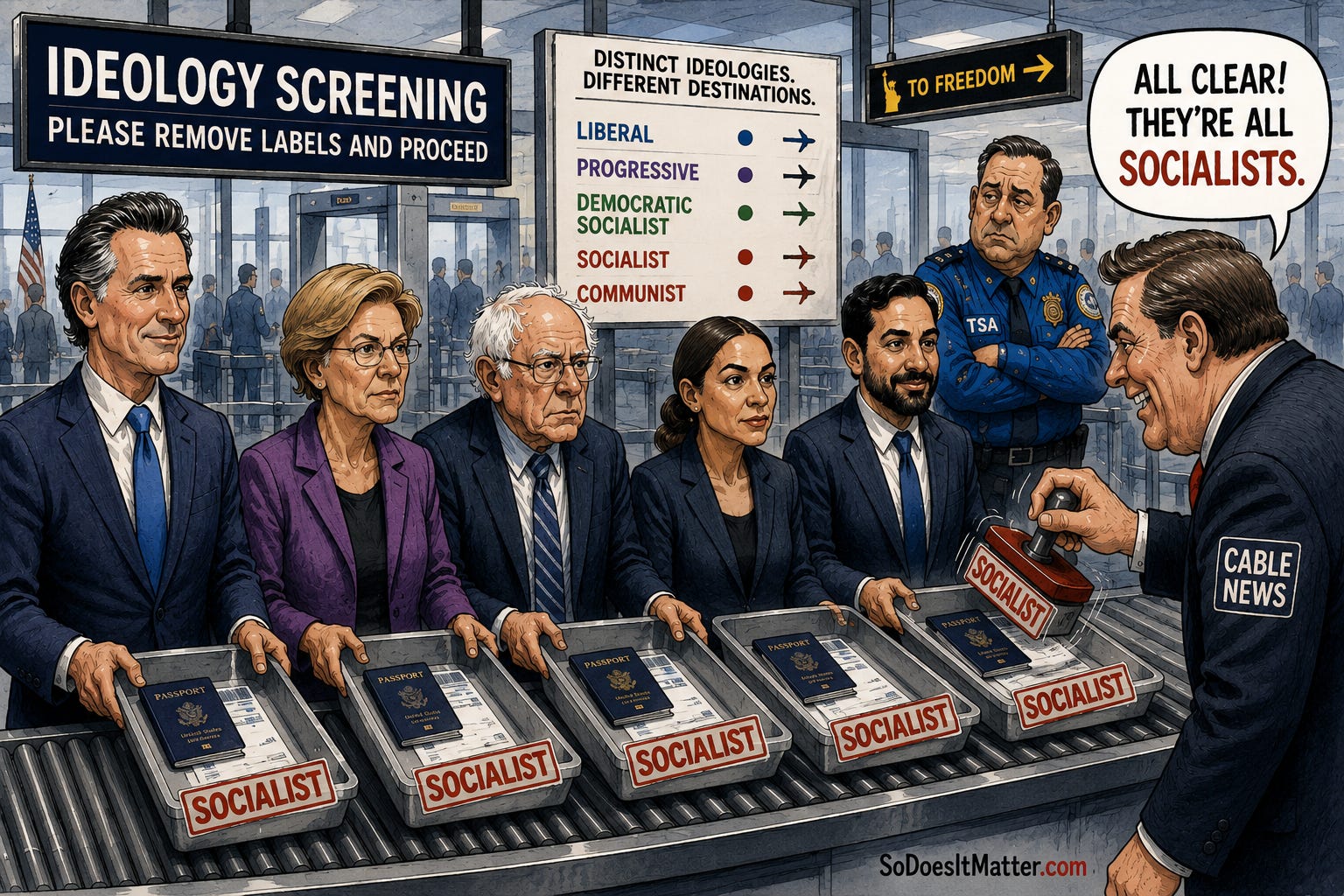
Politicians and pundits throw these labels around every day. But before deciding who belongs where, we should probably agree on what the words actually mean.

Typically, our afternoon content is behind a paywall — or there is something extra for our paid subscribers. If you are not one, please consider upgrading. You are missing a significant portion of what we produce each week, and your support makes it possible.
If you want to get it all and support my efforts, please consider a paid subscription!
Because of the paywall this piece is not offered on our podcasting channel.
🕒 8-minute read
Everybody’s A Communist, A Socialist, Or A Fascist… Depending On Who’s Talking.
Is Gavin Newsom a socialist?
Is Zohran Mamdani something entirely different — and is he already proving it? He isn’t just talking about socialism. As mayor of New York City, he’s opening city-owned grocery stores in the Bronx right now.
Political labels aren’t supposed to end arguments. They’re supposed to help us make better ones. Conservatives have history on our side. We don’t need to redefine words to win debates — we need to use the right ones. If socialism has repeatedly failed, and if communism has produced some of history’s most repressive governments, then the historical record is already compelling. We don’t strengthen that case by calling every politician to the left of Ronald Reagan a communist.
By the end of this column, you’ll know why Gavin Newsom isn’t a socialist, why Bernie Sanders isn’t simply another liberal, why Alexandria Ocasio-Cortez and Zohran Mamdani occupy more than one political category, and why conservatives sometimes weaken their own case by using these labels interchangeably.
Political philosophies don’t fit neatly into boxes. Politicians often borrow ideas from more than one tradition. But these labels still have core meanings, and if we’re going to debate America’s future honestly, we ought to begin there. Before we classify today’s politicians, let’s first define the categories.
Liberalism: Still Capitalism
Ironically, the word “liberal” has probably changed more than any of the labels in this column.
America’s Founders would have recognized themselves as classical liberals. Classical liberalism emphasized individual liberty, private property, free markets, limited government and constitutional rights. Think John Locke, Adam Smith, James Madison and Thomas Jefferson. In today’s political vocabulary, many of those ideas sound more conservative than liberal — a reminder that political labels evolve over time.
Modern American liberalism took a different path, particularly during the Progressive Era and Franklin Roosevelt’s New Deal. Today’s liberals still believe in democracy, private property and capitalism, but they also believe government should play a much larger role correcting what they see as capitalism’s shortcomings. They generally place greater confidence in government action, favor more direct democratic decision-making over many of the structural checks built into our constitutional republic, and support broader regulation, higher taxes and a more expansive social safety net.
That’s where most Democratic elected officials still live philosophically.
Governor Gavin Newsom isn’t proposing that California nationalize Apple, Chevron or Disneyland. He supports a larger welfare state, stricter environmental regulation, expanded Medi-Cal, stronger labor protections and a more activist government than I would prefer. Those are perfectly legitimate subjects for political debate, but they’re still debates taking place within a capitalist system — not arguments for replacing capitalism altogether.
Conservatives have spent decades arguing that ever-larger government often produces slower economic growth, more bureaucracy, less innovation and greater dependence on the state. That’s an entirely legitimate argument to have. But we don’t strengthen it by pretending every expansion of government is socialism. In fact, doing so makes it easier for actual socialists to argue they’re no different from mainstream liberals.
So Where Does Gavin Newsom Fit?
Read on…
You’ve reached the part of our afternoon content where the free preview stops — the paywall. If you’ve found this discussion worthwhile so far, you’re about to reach the part where we apply these definitions to today’s political movements and finish classifying the politicians we began with. That’s the content reserved for paid subscribers.
Here’s what’s below the paywall:
Is Gavin Newsom really a socialist?
Is progressivism just liberalism with a new name?
Why are Bernie Sanders and Gavin Newsom different?
Where do AOC and Zohran Mamdani actually fit?
What has socialism traditionally meant — and what does it look like when someone actually does it?
Why did communist governments never resemble Marx’s vision?
What mistake do conservatives make when arguing about the left?
Why is precision a political advantage?
