


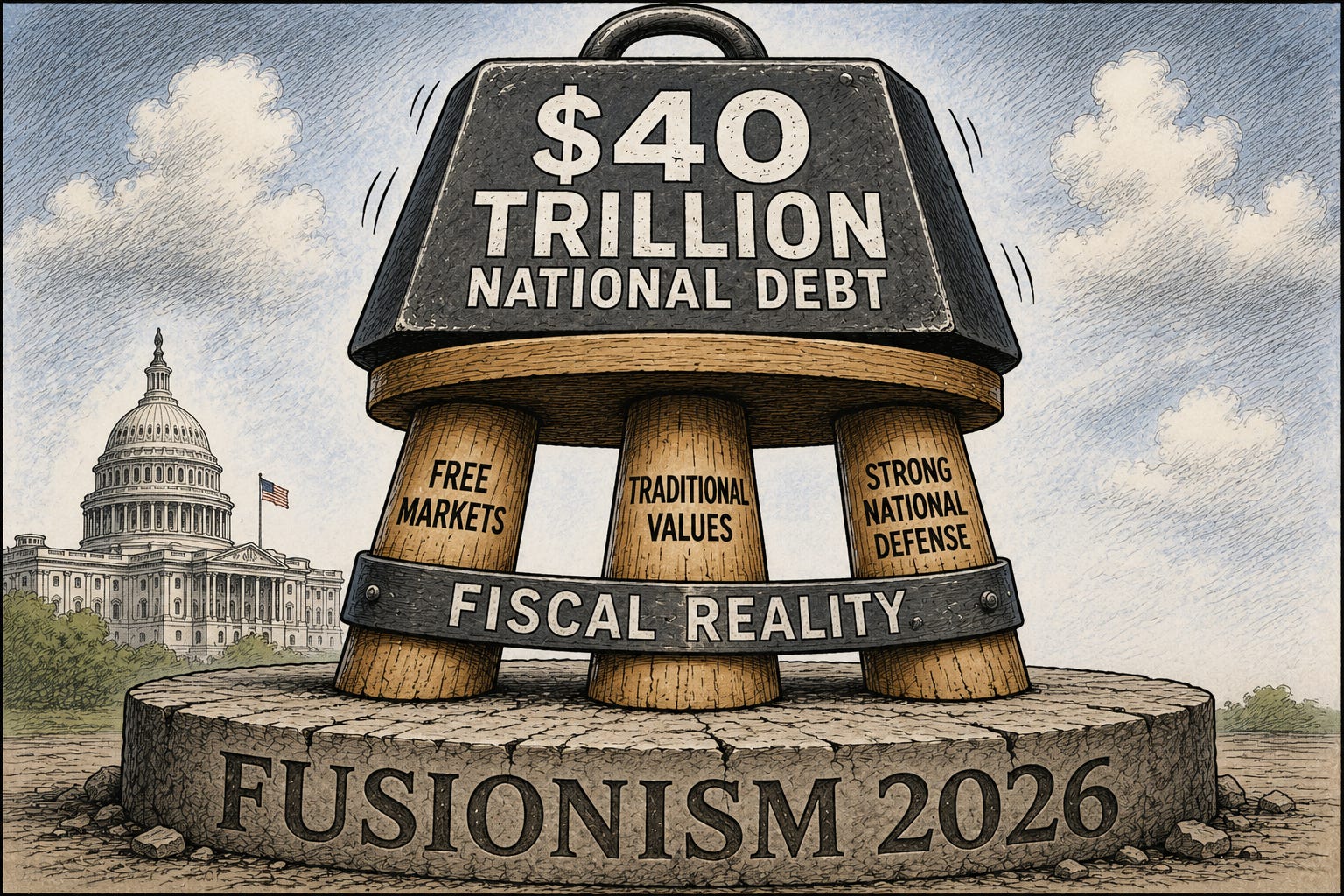
One of the questions I get a lot from subscribers is about my political philosophy. I write a lot, and I think people are trying to understand the underpinnings behind my clarity on so many issues. This column is my humble effort to answer that very question. I hope that you find it useful as you do your own self-reflection on what you believe, and why. I tried to keep this relatively short and easy to digest.
Typically, our afternoon content is behind a paywall—or paid subscribers get something extra. This piece is non-paywalled. If you aren't, please consider upgrading. You are missing a significant portion of what we produce each week, and your support makes it possible. If you want it all and want to support my efforts, please consider a paid subscription!
You can listen to this content on our Podcast channel — So, Does It Matter, Spoken! - on your favorite podcast app. Or you can just go listen here.
🕒 5-minute read
The Books That Formed My Political Philosophy
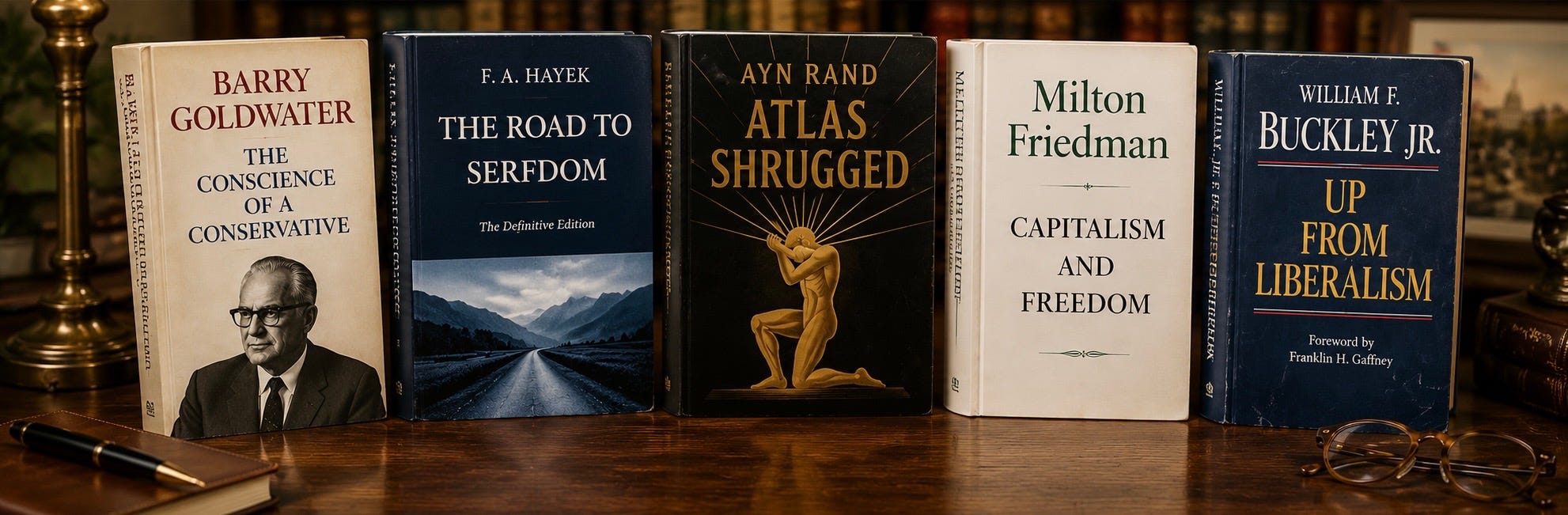
When I got involved in politics in the late 1980s, I did what young political activists used to do: I read books. Lots of them. Barry Goldwater’s The Conscience of a Conservative, Friedrich Hayek’s The Road to Serfdom, Ayn Rand’s Atlas Shrugged, Milton Friedman’s Capitalism and Freedom and William F. Buckley Jr.’s Up from Liberalism. I was trying to figure out not just what I believed, but why.
I got my start in Young Americans for Freedom, the leading national conservative youth organization of the day. At every chapter meeting, we read the Sharon Statement, adopted in 1960 at Buckley’s home in Sharon, Connecticut. It declared that “liberty is indivisible,” defended the Constitution and market economy, spoke of “transcendent values,” and identified international communism as the great threat to freedom.
There it was: individual liberty, limited constitutional government and free markets joined to moral order, patriotism and a strong national defense. I was reading the architecture of fusionism at every YAF meeting without calling it that.
That was the conservative movement I entered. Ronald Reagan was still president. The Cold War was real. We talked about the Soviets — the Ruskies — as an existential adversary, and nobody knew the Berlin Wall would soon come crashing down. The mission seemed clear: defeat communism abroad, constrain government at home and defend the institutions of a free society.
Thirty-eight years later, I still believe most of it.
Freedom And Virtue
Fusionism came largely out of the intellectual world around National Review. Frank Meyer argued that the libertarian emphasis on freedom and the traditional conservative emphasis on virtue were not enemies. They needed each other.
Virtue means little if coerced. A government powerful enough to enforce it is powerful enough to define it. But freedom does not survive on autopilot. It depends on families, churches, synagogues, communities and personal responsibility. Liberty gives virtue room to flourish. Virtue keeps liberty from collapsing into license.
That still describes me pretty well. I believe in individual liberty, free markets, private property, constitutional government and federalism. I am deeply skeptical of centralized power. Government should generally leave people alone, while the institutions and traditions that sustain freedom remain worth preserving.
So if somebody asked me today to put a label on my political philosophy, fusionist is probably the closest one I have found.
But my fusionism in 2026 is not exactly the fusionism I absorbed in 1988.
What Changed
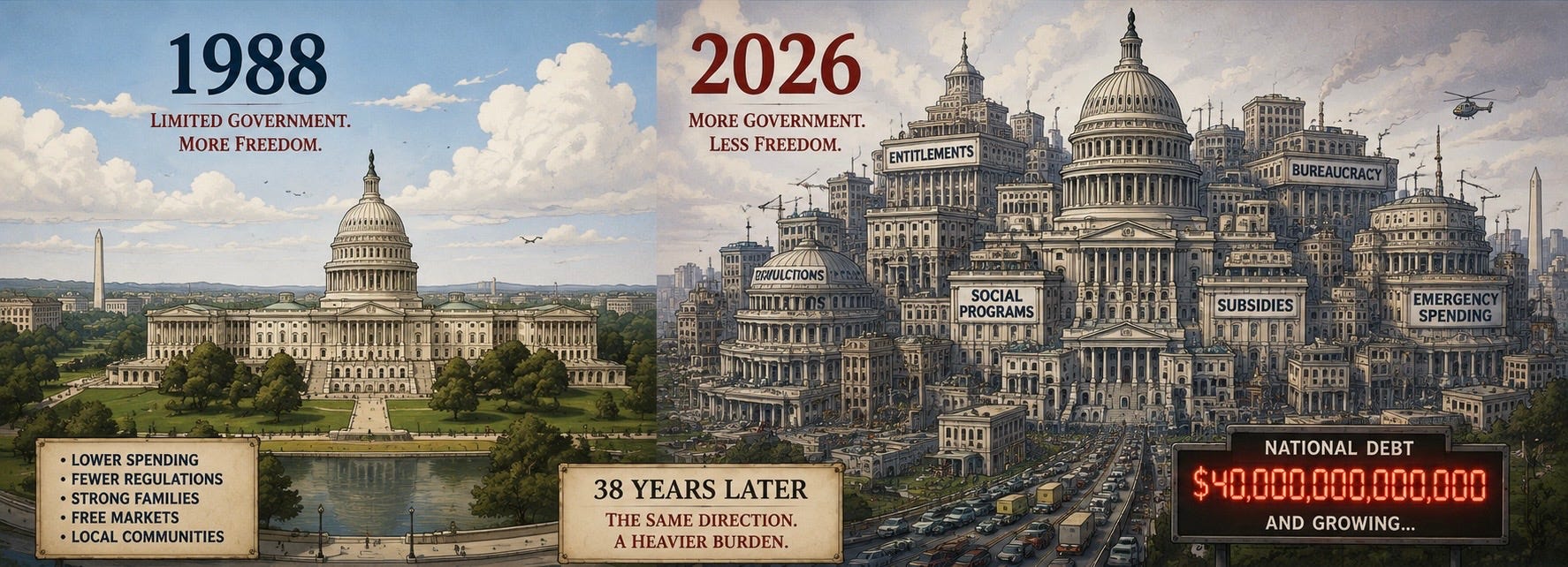
The first change is the enormous expansion of government. When conservatives of my generation warned about socialism, we pictured something imposed from abroad or advanced by a fringe at home. The Soviet Union is gone, but Washington has spent decades taking responsibility for more and more of American life.
It regulates more. Spends more. Subsidizes more. Promises more. Temporary programs become permanent constituencies. Emergency spending becomes the new baseline. Republicans campaign against big government, Democrats campaign for bigger government, and somehow government almost always gets bigger.
By the steady march of domestic socialism, I mean the century-long transfer of responsibility from individuals, families, communities, and markets to Washington — a transformation with roots in the Progressive Era and the administrative state of Woodrow Wilson. More dependency, regulation, spending, and permanent obligations. Different labels, same direction.
That has made me more, not less, committed to limited government.
The second change is harder to ignore because arithmetic eventually beats ideology.
This week, the national debt surpassed $40 trillion. The number itself is not the whole problem; a country as large and wealthy as the United States can carry substantial debt. What alarms me is what it represents — a federal government whose spending and permanent obligations have grown far beyond what we are willing to pay for.
Interest on that debt is now one of the federal government’s largest expenses. Decades of promises, wars, emergencies, entitlements, and plain political cowardice have piled up into a burden that cannot be wished away.
How could that not change the way a conservative thinks about government?
Fusionism With A Fiscal Constraint
For me, fiscal prudence can no longer be one item on a conservative checklist. It has to be a governing principle.
That applies at home. It applies abroad.
Cold War fusionism placed enormous emphasis on American military strength, and for good reason. Reagan believed in peace through strength, and so do I. America should maintain overwhelming military capability, deter its enemies, honor genuine commitments, and recognize China as a profound strategic challenge.
But the conservatism I grew up with often worked on a cause-first, cost-later basis. Fiscal restraint mattered until a national-security objective was judged important enough. Then America would find the money.
For me, that luxury is gone.
None of this suggests that foreign commitments are the principal cause of our fiscal crisis. They aren't. The much bigger fiscal problem is the federal government's enormous domestic commitments, especially the entitlement programs that run largely on autopilot. I focus on foreign policy here because that is where the fiscal reality has most changed the fusionism I learned as a young man.
At $40 trillion in debt, cost has to be part of the strategic and moral argument itself. Before the United States undertakes a major action, foreign or domestic, we should ask what it does to the debt, what it crowds out, and whether the benefit justifies pushing more obligations onto future generations.
That is not isolationism. It means every major commitment has to justify itself against the demands on a deeply indebted country.
Treaties and alliances should not be tossed aside casually, but neither are they holy writ. Does the commitment still advance a vital American interest? Are wealthy allies carrying their share of the burden? What does fulfilling it actually cost?
A strong national defense does not require pretending the money is infinite.
My updated fusionism therefore puts two questions near the front of almost every major policy debate: Does this worsen the country's fiscal condition? And does it expand the reach and permanence of the state?
A worthy objective does not make either question disappear.
So, Does It Matter?
I have not abandoned the conservatism I learned as a young man. If anything, I am more convinced of its central proposition: a free people needs limited government, constitutional restraint, free enterprise, strong families and institutions, and enough virtue to govern itself without requiring government to do it for us.
But political philosophy cannot mean mechanically applying the answers of 1988 to the problems of 2026. My fusionism now asks not only whether government action advances a legitimate American interest, but whether government should be doing it, whether it enlarges the permanent reach of the state, and whether we can afford it.
The challenge to limited government no longer comes only from the progressive left. A growing national populism is increasingly comfortable using federal power aggressively when the objective is one conservatives favor. The temptation is familiar: if government can punish the right enemies, protect the right industries, shape the right culture or produce the right economic outcome, maybe conservatives should seize the machinery rather than restrain it.
One can’t say this without conjuring images of Denethor or Boromir in J.R.R. Tolkien’s The Lord of the Rings, desiring to use the One Ring rather than see it destroyed.
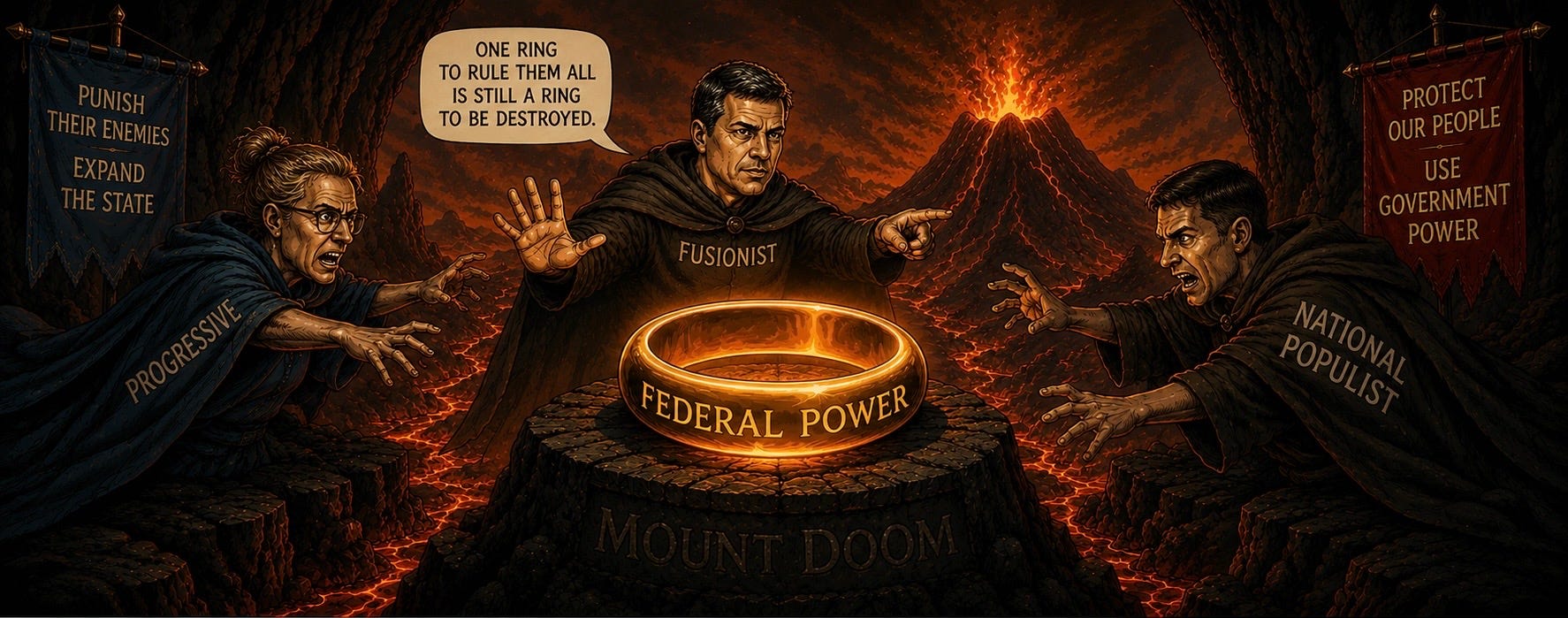
That is precisely where fusionism still matters. Limited government is not a tactic to be abandoned when our side controls it. Constitutional restraint, federalism, free markets and individual liberty are principles because they bind us when using power would be politically convenient.
Debt is not merely an accounting problem. It is a question of self-government. A country that continually consumes more than it is willing to pay for is making promises with somebody else’s money — usually the money of people who have not yet had any say in the matter.
The Sharon Statement taught conservative youth of my generation that freedom cannot survive unlimited government. Thirty-eight years later, I would add this: a republic that cannot discipline its appetites — fiscal or political — will eventually lose the capacity to preserve its liberties.
-JSF