

The California Governor’s Debate Got Louder. The Race Did Not Get Much Clearer.
Candidates for governor finally started throwing punches, but the crowded debate still left voters with more conflict than clarity.

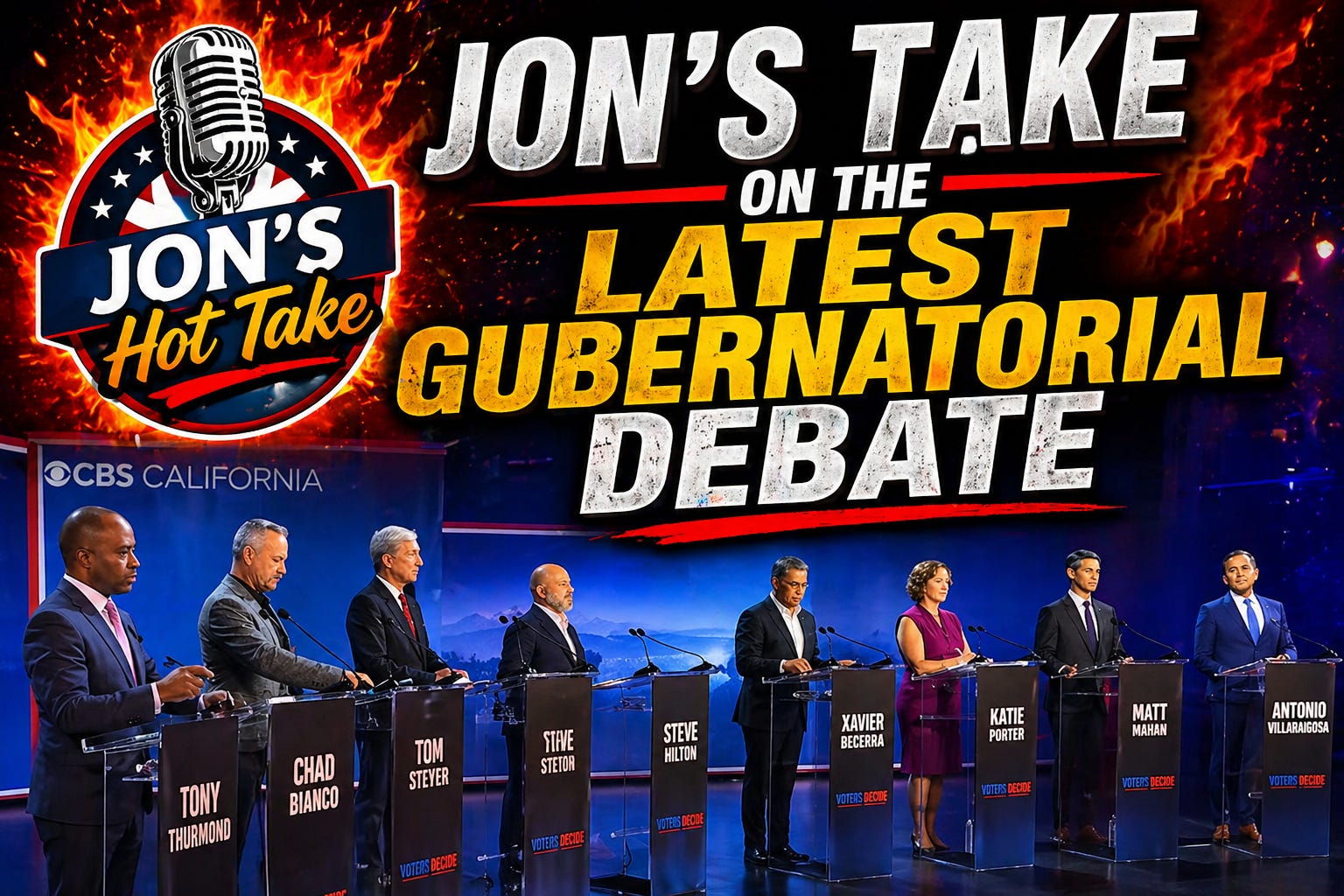
You can listen to this post on our podcast feed, So, Does It Matter? SPOKEN. It’s available on your favorite podcasting app, or you can find it here. Our afternoon content is typically either paywalled for our premium subscribers or has paywalled bonus content.
For our paid subscribers, below this column is a video where I talk about what I think might be the best format for the next debate…
⏱️ 7 min read
The Debate Finally Had A Pulse
The problem was obvious before the debate began: eight candidates on one stage is not really a debate. It is political speed dating with better lighting.
That turned out to be exactly right. Tuesday night’s California governor’s debate at Pomona College was louder, sharper, and more entertaining than last week’s bloodless affair. Candidates interrupted each other, moderators jumped in aggressively, and at times the whole thing felt less like a forum for California’s next governor and more like a family dinner after everyone had read the latest poll.
Katie Porter said it best after one especially messy stretch: “This is worse than my teenagers at dinner.”
She was not wrong.
There were real exchanges. Xavier Becerra called Donald Trump “Steve Hilton’s daddy,” trying to tie Hilton as tightly as possible to the president. Hilton turned the attack around, arguing that Democrats have run California for years and still want to blame Trump for everything wrong with the state. Chad Bianco called the debate “the hour and a half that you’re never going to get back.” One student in the audience reportedly summed up the evening with: “Wow, that was a bit of a mess.”
That was the debate in miniature. It was a mess. But it was not a boring mess.
The debate mattered, but not because it produced a winner. It mattered because it exposed the central weakness of the race: California has a stage full of candidates who can describe the state’s problems, blame someone else for them, and generate the occasional clip. What remains less clear is who has the seriousness, discipline, and governing imagination to fix any of it.
The moderators became part of the story, too. CBS’s Julie Watts pressed Becerra hard over whether he could legally declare a state of emergency and freeze insurance rates. When Becerra pushed back, he quipped that he would “like to go to court with you on that.” Watts also threatened to ban mentions of Trump and warned Tom Steyer that she might cut his microphone if he was “not respectful” during a testy exchange over oil prices.
That is not exactly Lincoln-Douglas.
But it mattered more than last week’s debate because the candidates finally acted like there was something at stake. With ballots about to arrive in mailboxes, they could not afford another sleepy evening. They needed moments, contrasts, and reminders to voters that this race is actually happening.
They delivered some of that. But they did not make the race meaningfully clearer.
Becerra And Steyer Became The Main Targets
The central political development of the night was that Xavier Becerra and Tom Steyer became the two main targets. That tells us where the race is right now. Candidates do not waste precious debate time attacking people who do not matter.
Becerra entered the debate with momentum, and the stage reflected it. Steve Hilton challenged him over whether he would actually have the legal authority to declare a state of emergency and freeze home insurance rates. Matt Mahan hit him over his record as Health and Human Services secretary, including COVID, mpox, and the handling of unaccompanied minors. Even the moderators pressed him hard.
The sharpest policy challenge came from Hilton.
“We can’t have a governor who doesn’t understand how the government works,” Hilton said.
Becerra fired back: “We don’t need a talking head from Fox News to tell us how the government works.”
That was a good television exchange. It also exposed the weakness of Becerra’s candidacy. He has a long résumé — attorney general, congressman, cabinet secretary — but when pressed on what he would actually do as governor, he still often sounds more like a bureaucrat defending his credentials than a candidate offering a clear break from the status quo.
Mahan landed the best Democratic punch on Becerra. He accused him of having “never met a crisis that he couldn’t ignore,” pointing to COVID, mpox, and the border crisis during Becerra’s time at HHS.
Becerra’s response was combative, but not especially reassuring. “You’re not wearing a mask, are you, Matt? You’re not worried about catching monkeypox, right?” he said.
That was zesty. It was not necessarily gubernatorial.
Still, Becerra did not collapse. That may have been enough for him. His victory was not that he persuaded anyone that he is the future of California. It is that his rivals treated him like the future of the Democratic field. In politics, being attacked is often a form of promotion.
Steyer had a different problem. He came in as the billionaire self-funder and therefore the easiest target on the stage. Porter landed the cleanest blow when Steyer talked about making polluters pay.
“How about profiteers pay?” Porter asked.
That was probably the best Democratic attack line of the night. It was pointed, personal, and easy to understand. Porter accused Steyer of making billions from fossil fuel investments and then using that fortune to fund his campaign while paying the lowest tax rate on the stage.
Steyer answered by casting himself as a “change agent” opposed by special interests. That is his best defense: if the establishment is attacking him, he must be doing something right.
But Steyer still has a deeper problem. He wants voters to see his money as proof he cannot be bought. But in a state where ordinary people are being crushed by costs, billionaire self-funding can also read as proof that he lives in a different political and economic universe.
His money gives him reach. It also makes every answer sound like it comes from a man who has never had to persuade anyone he could not outspend.
Hilton Had An Argument. Bianco Had A Mood.
Steve Hilton had a straightforward job: keep the focus on Democratic control of California and avoid getting sucked into a Republican-on-Republican fight with Chad Bianco.
He largely did that.
Becerra tried to tie Hilton to Trump with the “Steve Hilton’s daddy” line. It probably pleased some Democratic viewers. But Hilton’s answer was more strategically useful. He joked that his actual father, the former goalie for the Hungarian national ice hockey team, had not weighed in on the race. Then he pivoted to his central argument: California’s problems were made in California.
“All these big things that affect us on a daily basis, these are decisions made here in California by our politicians,” Hilton said. “And we’ve had the same people in charge for 16 years now.”
That is Hilton’s campaign in one sentence.
His strongest debate frame was simple: Democrats run the state, California is too expensive and badly governed, and they still want to blame Trump. That is easy for voters to understand. Whether it is enough to overcome California’s deep-blue electorate in November is a separate question. But in a top-two primary, it is a coherent message.
Hilton’s problem is not message clarity. His problem is whether California has enough voters willing to hear that message from a Trump-endorsed Republican.
Hilton also avoided what could have been a mistake: spending the night fighting Bianco. The two Republicans are competing for many of the same voters, but neither benefits from turning the debate into a GOP family feud, while six Democrats are on stage defending, or trying to explain away, the condition of California.
Bianco remained Bianco: angry, blunt, and contemptuous of Sacramento. At one point, frustrated by Democrats blaming Trump, he said: “We have a group of 20-ish-year-old kids, and we’re just sitting here lying to them about broken Democrat policies in California for the last 20 years, and we’re going to sit here and blame a president who’s been president for a year. This is absolutely ridiculous.”
That was a real Bianco moment. It was blunt. It was populist. It is probably connected with voters who believe California’s ruling class has been lying to them for years.
But there is a difference between Hilton and Bianco. Hilton gives voters an argument. Bianco gives them a mood.
That mood is not meaningless. Anger at Sacramento is rational. Frustration with crime, homelessness, taxes, regulation, schools, and the cost of living is rational. A lot of Californians feel like the state’s ruling class has failed upward for years while ordinary families pay the price.
But Bianco also reinforced his limitation. He is very good at expressing voter frustration. He is less effective at demonstrating how he would govern the entire state. He needed to show enough policy range to reassure persuadable voters that he is more than a protest candidate. He reinforced his brand, but he did not obviously expand it.
The Rest Just Had Moments…
Katie Porter helped herself. The question is whether she helped herself enough.
Her “teenagers at dinner” line captured the absurdity of the format, and her “How about profiteers pay?” attack on Steyer reminded voters why she can be dangerous in a debate. That was Porter at her best: sharp, prosecutorial, and able to turn an opponent’s talking point against him in real time.
She also returned to her core reform message, saying, “I am not for sale.” That is the cleanest version of the Porter brand. She wants voters to see her as the candidate who cannot be bought, will not take corporate money, and is willing to confront wealthy interests.
But Porter needed more than a few good moments. She needed a reset. She showed she can still prosecute a case. What she did not fully show is why this race should become her case.
Matt Mahan also did what he needed to do, at least partially. The problem for Mahan has always been that he comes across as practical, sane, and results-oriented — admirable, but politically dull in an eight-candidate debate.
He needed to stop selling oatmeal.
Tuesday night, he added some hot sauce. His attack on Becerra’s record at HHS was probably the most effective Democratic attack on Becerra all night. He positioned himself as the accountability candidate — the mayor who actually runs a city and understands that voters want results, not excuses.
But Mahan still has a problem. He can diagnose the failures of both parties, but he often struggles to deliver a memorable alternative. When he tried to split the difference on health care, saying the answer was “incentivizing actual health,” it sounded more like a consultant’s phrase than a governing agenda.
Mahan may appeal to editorial boards, good-government voters, and Democrats exhausted by ideological theater. But in a crowded top-two primary, respectability is not the same thing as momentum. Competence is a virtue. It is not a movement.
Antonio Villaraigosa and Tony Thurmond had the hardest task. Both needed something dramatic because low single digits do not give a candidate the luxury of subtlety.
Villaraigosa leaned on his record as Los Angeles mayor, arguing that graduation rates improved and crime declined during his tenure. He said voters should elect him because he wants to be “transformational.” Thurmond leaned heavily on biography and “lived experience,” talking about losing both parents by the time he was six and being raised by other family members.
Thurmond also went after Bianco hard over the Riverside County ballot controversy, accusing him of wasting public dollars to “steal ballots.” That gave him a moment. It did not appear to give him a path.
For Villaraigosa and Thurmond, the debate was not a missed opportunity so much as a reminder that airtime is not the same thing as viability.
So, Does It Matter?
The debate was louder, sharper, and more revealing than last week’s debate. But it did not reshape the race.
No one melted down. No one broke through. Becerra survived. Steyer absorbed fire. Hilton stayed on message. Bianco remained in his lane. Porter and Mahan helped themselves, but only around the edges.
And now the clock matters more than the candidates. The next major debate is the CNN California gubernatorial primary debate on Tuesday, May 5, at 6 p.m. Pacific. It will feature the same lineup, minus Tony Thurmond, who did not qualify.
By then, voters will have ballots in their hands.
That is the problem. The candidates finally acted as if the election were real, but the race still feels unresolved. This debate gave the campaign energy. It did not give voters clarity.
The candidates proved they could interrupt each other, land a few punches, and manufacture moments. What they did not prove is that California is any closer to finding the next governor it actually needs.
Below is a video in which I suggest a format I think would make the third debate more meaningful… If you aren’t a paid subscriber, you should think about it. The value proposition is simple — two points:
1) A big chunk of our content (like the video below) is for our paid subscribers, and for the relatively low cost, it means you pay like 10 cents to see extra stuff.
2) You should invest in the kind of journalism/commentary that you want, or it won’t be around. Support my efforts, and it means I can do more of it! I call balls and strikes in California politics - and not enough people do!
