

Ten Reasons Cameras Should Stay Out of the Supreme Court
Transparency is good. Turning the Court into another political stage is not.

Usually our afternoon content is behind a paywall…. If you are not yet a paid subscriber, consider upgrading — you are missing a significant portion of what we produce each week, and your support makes it possible. If you want to get it all and support my efforts, please consider a paid subscription! There is exclusive content below the paywall on this post… A video commentary to go with this column (My first since coming back from the Aloha State!)
You can also listen to this post on our podcast feed, So, Does It Matter? SPOKEN. It is available on your favorite podcast app. And you can listen to it here.
Finally, less then 10% of the time I stray from California politics, like with this piece…
🕒 Est. Read Time: 6 minutes
Congress Advances Legislation…
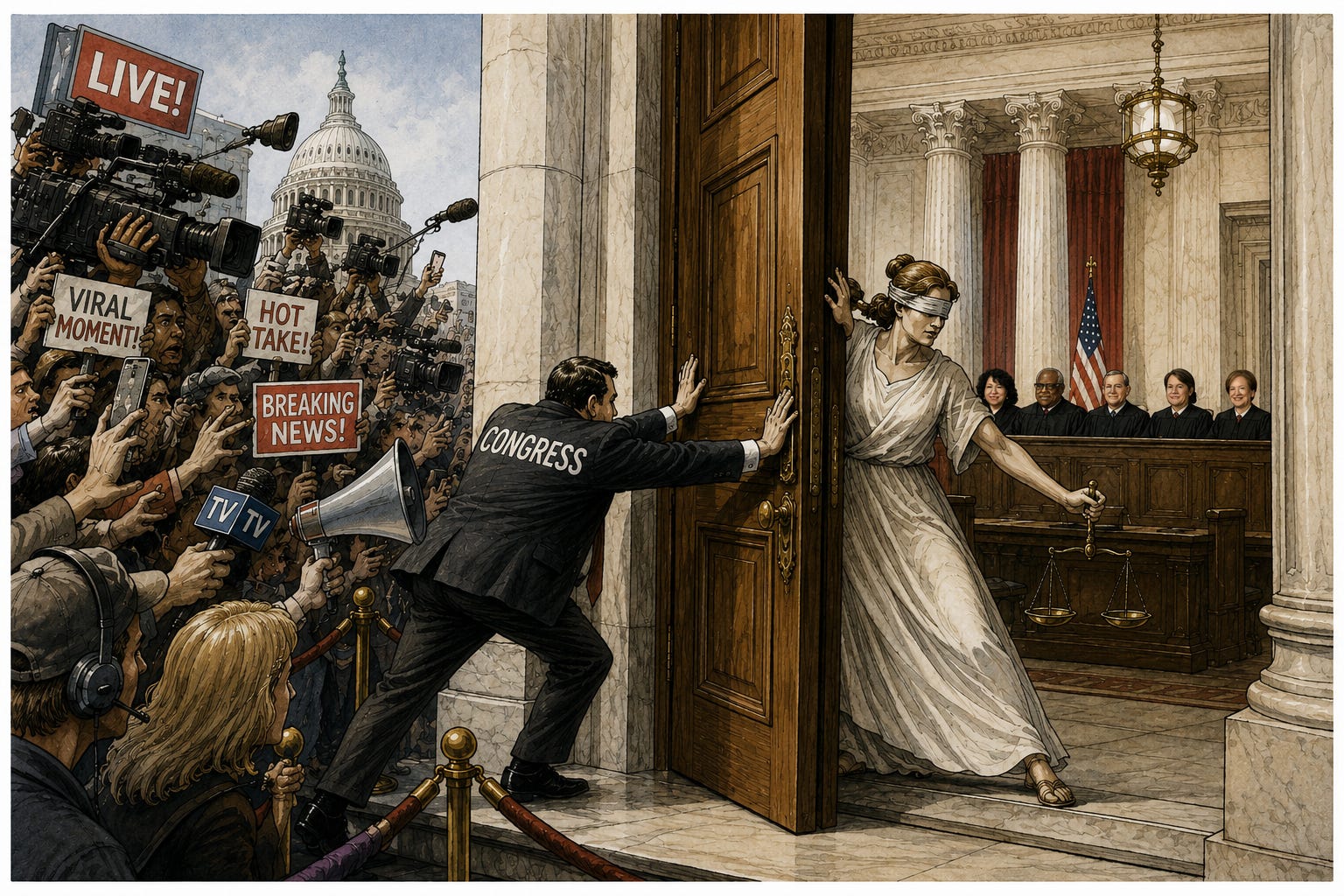
The United States Senate Judiciary Committee last week advanced bipartisan legislation that would require the U.S. Supreme Court to allow television coverage of its oral arguments unless a majority of the justices concluded doing so would interfere with due process rights. That may sound reasonable at first. It would be a serious mistake.
The Supreme Court is the one branch of government that has mostly resisted becoming a stage for political theater. Congress should be trying to preserve that—not importing the same incentives that have made so much of our public life performative. Here are ten reasons cameras should stay out of the Supreme Court.
1. The Supreme Court Isn’t Congress
Congress is a political branch. Its members campaign, debate, negotiate, posture, and ultimately answer directly to voters. The Supreme Court serves a different constitutional role. Its job is to interpret the Constitution and laws, not to perform for public approval. Treating both institutions the same ignores why the Framers deliberately designed them differently.
2. Cameras Change Behavior
People behave differently when they know millions may be watching. We have seen it in Congress, where many hearings have become vehicles for viral moments, fundraising clips, and social media theater. There is no reason to believe lawyers—or eventually even judges—would somehow be immune to the same incentives.
3. Cameras Would Change Judicial Selection
Most current justices would probably continue conducting themselves professionally. The bigger danger is long-term. Television changes what presidents, senators, activists, and donors look for in nominees. Being camera-friendly becomes another qualification. The temptation to nominate personalities rather than scholars grows stronger with every vacancy.
4. Lawyers Would Start Arguing to the Cameras
Today, attorneys argue to an audience of nine justices. Introduce television cameras, and suddenly they have millions of potential viewers. Instead of focusing exclusively on persuading the Court, some lawyers will inevitably chase the memorable exchange, the viral clip, or the cable television appearance that follows.
5. Oral Argument Is Only One Part of the Process
Many Americans assume oral argument is where cases are decided. Usually, it is not. By the time lawyers appear before the Court, the justices have already spent months reviewing briefs, studying the record, and considering the legal questions involved. Televising oral arguments risks giving viewers a distorted understanding of how the Court actually reaches decisions.
6. The Court Is Already Transparent
This is not a secret court. The public can attend arguments in person. The Court releases transcripts. It provides live audio. Every opinion, concurrence, and dissent is published for the world to read. Supporters of cameras should have to explain what meaningful transparency video provides that these existing tools do not.
7. Congress Should Not Micromanage a Co-Equal Branch
This proposal is not simply giving the Court permission to use cameras. It is Congress directing the Supreme Court how it must conduct its own proceedings. That is especially troubling because Congress created the lower federal courts, but not the Supreme Court. The Supreme Court exists because the Constitution created it, which is why conservatives should be especially skeptical whenever one branch begins prescribing the internal operations of another. A credible argument could even be made that this legislation itself is unconstitutional because it attempts to dictate the internal procedures of a coequal branch created directly by the Constitution.
8. Television Rewards Conflict
Almost no one will watch three hours of oral argument. People will watch twenty-second clips. The media economy rewards confrontation, not nuance. The incentive will always be to isolate the most dramatic exchange and present it as though it defines the entire proceeding. That is a recipe for misunderstanding, not public education.
9. The Court Does Not Need More Celebrity
The Supreme Court should not become another personality-driven institution. Americans should be debating constitutional reasoning, not facial expressions, sarcastic remarks, or which justice had the sharpest one-liner. The less attention focused on individual personalities, the healthier the institution remains.
10. Congress Is the Warning Label
We already have one branch of government that performs for the cameras. It is called Congress. Has television made Congress more thoughtful? More deliberative? More respected? If the answer is no, why would we willingly expose the Supreme Court to the same forces that have helped diminish confidence in the legislative branch?
So, Does It Matter?
The Supreme Court’s legitimacy does not rest on applause, ratings, viral moments, or public approval. It rests on confidence that its decisions are driven by law rather than performance. Transparency is an important value, but preserving the judiciary’s unique constitutional role is even more important.
Keep reading with a 7-day free trial
Subscribe to So, Does It Matter? On CA Politics! to keep reading this post and get 7 days of free access to the full post archives.