

Tariffs Once Funded America — But That America Had A Much Smaller Government
The President Is Right About History. The Math Today Is The Hard Part.

Our morning columns are available to all subscribers and guests. There is some interesting extra data below the paywall for our paid subscribers. You can listen to this content on your favorite podcasting app. Search for So, Does It Matter? Spoken. Or click here.
⏱️ 5 min read
A Single Sentence Worth Scrutiny
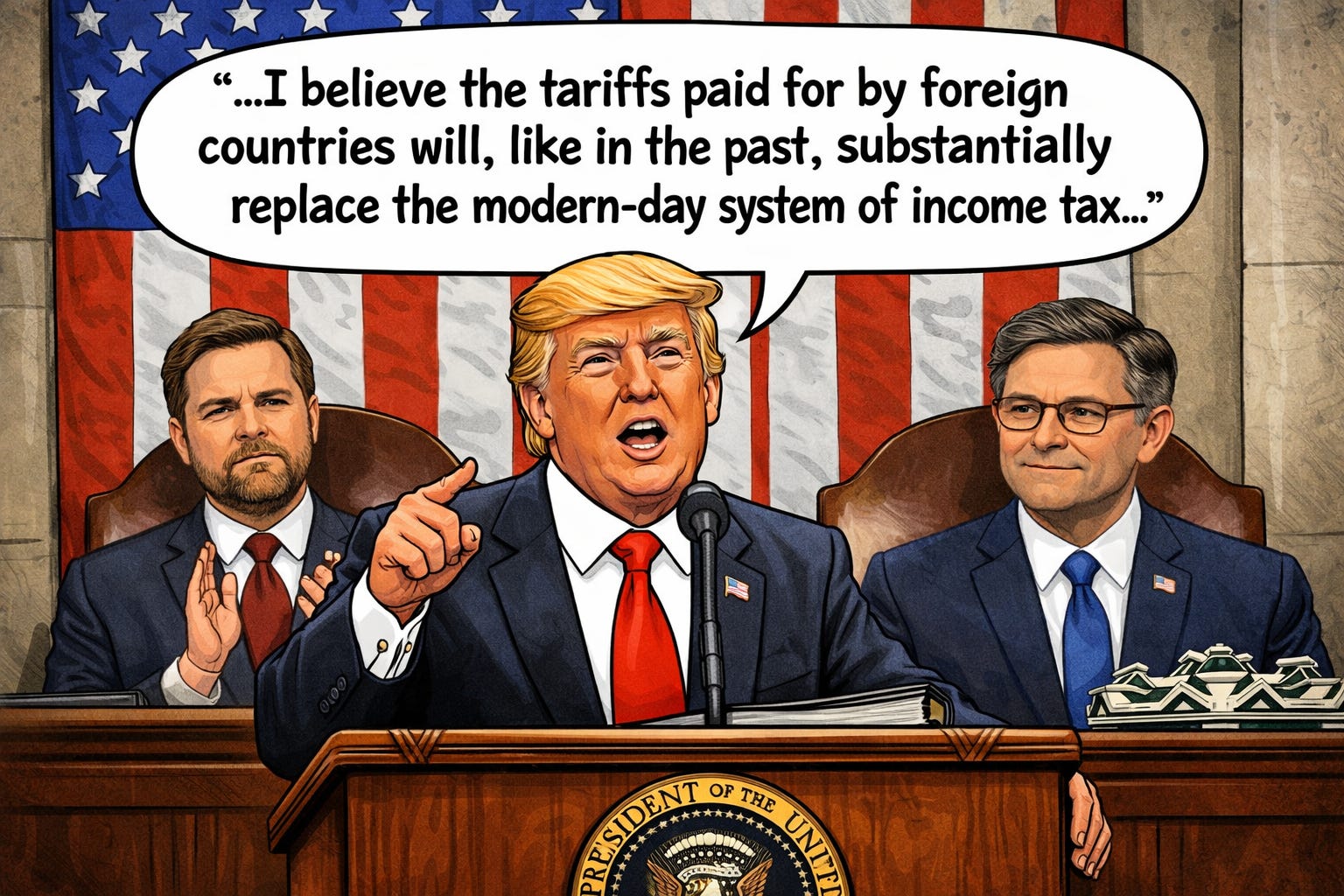
Last night, President Trump delivered a commanding State of the Union address that reaffirmed his commitment to American strength, prosperity, and national sovereignty. The speech ran nearly two hours — perhaps the longest ever — yet it was marked by an unexpected level of discipline and restraint, certainly for President Trump. While the address covered a wide range of issues, I want to zero in on one sentence that deserves careful examination.
At one point, the President said:
“As time goes by, I believe the tariffs paid for by foreign countries will, like in the past, substantially replace the modern-day system of income tax, taking a great financial burden off the people that I love.”
The President is right about the history. For much of the 19th century, tariffs were the federal government’s primary source of revenue. From the founding through the ratification of the 16th Amendment in 1913, customs duties carried most of Washington’s fiscal load. But that government was dramatically smaller than the one we have today.
What Washington Looked Like Then
In 1900, total federal spending was about $520 million — roughly 2.5% of GDP. Customs duties generated about $230 million, nearly half of federal revenue. There was no permanent federal income tax.
Washington’s responsibilities were limited to national defense, debt service, the Post Office, customs administration, and Civil War pensions. There was no Social Security, no Medicare or Medicaid, no federal student loan system, and no vast entitlement state. The federal government was narrower, lighter, and far less expensive.
The Modern Fiscal Reality
Today, federal spending is roughly $6.5 trillion — about 24% of GDP. Individual income taxes alone generate about $2.2 trillion per year. Tariff revenue totals roughly $80-$90 billion annually — about 1–2% of federal revenue.
The United States imports about $4 trillion in goods each year. Replacing $2.2 trillion in income tax revenue with tariffs alone would require average tariff rates of 50% or more across most imports — and likely higher once import volumes declined in response.
Tariff advocates argue that tariffs are not merely revenue tools but instruments of leverage, industrial policy, and economic nationalism. They contend that tariffs can strengthen domestic manufacturing, rebalance trade relationships, and negotiate better terms for American workers. Those arguments deserve serious debate.
But as a matter of revenue arithmetic, tariffs are collected from American importers at the border, and a significant share of the cost is passed through the domestic economy. At the scale required to replace income taxes, they would mean materially higher prices and substantial economic disruption.
The Spending Constraint
There is another path: dramatically shrink federal spending. But here again, scale becomes decisive.
Social Security costs roughly $1.3 trillion annually. Medicare and Medicaid together exceed another trillion. Add defense and interest on the national debt, and most of the federal budget is already spoken for. Even eliminating every other discretionary program would not return spending to anywhere near the 2–5% of GDP levels that characterized the tariff era.
To make tariffs the primary funding source again would require reducing federal spending by trillions of dollars per year — restructuring entitlement programs and altering federal commitments on a scale not currently under serious consideration in Congress.
One cautionary note: if tariffs are raised significantly while income taxes remain in place, Americans could find themselves squeezed between two tax regimes at once — paying income taxes on what they earn and higher prices on what they buy. Historically, governments tend to layer on revenue streams rather than replace them, and without corresponding spending reductions, tariffs would likely supplement the current system rather than replace it.
A Matter Of Scale
The President is correct that tariffs once funded the federal government. But that government consumed a small fraction of national output and performed a narrow set of functions. There has never been a period in American history when a federal government approaching one-quarter of GDP was financed primarily through tariffs.
If conservatives want to talk seriously about replacing income taxes with tariffs, we must also talk seriously about the size of government. The tariff era worked because Washington’s footprint was limited. Revenue policy followed the structure, not the other way around.
So, Does It Matter?
It matters because income taxes and tariffs do have one thing in common: both are ultimately borne by the American people. If we are going to shift how Americans fund their government, we also have to confront how large that government has become. A smaller, more restrained federal government could make older revenue models plausible again. Without spending discipline, tariffs would simply become another layer in an already complex tax system.
Hope springs eternal. But arithmetic still applies.