

Supreme Court Upholds The Fourth Amendment In Major Digital Privacy Ruling
A 6-3 Supreme Court decision reminds Americans that carrying a smartphone does not mean surrendering constitutional protections against unreasonable government searches.

Typically, our afternoon content is behind a paywall — or there is something extra for our paid subscribers. If you are not one, please consider upgrading. You are missing a significant portion of what we produce each week, and your support makes it possible. Today, there are three additional, strong political cartoons on this topic below the paywall.
You can also listen to this post on our podcast feed, So, Does It Matter? SPOKEN. It is available on your favorite podcast app. And you can listen to it here.
⏱️ 5-minute read
The Digital Dragnet
The Fourth Amendment exists because government searches must start with suspicion, not curiosity. It requires the government to establish probable cause and particularity before invading an individual’s privacy. That principle has protected Americans for more than two centuries. Last week, the Supreme Court said it still applies in the digital age.
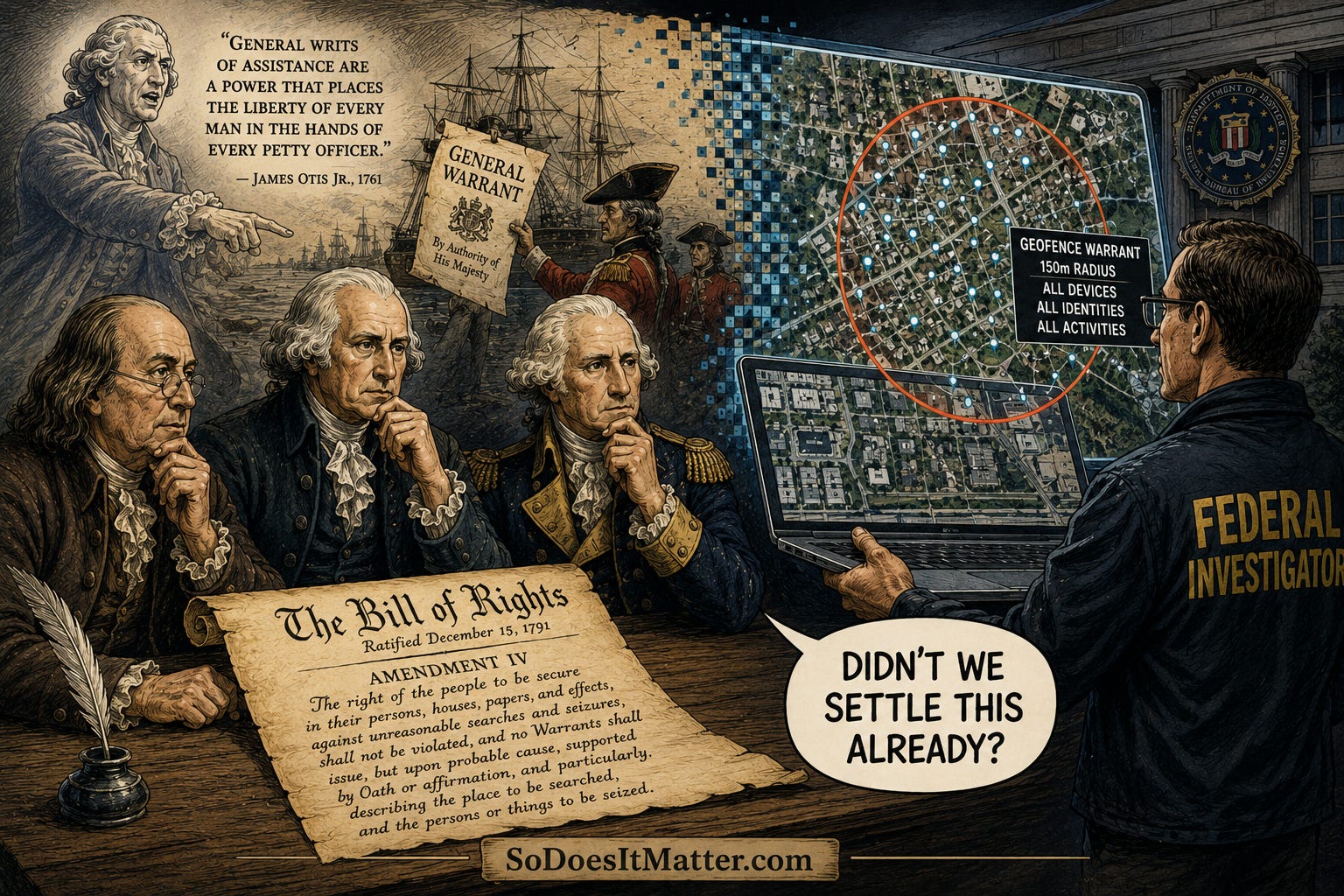
That was the issue before the Court in Chatrie v. United States. The case arose from a 2019 credit union robbery in Midlothian, Virginia. Investigators believed the suspect had been carrying a cellphone, so they obtained what is known as a geofence warrant requiring Google to provide location information for devices within roughly 150 meters of the crime scene during a limited period of time.
In legal circles, these are often called “reverse warrants” because they flip the traditional process on its head. The government did not begin with a suspect and then seek evidence. It began with everyone who happened to be nearby and then worked backward to find one. That should concern anyone who values the Fourth Amendment.
The Court Gets It Right
The Supreme Court ruled 6-3 that obtaining geofence location data is a search under the Fourth Amendment. Justice Elena Kagan wrote the majority opinion, joined by Chief Justice John Roberts and Justices Sonia Sotomayor, Brett Kavanaugh and Ketanji Brown Jackson. Justice Neil Gorsuch agreed with the outcome in a separate opinion. Justices Clarence Thomas, Samuel Alito and Amy Coney Barrett dissented.
As a conservative Republican, I do not often find myself praising an opinion written by Justice Kagan. But constitutional rights are not supposed to depend on political ideology. When a justice faithfully applies the Fourth Amendment, even in a way that limits government power, that deserves recognition.
Kagan’s central point was straightforward: “An individual has a reasonable expectation of privacy in records about his cell phone’s location.” Police intrude on that protected interest when they demand the information, even if they seek it for only a limited time and even if the information is held by a third-party technology company.
That is the key move in the decision. For decades, courts have wrestled with the so-called “third-party doctrine”—the idea that information voluntarily shared with someone else loses much of its Fourth Amendment protection. The Supreme Court wisely refused to stretch that doctrine beyond recognition.
Kagan captured the practical reality well: “Pretty much everything a person does on a smartphone requires some kind of opt-in.” In today’s world, participating in ordinary life requires sharing information with technology companies. That practical necessity cannot become an all-purpose loophole allowing the government to sidestep the Constitution.
One caveat is in order. The Court did not declare geofence warrants unconstitutional. It held only that obtaining the data is a search, and it sent the case back to the lower courts to decide whether this particular warrant passed constitutional muster. Chatrie himself may yet lose under the good-faith exception. But the constitutional principle is now settled, and that is what matters.
Why The Fourth Amendment Exists
The Founders did not write the Fourth Amendment as a technicality. They understood the danger of unchecked government power.
One of the grievances that helped fuel the American Revolution was the British Crown’s use of general warrants and writs of assistance. These broad authorizations allowed government officials to search widely without first identifying a particular person, place or thing. The Framers rejected that approach. They required probable cause, particularity and constitutional justification before the government could invade private life.
That is the constitutional problem. Geofence warrants raise the same basic concern in digital form. They allow the government to draw a circle on a map and demand information about the people inside it. Some of those people may be suspects. Many may be completely innocent.
The Founders would have recognized the danger immediately. They may not have imagined smartphones or cloud computing, but they understood the temptation for government to search first and ask constitutional questions later.
Liberty In The Smartphone Age
The danger is not hypothetical. Geofence warrants are troubling because the overwhelming majority of people swept into them have done absolutely nothing wrong. They may have been buying groceries, picking up prescriptions, eating lunch or simply driving through an intersection. Yet their location data becomes part of a government investigation despite there being no individualized suspicion that they committed any crime.
Some people instinctively respond to privacy arguments by saying, “I have nothing to hide.” That misses the point. The Fourth Amendment was never written only for criminals. It was written for free citizens.
Your phone can reveal where you worship, which doctors you visit, what political meetings you attend, what businesses you frequent, where you sleep and who you spend time with. It can create a detailed portrait of your life more revealing than almost anything the government could have obtained in earlier generations.
This is not an argument against law enforcement. Police should investigate robberies, assaults, murders and other serious crimes. They should use lawful tools to identify suspects and protect the public. But those tools must remain bounded by constitutional rules.
So, Does It Matter?
This ruling may not get the public attention of the Court’s more politically explosive decisions, but it deserves serious praise. It addresses a question that will only grow more important: Do constitutional rights survive when private life moves onto digital platforms?
The Court answered yes, and rightly so.
The easier surveillance becomes, the more important constitutional limits become. If the government can obtain sweeping location data merely because Americans use smartphones, then the Fourth Amendment becomes weaker precisely when it needs to be stronger. That would be exactly backward.
There is always a reason for government to ask for more power. Public safety. Efficiency. Convenience. Technology just makes the ask easier. But rights do not become less important because enforcing them is inconvenient.
That should not be a partisan point. It should be an American one. Conservatives, libertarians and anyone else who believes government power must be limited should welcome this decision.
Smartphones have made government surveillance easier than the Framers could have imagined. That is precisely why the Fourth Amendment must remain strong today.
Last week, the Supreme Court reminded the country of a timeless constitutional principle: in America, the government is supposed to identify a suspect before searching—not search everyone in hopes of finding one.
P.S. It’s worth mentioning that there are plenty of well-meaning conservatives who will disagree with me on this topic. Not the first time that I will be right, and they will be wrong ;-)
