

Supreme Court Roundup: Quick Hits On Ten Big Decisions From The Court’s Final Two Weeks
SDIM Publisher Jon Fleischman Takes A Few Minutes To Run Through The Big Decisions From The Final Two Weeks Of The Supreme Court Term.

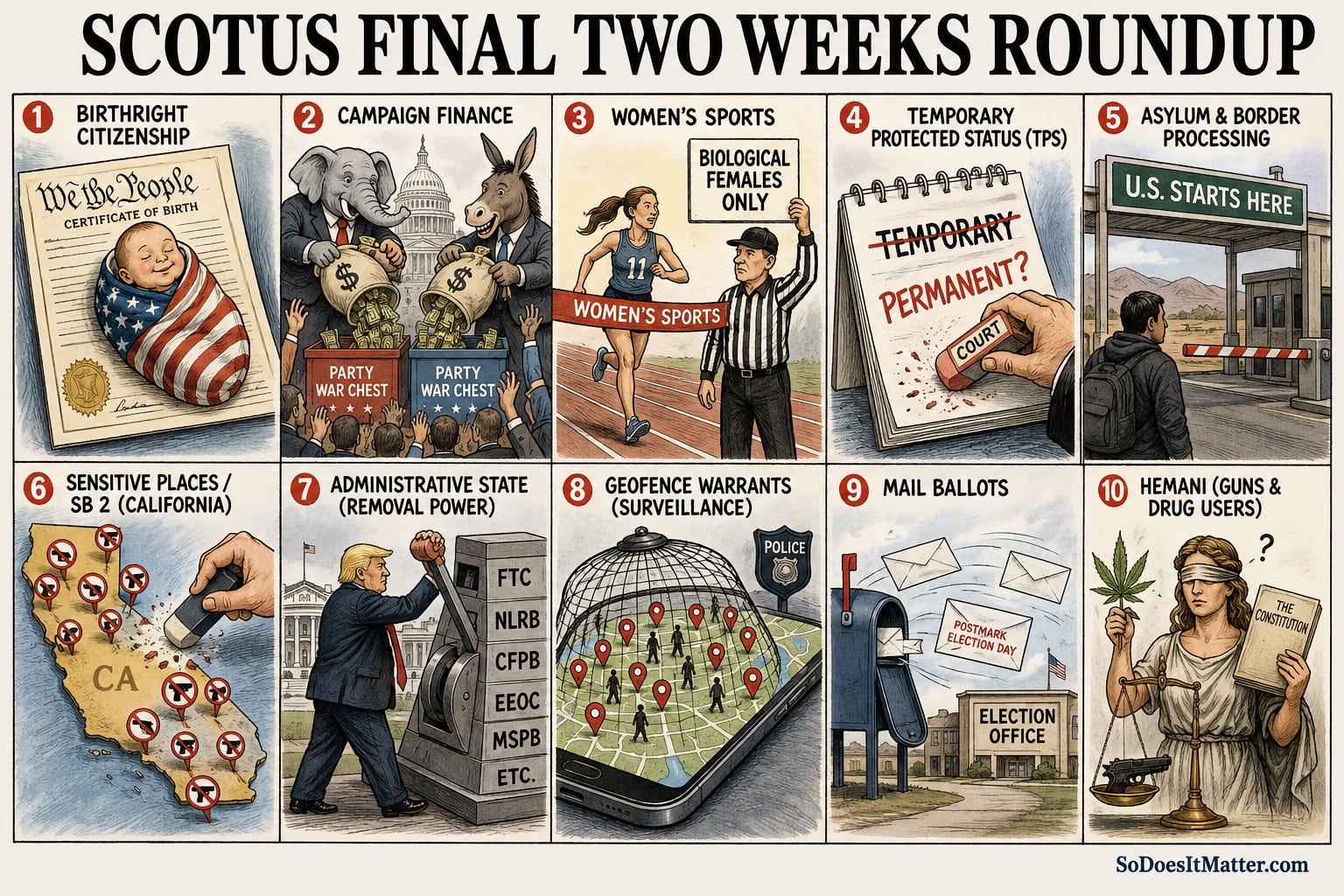
Normally, this is the kind of piece I would put behind the paywall. It took some work to pull together, and this kind of quick analysis is a big part of what paid subscribers support. But today I am leaving the paywall down so free readers can get a better sense of what they are missing. Also, ideal for sharing with friends or on social media. If you like this kind of content, please consider upgrading.
You can also listen to this post on our podcast feed, So, Does It Matter? SPOKEN. It is available on your favorite podcast app. And you can listen to it here.
⏰ Estimated read time: 7 minutes
Time To Run Through A Lot Of Decisions — Buckle Up.
The Supreme Court wrapped up its 2025-26 term in unusually dramatic fashion, issuing a remarkable number of major decisions touching on immigration, campaign finance, the Second Amendment, the administrative state, election law, and digital privacy.
It will take years for scholars, politicians, and litigants to fully understand the implications of some of these rulings. But I wanted to take a few minutes to walk through what I consider the most consequential decisions from the Court’s final two weeks, along with a few first-blush thoughts about what they may mean going forward.
This column runs a little longer than usual, but I have structured it on a case-by-case basis so you can digest it in pieces if you prefer. The cases below are in no particular order. All are consequential. Here we go.
1. Trump v. Barbara (Birthright Citizenship)
Decided 6-3, with Chief Justice Roberts writing for the majority, this was probably the least surprising outcome on the list. The Court struck down President Trump’s executive order and reaffirmed birthright citizenship for children born in the United States to illegal immigrants and temporary-status parents. Very few court watchers expected the Court to overturn more than a century of precedent in this area. Conservatives had a very good two weeks at the Supreme Court, but perhaps their most predictable loss came first. The more interesting story was the fractured conservative coalition and the reminder that Roberts and Barrett in particular, and often Gorsuch as well, possess strong institutional instincts when it comes to longstanding precedent and major constitutional change.
2. NRSC v. FEC (Campaign Finance)
By a 6-3 ideological vote, written by Justice Kavanaugh, the Court struck down federal limits on how much political parties may spend in coordination with their own candidates, holding that the Watergate-era restrictions violated the First Amendment. From a free speech perspective, it was always somewhat odd that parties faced legal restrictions on supporting their own nominees. Expect money and influence to shift away from Super PACs and back toward political parties themselves. Over the next few years, this ruling may also trickle down into state and local politics, as parties test whether similar restrictions on coordination with candidates can withstand legal challenge. The less-discussed implication is that party establishments and leadership-backed candidates probably grew stronger relative to insurgents and outsiders.
3. Little v. Hecox / West Virginia v. B.P.J. (Transgender Athletes)
In a 6-3 decision authored by Justice Kavanaugh, the Court held that states may restrict girls’ and women’s sports participation to biological females, upholding the Idaho and West Virginia laws. The justices were unanimous that Title IX itself does not prohibit states from maintaining separate women’s sports based on biological sex, with the constitutional disagreement arising under the Equal Protection Clause. This was a major victory for common sense and for the integrity of women’s athletics. The ruling recognizes that eligibility for female sports may be based on biological sex, not subjective decisions by individuals about what sex they identify as.
4. Mullin v. Doe (Temporary Protected Status)
In a 6-3 decision authored by Justice Alito, the president was held to have unreviewable authority to terminate Temporary Protected Status designations, meaning federal courts may not second-guess those decisions. TPS was originally intended to be exactly what its name suggests: temporary. Over time, however, many designations evolved into something approaching permanent residency by another name. This ruling is as much about institutional authority as it is about immigration policy. If Congress delegated this authority to the executive branch, judges should not substitute their own preferences for those of elected officials.
5. Mullin v. Al Otro Lado (Asylum and Border Processing)
Also decided 6-3 by Justice Alito, this case held that a migrant standing in Mexico has not “arrived in the United States” and therefore is not entitled to asylum processing protections under U.S. law. The decision reverses the Ninth Circuit and clears the way for future administrations to revive metering policies at ports of entry. Like the TPS case, this ruling pushes immigration decisions back toward the political branches rather than allowing federal courts to become day-to-day managers of border policy.
6. Wolford v. Lopez (Second Amendment)
In another 6-3 decision authored by Justice Alito, Hawaii’s so-called “vampire rule” was struck down because it prohibited concealed carry on private property open to the public absent the owner’s express permission. The practical significance may be especially large in California, where portions of SB 2 relied on similar legal theories. States cannot simply declare large portions of ordinary public life to be “sensitive places” where the right to carry effectively disappears. I wrote a separate, more detailed analysis of this decision, which is linked here.
7. Trump v. Slaughter (Removal Power) and the Lisa Cook Decision
By a 6-3 vote, the Court held that presidents may remove leaders of independent agencies such as the FTC without cause, dramatically narrowing the old Humphrey’s Executor framework, a 1935 precedent that helped create much of the modern administrative state by insulating regulators from presidential removal. The conservative argument is straightforward: elections should have consequences, and officials exercising executive power should ultimately answer to the elected president. Independent agencies increasingly operated as a quasi-fourth branch of government, insulated from democratic accountability. Yet in a companion 5-4 ruling authored by Roberts, the Court held that President Trump could not remove Federal Reserve Governor Lisa Cook, suggesting that even this Court intends to move incrementally rather than revolutionarily.
8. Chatrie v. United States (Geofence Warrants)
In a 6-3 opinion authored by Justice Kagan, police use of geofence warrants to gather cellphone location data near crime scenes was deemed a Fourth Amendment search. As someone more libertarian when it comes to government surveillance of its own citizens, I have little trouble with this one. The government should not be able to assemble lists of innocent people who happened to be near a crime scene simply because technology now makes such surveillance easy and inexpensive. The Fourth Amendment does not become less important merely because government databases become more sophisticated.
9. Watson v. RNC (Mail Ballots)
In a 5-4 opinion authored by Justice Barrett and joined by Roberts and the three liberal justices, Mississippi’s law allowing ballots postmarked by Election Day to be counted if they arrive afterward survived. This was a clear loss for the RNC and conservatives generally. The ruling impacts only a handful of states, but of course, California looms large among them. It also reflects the Court’s continuing reluctance to invalidate state election procedures absent clear constitutional violations. Once again, this was a reminder that the Court’s conservative majority is not a monolith and that Barrett, in particular, can be difficult to predict in election law disputes.
10. United States v. Hemani (Guns and Marijuana Users)
In a unanimous opinion authored by Justice Gorsuch, the federal prohibition on firearm ownership by unlawful users of controlled substances was held unconstitutional as applied to a regular marijuana user absent evidence of dangerousness. Importantly, this was a deliberately narrow decision rather than a wholesale invalidation of the law itself. Still, it continues the Court’s broader insistence that governments justify firearms restrictions with historical analogs and individualized evidence rather than broad categorical assumptions about risk.
Also Of Note: Trump v. Carroll
The Court declined to hear President Trump’s appeal of the $5 million verdict finding that he sexually abused and defamed E. Jean Carroll, leaving the judgment in place. This was not a decision on the merits of the case and establishes no legal precedent whatsoever. The Court simply chose not to take up the appeal and offered no explanation, which is entirely normal practice. The separate $83.3 million Carroll judgment remains on appeal and could still come before the Court.
In Conclusion
Some of these rulings are easy to understand immediately. Others will take years of litigation, legislation, and political reaction before we really know how far they reach. But there is no question the Court ended this term with a burst of decisions that will shape politics and public policy for a long time.
As much as we have covered here, this is not all of the Court’s decisions from its final two weeks; there were other rulings, including additional Second and Fourth Amendment cases, but these are the ones I think are most immediately consequential.
Finally, this piece is much more informational than analytical, because there is so much. I will be going deeper on some of these rulings at some point.