

Supreme Court Justice Gorsuch And The Importance Of The Declaration of Independence and the United States Constitution
Justice Neil Gorsuch is using America’s 250th anniversary to make a broader argument about liberty, constitutional limits, and why the Declaration of Independence and our Constitution still matter.

You can listen to this post on our podcast feed, So, Does It Matter? SPOKEN. It’s available on your favorite podcasting app, or you can find it here. Our afternoon content is typically for our paid subscribers. Certain columns, like this one, are made available to all of our readers.
⏰ 5-minute read
A Justice Focused On The American Mission
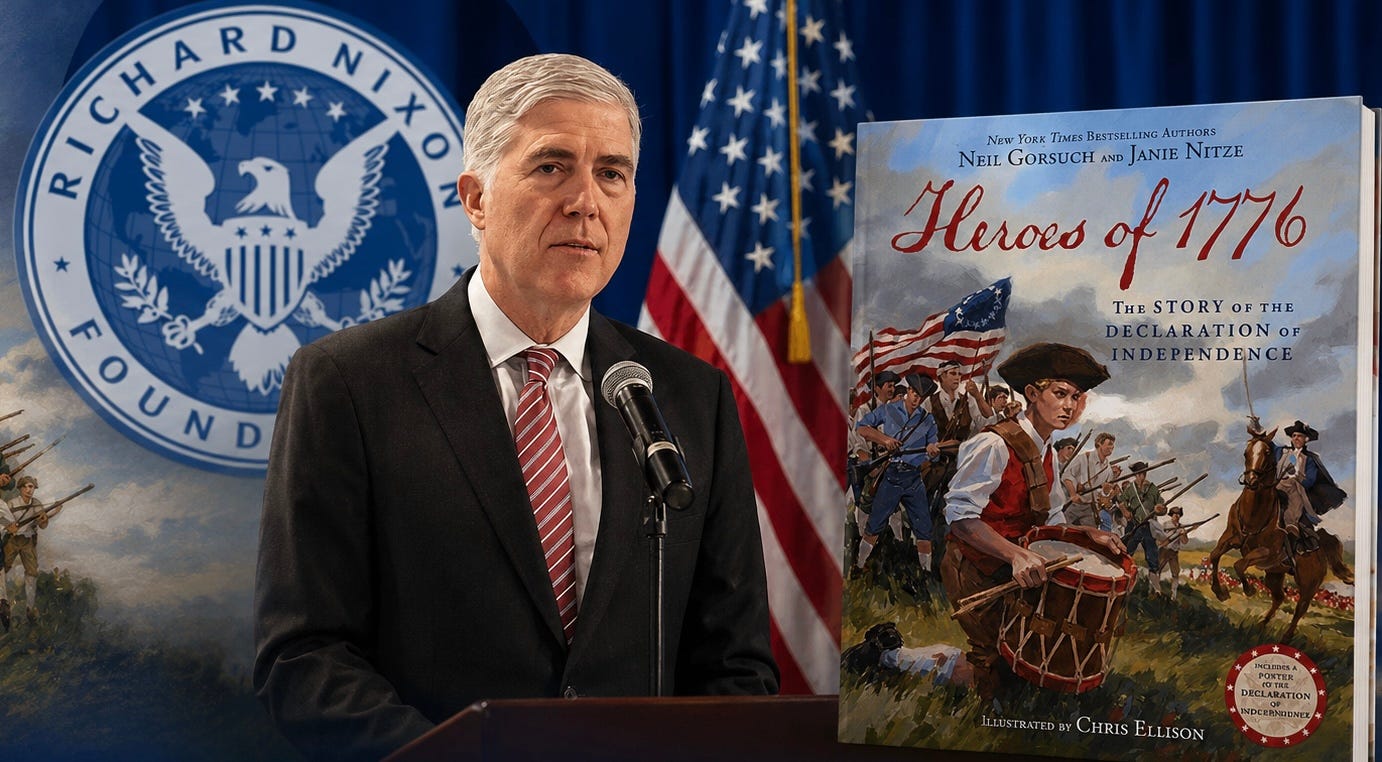
Last week, it was my honor to attend, with my friend Irvine Councilmember Mike Carroll, a special event at the Richard Nixon Library and Birthplace featuring United States Supreme Court Associate Justice Neil Gorsuch, who has been out talking about his new illustrated children’s book, Heroes of 1776, co-written with Janie Nitze.
I had the opportunity to share with Justice Gorsuch that I think he has been an exceptional jurist on the Court. Since that meeting, I have found myself thinking more about why. It is not simply that I usually like where he lands. It is that Gorsuch understands the American project in a way too many people in public life either do not understand or no longer bother to defend.
What comes through in his recent interviews is not just that Gorsuch loves history. Plenty of people love history. What stands out is that he sees history as essential to liberty. In his telling, the Declaration of Independence was not inevitable, not safe, and not merely ceremonial. It was a radical claim that rights come from God, not government, that all men are created equal, and that the people have the right to govern themselves.
That understanding also explains why Gorsuch proudly describes himself as an originalist. In a recent interview with Nick Gillespie of Reason Magazine, he explained originalism this way: “My job is to apply the law as a reasonable person would have understood it at the time it was enacted.” That is probably the clearest and most concise definition of originalism you will hear from a sitting justice.
Originalism, Structure, And Limited Government
For Gorsuch, judges are not supposed to update laws to match current political trends or their own personal preferences. Their job is to interpret the law that was actually passed.
This is the key to understanding Gorsuch. He is not a conservative justice in the partisan sense. He is a constitutionalist, a textualist, and an institutionalist in the old-fashioned sense. He believes words matter, structure matters, and limits on power matter.
Gorsuch has described the Declaration as America’s mission statement and the Constitution as the country’s how-to manual. I like that formulation because it captures the relationship between aspiration and restraint. The Declaration announces the principles. The Constitution disciplines power. It divides authority between branches, between federal and state governments, and ultimately reserves rights to the people.
This is why Gorsuch’s jurisprudence is so compelling. He does not sound like a man trying to engineer preferred outcomes. He sounds like a man trying to keep government in its lane.
That broader philosophy also explains why Gorsuch has become one of the Court’s strongest critics of the modern administrative state. Again and again, he returns to the same concern: too much power concentrated in too few hands, with too little accountability to the people.
The Jurisprudence Conservatives Have Been Waiting For
That philosophy has produced opinions that conservatives should appreciate. In Kennedy v. Bremerton School District, Gorsuch wrote the majority opinion for the Court, holding that a public high school football coach could not be punished for personal postgame prayer. It was a major victory for religious liberty, free speech, and the basic principle that the Constitution does not require government hostility toward public expressions of faith.
In 303 Creative v. Elenis, Gorsuch again wrote for the Court, this time defending compelled-speech protections under the First Amendment. The case involved a Christian web designer who did not want Colorado to force her to create custom wedding websites celebrating same-sex marriages. Gorsuch’s opinion made the core point plainly: government may not compel an American to speak a message she does not believe.
And in Loper Bright Enterprises v. Raimondo, where the Court finally overruled Chevron deference, Gorsuch’s concurrence fit perfectly with his broader warnings about the administrative state. The point was not merely technical. It was constitutional. Judges should say what the law means. Agencies should not be allowed to expand their own power by interpreting ambiguous statutes in their favor.
That connects directly to Over Ruled, the book Gorsuch also co-wrote with Nitze, and to his concern that America now has too much law. His example of the Florida fisherman prosecuted under Sarbanes-Oxley over undersized red grouper is almost too absurd to believe, but that is the point. A free people cannot live confidently when ordinary citizens can be crushed by sprawling rules they never knew existed.
So, Does It Matter?
Gorsuch also has a striking view of the Court itself. He rejects the lazy idea that the justices are simply political actors in robes. He notes that the Court is unanimous in roughly 40 percent of its cases, despite taking the hardest disputes in the country.
That does not mean the Court is beyond criticism. Of course it is not. But Gorsuch’s answer is a serious one: the justices deliberate, disagree, listen, and write opinions for the public to read. At a time when so many institutions operate through slogans, pressure campaigns, and raw power, that still matters.
The most appealing thing about Gorsuch is that he connects humility and courage. Humility, because he insists that a judge is not a philosopher king. Courage, because he understands that defending liberty often means standing against pressure, fashion, and even popular opinion.
That is why his current tour matters. He is not merely selling a book. He is reminding Americans, especially our children, that the founding was not a museum exhibit. It was a set of claims about human dignity, limited government, religious liberty, free speech, self-rule, and ordered liberty.
And in Justice Neil Gorsuch, those principles have not merely an admirer, but a serious defender.
Below the paywall are a number of links to interesting interviews with the Justice that I strongly recommend watching, when you have the time!
